
The best game for a couple is the one that fits both people’s skill level, setup and tolerance for frustration, rather than whichever co-op title receives the highest review score. It Takes Two is the safest all-round recommendation for many pairs, Unravel Two is gentler when one person is new to controllers, Stardew Valley suits couples who want something calm, and Split Fiction is stronger when both players already enjoy faster 3D action. Before buying anything, decide whether you need couch co-op, online play, crossplay or a game that can be played from one purchased copy.
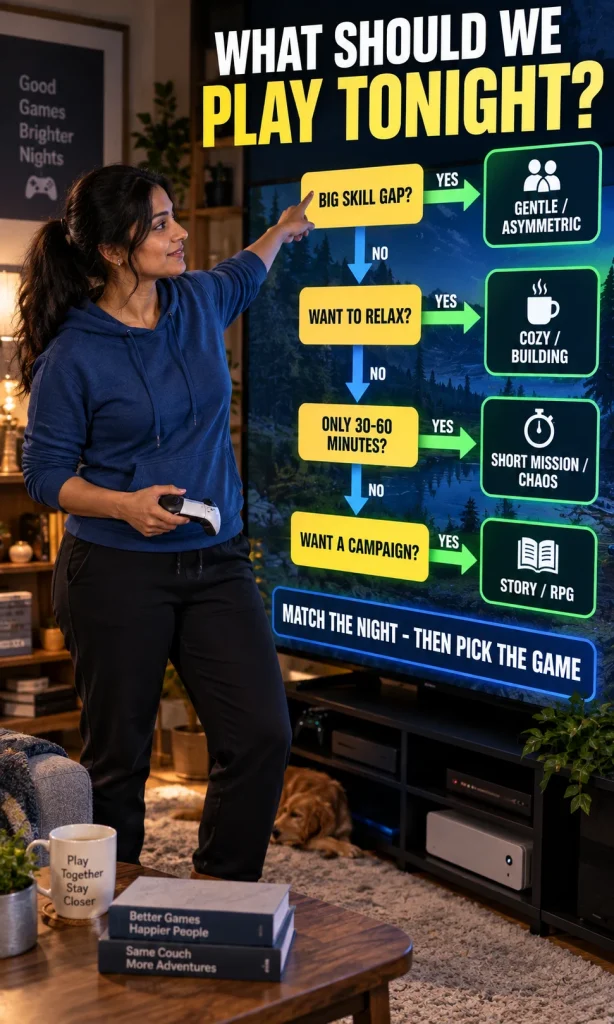
Start Here: Which Kind of Couple Are You?
| Your Situation | Start With | Why It Fits | Think Twice If |
|---|---|---|---|
| One experienced gamer + one beginner | Unravel Two | Cooperation matters, but the experienced player can help without turning the other person into a spectator. | You both want combat or a very long campaign. |
| Want one great all-round co-op adventure | It Takes Two | Every section gives both players a meaningful role and changes the mechanics frequently. | One partner is completely uncomfortable controlling a character in 3D. |
| Both already play action games | Split Fiction | Fast mechanical variety makes it excellent for two players who are comfortable reacting and moving in 3D. | One player wants a slow, low-pressure first game. |
| Want relaxing evenings rather than levels | Stardew Valley | You can divide jobs naturally and build a shared routine without constant failure. | You both need a tightly directed story telling you what to do next. |
| Only have short evening sessions | Moving Out 2 | Individual jobs provide a satisfying stopping point without requiring a long campaign commitment. | Physics chaos annoys rather than entertains you. |
| Love solving problems together | Portal 2 | Neither player can complete the co-op puzzles simply by being better at combat. | One person tends to solve everything aloud before the other can participate. |
| Want a genuine challenge | Cuphead | Failure becomes the shared activity when both players genuinely enjoy mastery. | One of you gets discouraged by repeatedly replaying difficult sections. |
The table is deliberately based on fit, not a universal ranking. Cuphead can be a far better date-night game than Stardew Valley for two people who love difficult action, while it can be a disastrous first game for someone still learning how to use two analog sticks.
The Five Things to Decide Before Choosing a Game
1. Are You in the Same Room?
Couch co-op means both people can play on the same gaming system in the same place. Online co-op means each player can connect remotely, usually from separate devices.
Do not assume that a game supporting online co-op also supports two people on one television. The reverse can also happen.
2. Do You Need Crossplay?
Crossplay matters when the two of you own different platforms. If one person is on PC and the other is using a console, ordinary online multiplayer support is not enough unless those versions can actually communicate with each other.
This is one reason Split Fiction has become such a useful option for couples living apart. EA’s Split Fiction multiplayer guidance confirms crossplay alongside Friend’s Pass.
3. How Big Is the Skill Gap?
Do not measure this only by whether somebody calls themselves a gamer. A person may be excellent at puzzle games but struggle with 3D cameras, or play strategy games every night while finding fast platforming uncomfortable.
Games with asymmetric roles, forgiving recovery or activities that can be divided naturally usually cope with a larger skill gap better than games requiring both players to perform identical high-speed actions.
4. How Do You React to Failure?
Some couples laugh harder every time the kitchen burns down in Overcooked! 2. Others stop having fun when a failed task forces them to replay the same section.
Neither reaction is wrong. It simply changes the right game.
5. Do You Want a Session or a Campaign?
There is a major difference between wanting 30 minutes of chaotic cooperation after dinner and beginning an RPG that may remain part of your evenings for months. Decide what kind of commitment you actually want before buying the biggest game on the list.
The 21 Best Games for Couples
1. It Takes Two – Best All-Round Choice
It Takes Two remains the easiest recommendation when both players are reasonably comfortable controlling a character in a 3D environment. Every major section changes the abilities given to each player, so cooperation is built into the level design rather than added as an optional second-player mode.
Its main weakness for mixed-skill couples is often understated. Someone who rarely plays games can initially struggle with simultaneous camera movement, jumping and aiming, which can make the first sessions less effortless than the bright presentation suggests.
One major advantage is ownership. EA’s It Takes Two Friend’s Pass allows the owner to invite a second player who does not own the full game. It does not support crossplay, however, so couples using different platform families need to check compatibility before treating Friend’s Pass as the answer.
Best for: Couples who want one polished adventure built entirely around two players.
Skip when: One player is completely new to 3D movement.
2. Split Fiction – Best for Two Experienced Players
Split Fiction takes the constant-mechanical-change idea further and moves quickly between science-fiction and fantasy scenarios. The result is exciting when both players enjoy learning a new movement or combat rule every few minutes.
That same strength makes it less suitable as the first game for somebody who wants a calm introduction to controllers. The better fit is a pair who enjoyed It Takes Two but wants something faster and mechanically denser.
Its practical advantage over It Takes Two is significant for remote couples: Friend’s Pass is available and crossplay is supported, which makes it considerably easier to recommend when the two people do not own the same platform.
Best for: Experienced pairs who want a modern two-player adventure.
Skip when: One player wants slower learning and fewer control changes.
3. Unravel Two – Best for a Gamer and a Beginner
Unravel Two is one of my preferred starting points when one person plays regularly and the other is still becoming comfortable with a controller. The two Yarnys are physically connected, and many sections encourage cooperation without demanding identical skill from both people.
The experienced player can help with movement and positioning without solving every problem alone. That distinction matters because a beginner usually learns faster when they still have meaningful actions to perform instead of following the stronger player through the level.
Best for: A noticeable controller-skill gap.
Skip when: You want combat or a large open world.
4. Stardew Valley – Best Cozy Long-Term Game
Stardew Valley works because cooperation emerges from the life you build rather than from a sequence of mandatory co-op puzzles. One person can concentrate on crops while the other fishes, mines, collects resources or reorganizes the farm.
That allows different skill levels and even different play preferences to coexist comfortably. The person who dislikes combat does not need to spend every evening in the mines simply because their partner enjoys that part of the game.
Its biggest weakness is also its freedom. Couples who need constant goals and a strong narrative pushing them forward can feel lost when the game simply hands them another morning.
Best for: Relaxed evenings and long-running shared projects.
Skip when: You need a linear story and obvious next objective.
5. Spiritfarer – Best Gentle Shared Journey
Spiritfarer provides a much calmer cooperative rhythm than the action-heavy games near the top of most lists. The second player participates meaningfully without every section turning into a mechanical test.
That makes it approachable for a partner who enjoys being involved but does not want a constant stream of precision jumps or combat. The subject matter can become emotionally heavy, though, because the story deals openly with death, departure and saying goodbye.
Best for: Couples who prefer atmosphere, exploration and emotional storytelling.
Skip when: You want upbeat action or dislike themes involving loss.
6. Overcooked! 2 – Best Controlled Relationship Chaos
Overcooked! 2 turns communication into the mechanic. Someone chops, somebody cooks, dirty dishes pile up, the environment moves, and the carefully agreed plan disintegrates within seconds.
It works brilliantly for couples who find that collapse funny. It is much less enjoyable when one person begins directing the other like an employee because they care more about efficiency than shared silliness.
Best for: Fast sessions and loud teamwork.
Skip when: Timers make either of you genuinely anxious.
7. Moving Out 2 – Best Short Casual Sessions
Moving Out 2 uses similar cooperative chaos but wraps it around physically moving furniture, awkward objects and absurd environments. It is easier to treat failure as comedy because the basic action remains understandable even when everything goes wrong.
Individual jobs also make it easier to play for a short period and stop. Couples who cannot commit to another long narrative can still feel as though they completed something useful during a weeknight session.
Best for: Short couch sessions with low emotional investment.
Skip when: Deliberately clumsy physics frustrates you.
8. Lovers in a Dangerous Spacetime – Best for Switching Roles
The spaceship in Lovers in a Dangerous Spacetime is effectively one large cooperative problem. Weapons, shields, navigation and other stations cannot all be operated simultaneously, forcing players to decide where each person is needed.
That produces an enjoyable form of communication because the stronger player cannot simply do everything from one position. Both people have to move, hand responsibilities over and react when the priorities change.
Best for: Couples who like arcade action and role coordination.
Skip when: Constant movement between responsibilities feels hectic.
9. Human: Fall Flat – Best for Laughing at Failure
Much of the entertainment in Human: Fall Flat comes from intentionally awkward movement and physics. The question is often less “Can we execute this perfectly?” and more “Can we somehow drag both of these ridiculous bodies to the other side?”
That makes it useful when a couple wants low-stakes interaction rather than performance. It can become less appealing when one player strongly prefers precise controls and hates losing because the character did not behave exactly as expected.
Best for: Physics comedy and unstructured cooperation.
Skip when: Imprecise controls make you impatient.
10. POPUCOM – Best Color-Matching Puzzle Adventure
POPUCOM is one of the newer recommendations worth adding to the page rather than recycling exactly the same decade-old co-op list. Its Story Mode is designed for two players and mixes color-based shooting, positioning and puzzle cooperation.
The attraction for couples is that both players need to read the environment instead of assigning one person to be permanent backup. The underlying rules are visually understandable, while the puzzles can still demand active coordination.
Best for: Two players who want colorful puzzle-action cooperation.
Skip when: Neither player enjoys puzzle mechanics.
11. Portal 2 – Best Pure Co-Op Puzzle Game
The co-op campaign in Portal 2 gives both players portal guns and designs the chambers around having two independent sets of portals. Progress therefore depends on understanding what the other player can see and how both positions fit into one solution.
The main couple-specific danger is not difficulty. It is one player solving every room aloud before the other has had time to think.
A good rule is to describe what you see before proposing the solution. That keeps the game cooperative rather than turning it into one player’s puzzle with a human assistant.
Best for: Couples who enjoy reasoning together.
Skip when: One person cannot resist taking over puzzles.
12. Keep Talking and Nobody Explodes – Best When One Person Does Not Like Controllers
This is one of the most useful recommendations for an unusual skill mismatch. One player interacts with a bomb while the other uses the manual and communicates what needs to happen, so both participants perform completely different jobs.
That removes many of the usual controller-skill problems. Someone who would struggle to jump across a 3D platform can still become the stronger player because they are better at reading, pattern matching and giving clear instructions.
Best for: Mixed gaming ability and strong verbal communication.
Skip when: You both want to control characters on screen.
13. Escape Academy – Best Escape-Room Date Night
Escape Academy works well for couples who already enjoy physical escape rooms, riddles or decoding clues together. The challenge is intellectual rather than primarily reflex-based, which reduces the advantage an experienced action gamer usually has.
It is particularly good when both people enjoy talking through possibilities instead of racing to solve the room individually. Couples who dislike timers should be aware that pressure is part of the escape-room atmosphere.
Best for: Puzzle-solving pairs.
Skip when: Timed puzzles make one partner freeze rather than focus.
14. A Way Out – Best Cinematic Co-Op Story
A Way Out was built around exactly two players and uses split perspectives even when both people are playing online. The story and action provide a strong sense that two characters are completing one journey together rather than merely occupying the same multiplayer world.
Its mechanical demands are generally easier to enter than a game such as Cuphead, although the themes are much more mature. It is also a finite narrative, making it a good choice for couples who want to complete one story rather than maintain an endless cooperative world.
EA’s A Way Out Friend Pass guidance confirms that one owner can invite another player who does not own the game, although online players must use the same type of platform.
Best for: A cinematic story you complete together.
Skip when: You want a light or family-friendly tone.
15. Nobody Saves the World – Best Action RPG for Two
Nobody Saves the World gives players different forms and abilities that can be combined into increasingly flexible builds. It works well when both people enjoy experimentation and progression but do not want an RPG whose learning curve begins with pages of character statistics.
The cooperative appeal comes from combining abilities rather than simply attacking the same enemy twice. There is enough mechanical depth for an experienced player while the basic movement and combat are approachable enough for a less obsessive one to grow into.
Best for: Couples who want progression without an enormous rules burden.
Skip when: One partner dislikes combat-focused play.
16. Minecraft – Best for Building Your Own Shared Goal
Minecraft does not tell a couple what their relationship with the game should be. You can build a house, explore, farm, fight, collect resources or spend several evenings redesigning one room because the staircase still looks wrong.
That freedom is excellent for different skill levels because tasks naturally separate according to preference. The stronger player can explore dangerous areas while the newer player learns the world at a slower pace, although this only works if both people respect each other’s contribution instead of treating building and collecting as lesser jobs.
Best for: Open-ended long-term play.
Skip when: You both need a clear campaign structure.
17. Baldur’s Gate 3 – Best Deep Campaign for Two
Baldur’s Gate 3 reduces the importance of fast reflexes because combat is turn-based, but that does not make it simple. Character creation, spells, inventory, dialogue choices and tactical combat create a much larger cognitive workload than the lighter games on this list.
It is therefore an excellent couples game when both people want a project rather than an occasional date-night activity. A more experienced player should resist optimizing the other person’s character unless they are actually asked to help, because discovering strange choices is part of what makes a shared role-playing campaign memorable.
Best for: Couples ready for a long, complex story.
Skip when: You want something that can be learned in one evening.
18. Deep Rock Galactic – Best Mission-Based Shooter
Deep Rock Galactic is a strong option when both players already enjoy action but want cooperation to matter beyond reviving each other. Different classes contribute different traversal and combat abilities, so the environment continually creates reasons to help the other player.
The mission structure also gives each session a natural beginning and end. It is not the game I would hand to a non-gamer first, however, because movement, aiming, enemies and navigation all demand attention simultaneously.
Best for: Action-oriented couples who already play games.
Skip when: One person is still learning first-person controls.
19. Phasmophobia – Best Horror Cooperation
Phasmophobia can turn ordinary communication into comedy because fear interferes with perfectly sensible plans. Players investigate paranormal activity using equipment and evidence while trying to avoid situations that suddenly become much more dangerous.
The learning curve is knowledge-heavy rather than purely mechanical. That means a less experienced gamer can still become highly useful by understanding evidence, equipment and ghost behavior.
Best for: Couples who enjoy horror and talking constantly.
Skip when: Either person genuinely dislikes being frightened.
20. PlateUp! – Best for Couples Who Love Systems
PlateUp! combines restaurant cooperation with longer-term decisions about layout, automation and how the business will operate. The interesting part is not only serving the next customer; it is building a system that makes tomorrow easier.
That makes it appealing to couples who liked Overcooked! but wanted more planning and progression. It can also create healthy role separation because one person may enjoy designing the kitchen while the other concentrates on keeping the service flowing.
Best for: Couples who enjoy planning as much as reacting.
Skip when: You want a story rather than an optimization loop.
21. Cuphead – Best for Two People Who Enjoy Losing Together
Cuphead belongs on the list precisely because it is not suitable for every couple. Its bosses demand timing, pattern recognition and repeated attempts, and cooperative play does not make those demands disappear.
For two people who genuinely enjoy mastery, that can create some of the most satisfying shared victories in gaming. For a large skill mismatch, it can instead leave one person repeatedly dead while the stronger player tries to finish the fight.
Best for: Two experienced players who enjoy difficult games.
Skip when: Failure feels discouraging rather than motivating.
Why Different Skill Levels Cause More Problems in Some Games
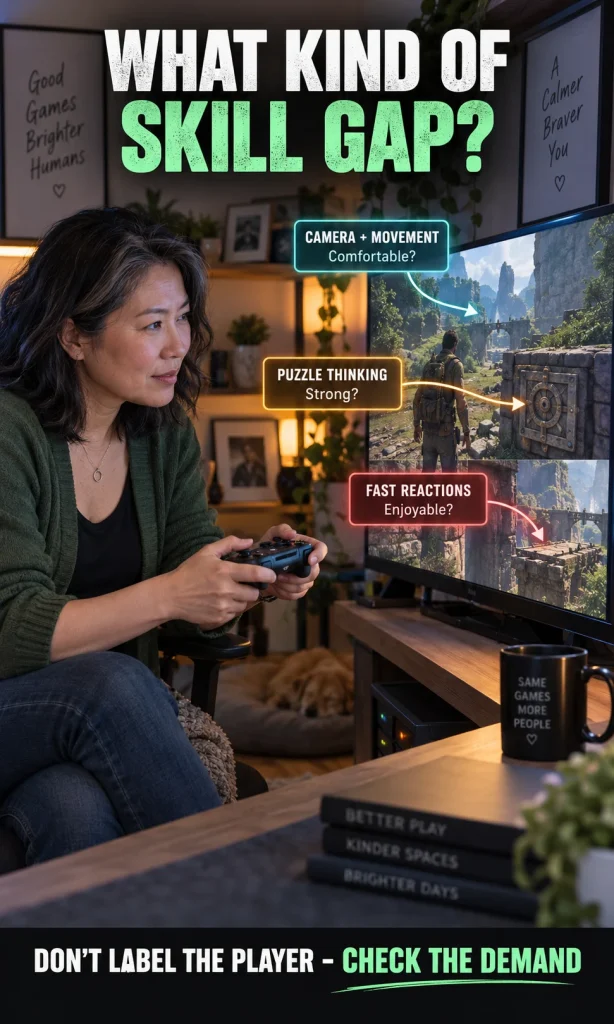
A skill gap becomes frustrating when the game repeatedly asks both players to perform the same difficult action at the same time. If one person can complete a jump immediately and the other fails it fifteen times, cooperation has temporarily stopped; one person is waiting.
Games cope with unequal skill better when they provide at least one of these structures:
- different roles rather than identical inputs;
- tasks that can be divided;
- forgiving recovery;
- room for the experienced player to assist physically;
- puzzle knowledge that does not depend on controller speed;
- difficulty coming from communication rather than reaction time;
- open-ended objectives where both players can contribute differently.
That is why Unravel Two, Stardew Valley and Keep Talking and Nobody Explodes can work particularly well across a large skill gap even though they are completely different games.
Couch Co-Op, Split-Screen, Online and Crossplay Are Different
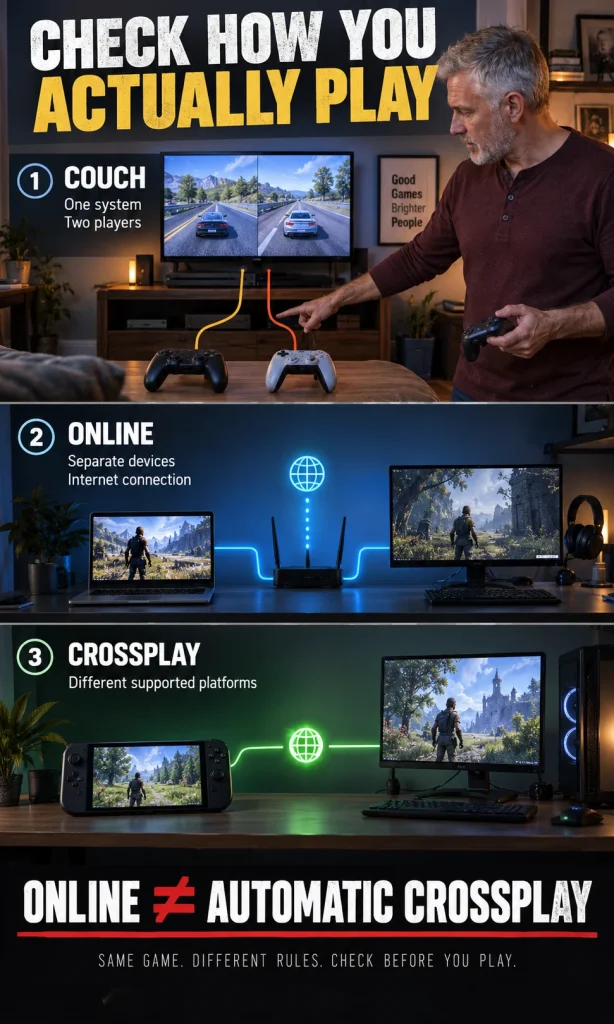
These terms are often treated as though they describe the same feature, which creates unnecessary buying mistakes.
| Term | What It Actually Means | Why Couples Should Care |
|---|---|---|
| Couch / local co-op | Both players can participate locally on the same system. | Important when you own only one gaming device. |
| Split-screen | Each player receives a separate view on the same display. | Players can often move independently, but each view is smaller. |
| Shared screen | Both characters remain inside one camera view. | You normally have to stay closer together. |
| Online co-op | Players connect over the internet from separate devices. | Useful for long-distance couples, but platform compatibility still matters. |
| Crossplay | Different supported platform families can play together. | Essential when one person uses one platform and the other owns another. |
Always check the current store or publisher page for the exact platforms you own before buying. “Online co-op” by itself does not guarantee that a PC copy can connect to a console copy.
Which Games Let One Person Buy the Full Game?
Three particularly useful couples games have official systems designed around one player owning the game and inviting the other.
It Takes Two: Friend’s Pass allows the second player to join without owning the full game, but crossplay is not supported.
Split Fiction: Friend’s Pass also works with one owner, and crossplay provides substantially more flexibility for couples on different supported systems.
A Way Out: Friend Pass lets an owner invite a second player, but online partners need compatible versions on the same type of platform.
The distinction matters more than it appears. A game may be excellent for couples and still become a poor purchase when the two people live apart, own different hardware and only discover the compatibility restriction after paying.
What Should You Play After It Takes Two?
Choose based on what you actually liked about it.
If you liked constant new mechanics, move to Split Fiction.
If you liked solving things together, choose Portal 2 or Escape Academy.
If you liked playing a complete story together, choose A Way Out.
If you liked sharing a game but want less action, choose Stardew Valley.
If you want something easier for a newer player, choose Unravel Two.
The question “What is most similar to It Takes Two?” is less useful than “Which part of It Takes Two made us want another game?”
What If One Person Is Basically a Non-Gamer?
Start by removing unnecessary control difficulty. A beginner can understand the goal perfectly and still struggle because moving a character, controlling the camera and reacting to prompts simultaneously have not yet become automatic.
I would begin with:
- Unravel Two when both people want to control characters.
- Keep Talking and Nobody Explodes when controller ability is the main gap.
- Stardew Valley when you want long, low-pressure sessions.
- Spiritfarer when story and atmosphere matter more than mechanical challenge.
- Moving Out 2 when you want short sessions where mistakes remain funny.
I would usually save Split Fiction, Cuphead and Deep Rock Galactic until the newer player actively wants more demanding controls.
What If One Person Keeps Taking Over?
This problem appears frequently in puzzle and management games because expertise can become more disruptive than the actual difficulty.
The solution is not necessarily choosing an easier game. Choose one where the design creates separate responsibilities or agree on one simple rule: do not tell the other person the solution until they ask.
In Portal 2, describe what you notice rather than immediately placing the other player’s portals verbally. In Stardew Valley, let each person own certain jobs. In Baldur’s Gate 3, let both players make imperfect character decisions rather than turning the campaign into one person’s optimized build guide.
Good co-op gives both players agency. Efficiency is not always the goal.
Common Couples-Gaming Mistakes
Buying the Highest-Rated Game Without Checking Co-Op Format
A masterpiece that requires two separate compatible systems can be useless to a couple sitting beside one television.
Assuming an Easy-Looking Game Is Easy to Control
Bright animation does not remove 3D camera movement, aiming or timed platforming.
Starting With a Very Long Game
A 50-hour campaign is a poor experiment when you do not yet know what kind of games both people enjoy.
Letting the Experienced Player Become the Instructor
Constant correction makes the weaker player feel assessed rather than included.
Choosing Competitive Games When One Person Hates Losing to the Other
Competing can be fun, but cooperative play removes the need for one partner’s success to require the other’s defeat.
Treating Failure as Proof That the Game Is Wrong
Some games become fun once both people understand the controls. The important distinction is whether the learning process itself is still enjoyable.
Frequently Asked Questions
What is the best video game for couples?
It Takes Two is the strongest general recommendation when both players are comfortable with 3D controls because the entire campaign is designed around two-player cooperation. It is not automatically the best choice for every couple, however. Unravel Two is gentler for a large skill gap, Stardew Valley works better for relaxed long-term play, and Split Fiction suits two more experienced action players.
What co-op game is best when one partner is not a gamer?
Unravel Two is a strong first choice when the newer player wants to learn ordinary controller movement because cooperation remains meaningful without demanding constant high-speed action. Keep Talking and Nobody Explodes is even better when controller skill itself is the obstacle because one participant can perform an equally important communication role without controlling an on-screen character.
What should couples play after It Takes Two?
Choose Split Fiction if you want another fast two-player adventure with constantly changing mechanics. Choose Portal 2 or Escape Academy if the puzzle-solving was your favorite part, A Way Out if you want another finite cinematic story, or Stardew Valley if you want a slower shared game that can continue for months.
Can two people play Split Fiction with one copy?
Yes. Split Fiction uses Friend’s Pass so one player can own the full game and invite the second player. It also supports crossplay across supported platforms, which makes it particularly useful for couples who play online from different systems.
Does It Takes Two support crossplay?
No. It Takes Two supports Friend’s Pass, which can allow the second person to play without owning the full game, but it does not provide crossplay between different platform families. Check both players’ platforms before planning an online session.
What is the best relaxing game for couples?
Stardew Valley is one of the strongest choices because the two players can divide responsibilities and progress without constantly succeeding or failing the same action together. Spiritfarer is another good option when you prefer an emotional story and gentler cooperative play.
What is the best difficult co-op game for couples?
Cuphead is an excellent choice when both people genuinely enjoy repeated attempts and mechanical mastery. The same difficulty makes it a poor recommendation for a large skill mismatch, because one player can spend too much time defeated while the stronger player continues the encounter alone.
Action Checklist
Before buying your next couples game, answer these questions together:
- Are we playing in the same room or remotely?
- Do we have one gaming device or two?
- If we have different platforms, does the game support the exact crossplay combination we need?
- Is one of us significantly less comfortable with controllers?
- Do mistakes usually make us laugh or make us frustrated?
- Do we want a 30-minute session or a long campaign?
- Do both of us want action, or would puzzles, building or management fit better?
- Does one copy support both players, or will we need two?
- Are we choosing the game because it fits us, or simply because everyone else recommends it?
If you answer those questions first, the list becomes much easier to use. The best couples game is not the one that wins somebody else’s ranking; it is the one where both people keep wanting to pick the controller back up.
Game Night Match
Match the game to both players - skill gap, setup, mood, session length and tolerance for failure. The result favors games you are more likely to enjoy together, not a generic ranking.
 YOUR TWO-PLAYER PROFILE
FIT FIRST - THEN PICK
YOUR TWO-PLAYER PROFILE
FIT FIRST - THEN PICK
Compatibility and store availability can change by platform, edition and region. Before purchasing, verify the exact local/online/crossplay combination on the current publisher or platform store page for both players.