



Running faster comes from training the specific quality that is limiting you – acceleration, top speed, race-pace endurance, force production, or the ability to recover between hard efforts. A 100-meter sprinter and a 10K runner can both want “more speed,” but the workouts that deserve the most attention are not the same. Start by matching the speed session to your goal, then support it with strength, reactive power, and enough recovery to keep fast running genuinely fast.
- Short sprint speed: acceleration, maximum-velocity exposures, resisted sprint work, strength and plyometrics.
- Mile to 5K speed: race-specific intervals, short strides or sprints, strength and controlled speed endurance.
- 10K to half-marathon speed: threshold and race-pace work first, with short fast running used as a neuromuscular support.
- New to speedwork: one quality session plus relaxed strides is usually a better starting point than stacking several hard days.
Speed is not one thing
Top speed is the highest velocity you can reach for a short period, while race speed is the pace you can sustain over a specific distance. Those qualities overlap, but they are limited by different combinations of neuromuscular power, running economy, aerobic capacity, lactate-related tolerance, technique, and fatigue resistance. That is why copying a sprinter’s workout is not automatically the fastest route to a better 5K, and copying a distance runner’s intervals is not enough to maximize 100-meter acceleration.
The useful question is not simply “How do I get faster?” but “Where do I lose speed?” A runner who feels powerful for 100 meters but fades after several minutes needs a different stimulus from someone who can hold a strong pace for a long time yet cannot change gears at the end of a race. The five strategies below work best when they are treated as parts of a system rather than five workouts to cram into the same week.
| Primary goal | Main speed emphasis | Support work |
|---|---|---|
| 100-400 m / field-sport acceleration | Acceleration + maximum-velocity sprinting | Resisted sprinting, heavy strength, plyometrics |
| Mile / 1500 m / 5K | Race-specific intervals + speed endurance | Short sprints or strides, strength, plyometrics |
| 10K / half marathon | Threshold + race-pace development | Strides, short hills, strength |
| General fitness | Controlled intervals + technique | Basic strength and progressive power work |
1. Practice sprinting while you are fresh
Fast running is a skill as well as a fitness stress, so the best speed repetitions are usually the ones performed before fatigue changes your mechanics. A review of sprint-training methods found that specific sprint training consistently improves sprint performance, which supports the basic principle that you need regular exposure to the type of speed you want to improve. The goal is high-quality repetition, not simply reaching exhaustion faster.
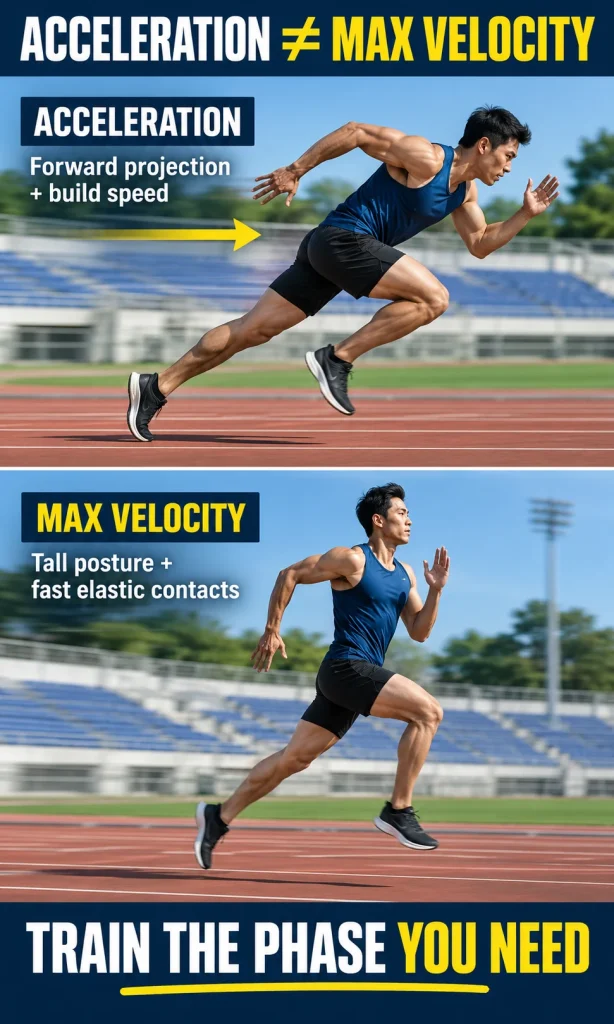
For acceleration work, use short efforts that let you focus on projecting the body forward and applying force cleanly into the ground. For maximum-velocity work, allow enough build-up and recovery that the fast portion feels coordinated rather than forced, and stop the set when your posture, rhythm, or speed visibly deteriorates. Distance runners can use relaxed strides or short fast repetitions to keep this neuromuscular quality without turning every run into an all-out sprint session.
Drills can help if they have a clear purpose, such as reinforcing posture, front-side mechanics, stiffness at ground contact, or rhythm before faster running. They are less useful when they become a long ritual that tires you before the actual speed work begins. Use a small number of drills, then apply the same movement idea during real running where speed, force, and timing have to work together.
2. Use hills or resisted sprints to build acceleration – not as a shortcut
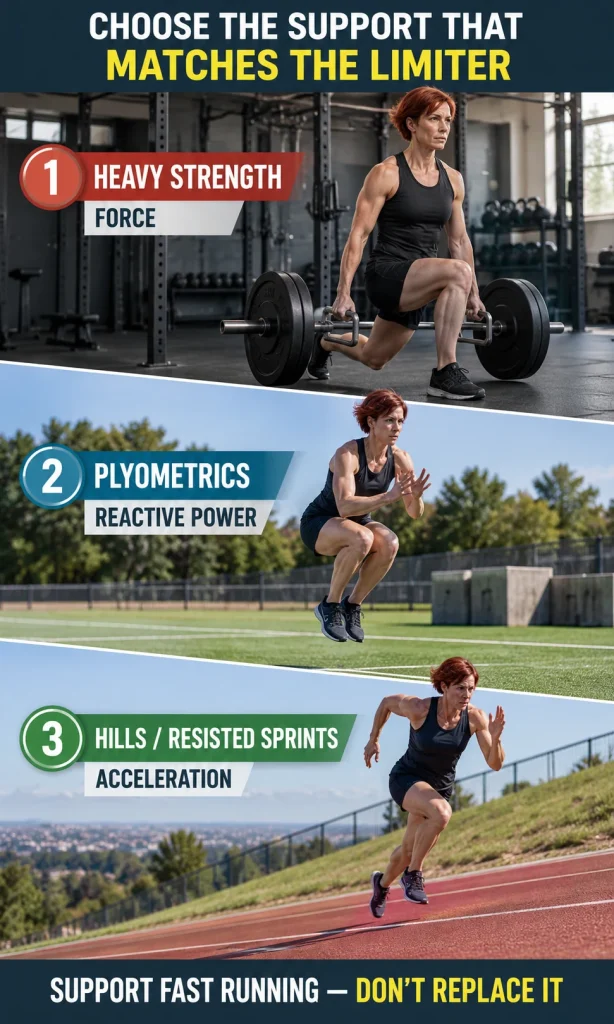
Resisted sprinting can be useful because added resistance makes the acceleration phase demand more horizontal force, but the load should not distort the movement you are trying to improve. A systematic review and meta-analysis of resisted sprint training found improvements in acceleration, while newer evidence suggests the response depends on training status, load, and how the work is programmed. That makes sleds, bands, and hill sprints useful options rather than mandatory equipment.
A moderate hill is often the simplest version for recreational runners because it naturally slows the athlete while still demanding forceful push-off and good posture. Keep the efforts short enough that the repetition still looks like acceleration training, then walk or jog back until you can repeat the same quality. If you use a sled or another external resistance, treat it as a technical training method rather than a test of how much load you can drag.
Running parachutes are less predictable because resistance changes with air speed, direction, and deployment, so they are harder to standardize than a hill or a properly loaded sled. They can still add variety for experienced athletes, but the article’s old idea that a parachute is a universal path to faster running overstates what the equipment itself can do. The training effect comes from repeated, well-executed acceleration under an appropriate resistance, not from the accessory.
3. Build force with heavy strength training
Strength training matters because every stride requires you to generate force against the ground in a very short time. For middle- and long-distance runners, a systematic review and meta-analysis of strength-training methods found that high-load and combined strength approaches can improve running economy, while earlier review work also reported benefits for time-trial performance and maximal sprint speed. The practical message is that runners do not need bodybuilding-style volume to benefit from lifting; they need enough force-producing stimulus to complement running.
Prioritize large movement patterns that train the hips, knees, calves, and trunk to produce and transfer force, then keep accessory work proportional to the time and recovery you have available. Squat, hinge, split-squat, step-up, calf-strength and pulling or bracing variations can all fit, but the exact exercise matters less than good technique, progressive loading, and consistency. If heavy lifting is new to you, learn the movement first and increase resistance gradually rather than chasing a percentage from someone else’s program.
Strength work should support the quality of your running week, not compete with it. If your legs are so sore that your next fast session becomes slow and mechanically messy, either the lifting dose, exercise selection, timing, or total training load needs adjustment. Experienced runners often group demanding work so that genuinely easy days remain easy, but the best arrangement depends on schedule, training age, and how quickly you recover.
| Method | Best used for | Main caution |
|---|---|---|
| Specific sprinting | Acceleration, top speed, sprint mechanics | Quality drops quickly when fatigue is high |
| Resisted sprinting / hills | Acceleration and force application | Too much resistance can alter mechanics |
| Heavy strength | Force production and running economy support | Excess volume can interfere with key run sessions |
| Plyometrics | Reactive power and fast force transfer | Jump volume should progress gradually |
4. Add plyometrics for reactive power
Plyometrics train the rapid stretch-shortening actions used when the foot contacts the ground and force has to be returned quickly. A recent systematic review and meta-analysis found that plyometric training improved sprint and jump outcomes across different surface types, while a track-and-field review also reported improvements in 30-meter sprint performance and running economy. That does not mean more jumping is always better; the useful dose is the one you can land, control, and recover from.
Begin with low-complexity contacts such as pogo variations, skips, small hops, and controlled bounds before progressing to higher-intensity or more demanding single-leg work. The quality markers are stiffness without rigidity, quiet controlled landings, alignment, and the ability to repeat the movement without losing rhythm. If landing quality deteriorates, adding more repetitions usually turns a power drill into fatigue practice.
Plyometrics fit best as a short, purposeful layer around running and strength rather than a separate marathon workout. You can place low-volume power work after a dynamic warm-up or before lifting, when coordination is fresh, and keep higher-impact work away from days when the lower legs are already heavily fatigued. Runners with a history of tendon, bone, or joint problems should progress impact work more cautiously and seek individualized guidance when symptoms persist.
5. Train speed endurance, then protect the recovery that makes it work
Top speed matters less if you cannot preserve useful mechanics and pace once fatigue arrives, which is where speed-endurance and race-specific interval work become important. Sprint interval training can improve multiple performance outcomes in healthy adults, although a systematic review and meta-analysis also noted wide protocol variation and signs that some published effects may be overestimated. The sensible approach is to use hard intervals as a targeted dose, not as proof that every workout should become maximal.
For a 5K runner, speed endurance may mean repeated intervals around current race effort or a little faster with enough recovery to keep the repetitions controlled. For a sprinter, it can mean longer sprints or repeated high-speed efforts that challenge the ability to preserve mechanics after the initial acceleration phase. In both cases, the session should have a reason: improve a specific race demand, not simply collect suffering.
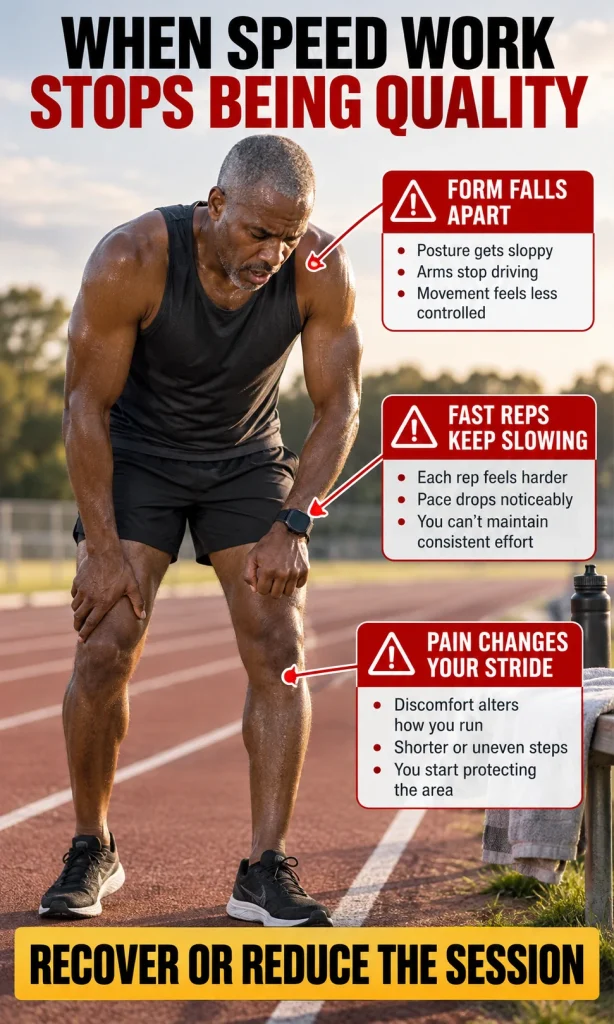
Recovery is part of speed development because nervous-system quality, force output, coordination, and connective-tissue tolerance all fall when hard days accumulate faster than you can absorb them. The right spacing varies, but hard speed sessions should generally be separated by easy running, rest, or lower-stress training until you can reproduce good mechanics and intent. If every “fast” day becomes slower than the last, the problem is often not a lack of toughness but a lack of recovery or too much total high-intensity work.
- Stop the set when mechanics clearly unravel. A poor final repetition does not automatically add a useful adaptation.
- Do not increase volume, intensity, and frequency at the same time. Change one major variable, then observe the response.
- Keep easy days genuinely easy. Turning recovery runs into moderate efforts can quietly reduce the quality of the next speed session.
- Watch persistent pain, not just normal effort. Sharp, worsening, or recurring pain deserves assessment rather than being treated as a normal sign of speed training.
A simple way to arrange the five strategies
A recreational runner does not need all five strategies in large doses every week. A practical structure is one primary fast-running session, one strength session that is challenging but recoverable, a small amount of strides or plyometrics, and enough easy aerobic work to preserve consistency. More experienced athletes can add a second quality session when the first one is already being completed well and recovery remains stable.
The session order matters because high-speed work is sensitive to fatigue. Warm up, perform the fastest and most technical running while fresh, then place slower intervals, strength, or supplementary work later according to the goal of the day. This simple rule protects the quality of the skill you are trying to improve instead of asking a tired body to learn high-speed mechanics.
Runners returning from a break should rebuild consistency before reintroducing maximal work. If you are not yet running comfortably several times per week, a gradual run-walk base may be a better starting point than immediate sprint sessions, and our guide to walking more consistently can help with that transition. Once basic tolerance is stable, add speed in small doses and judge progress by repeatable quality rather than one dramatic session.
Build your speed week with the Speed Session Studio
The interactive experience below turns the article into a practical weekly structure based on your goal, training experience, available days, and equipment. It does not give a fake “speed score” or claim to predict your genetic potential; instead, it shows which session deserves priority, which supporting method fits, and where recovery should sit. If you enter a recent benchmark, it also converts that result into average pace so you have a clean reference point without pretending that every interval should be prescribed from one race time.
Speed Session Studio
Choose the kind of speed you want to improve, then build a weekly emphasis around your experience, available days and recovery status.

How to tell if the program is actually working
Speed progress is easiest to trust when you compare the same task under similar conditions. Time a short acceleration segment, a flying sprint, a repeatable interval session, or a race-distance benchmark that matches your goal, then keep the surface, warm-up, footwear, and measurement method as consistent as practical. A single unusually fast day can be noise, while a repeated improvement with stable form is stronger evidence that the training is working.
Also track how the work feels and how quickly you recover, because better performance with steadily increasing pain or exhaustion is not a good trade. If you need more days to recover from the same session, your easy pace is deteriorating, or your fast mechanics feel less coordinated week after week, reduce the total stress before adding another method. The fastest long-term plan is usually the one you can repeat often enough to adapt without constantly restarting after setbacks.
Frequently Asked Questions
How many speed sessions should I do each week?
Many recreational runners can make progress with one dedicated speed session plus short strides, while experienced runners may tolerate two quality sessions when easy days remain truly easy. Your running history, race goal, strength work, sleep, and injury history all affect how much high-intensity work you can recover from. Add a second session only when the first one is consistent, technically sound, and not creating lingering fatigue.
Do hill sprints make you faster on flat ground?
Hill sprints can support acceleration by increasing force demand and encouraging a strong forward drive, but they do not replace flat sprinting if your goal is maximum flat-ground speed. Use hills as a resisted variation, then keep some flat running in the program so the coordination and mechanics transfer to the surface where you want to be fast. Very steep hills can change the movement too much to serve the same purpose.
Is a running parachute necessary for speed training?
No. A parachute is one form of resisted sprinting, but hills, sleds, bands, and ordinary unresisted sprints can all be used depending on the goal and equipment available. Because parachute resistance changes with speed and wind, it is less standardized than a sled or a consistent hill.
Does strength training make distance runners slower?
Not when it is programmed appropriately. Research in middle- and long-distance runners shows that heavy or combined strength training can improve running economy and performance-related outcomes without requiring large bodybuilding volumes. The main practical risk is poor scheduling or excessive volume that leaves the runner too fatigued to complete key running sessions well.
Should I sprint when I am sore?
Mild general muscle soreness is different from sharp, localized, worsening, or recurring pain. Because true speed work demands high force and coordination, it is usually better to delay or reduce the session when soreness meaningfully changes your movement. Persistent pain, swelling, instability, or symptoms that worsen with running should be assessed by an appropriate health professional rather than pushed through.
The bottom line
Running speed improves most reliably when the training target is clear: practice the speed you actually need, use resistance selectively for acceleration, build force with strength work, add plyometrics for reactive power, and develop speed endurance without sacrificing recovery. The old idea that one gadget, one pace calculator, or one brutally hard session unlocks speed is too simple. Build a week that preserves high-quality fast running, then progress one variable at a time and measure the result against the type of speed that matters to you.