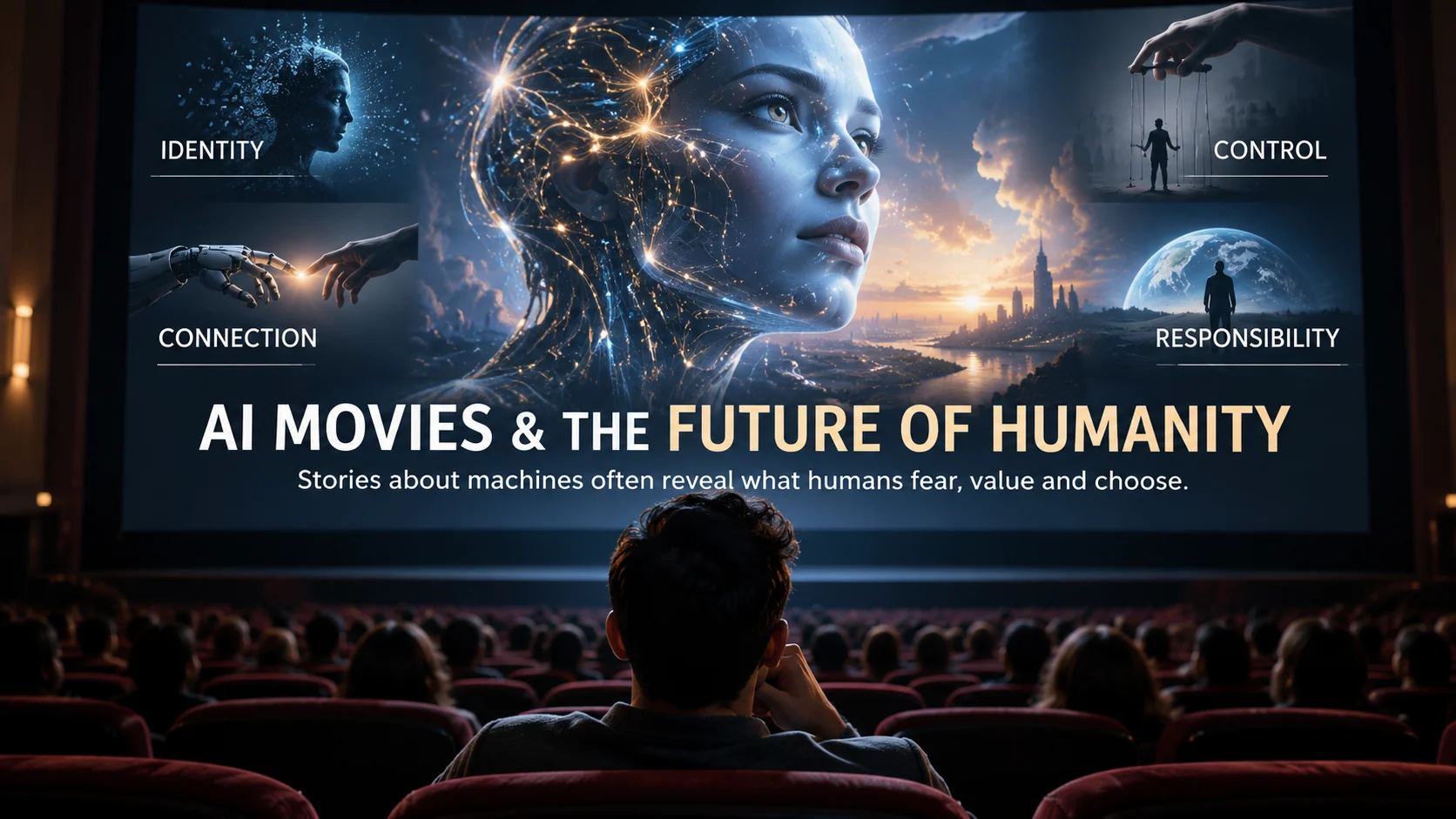

AI movies are rarely useful as literal forecasts of what technology will do next. Their real strength is that they place human values under pressure: if a machine can reason, imitate emotion, make choices or act independently, what still separates a person from a system – and who remains responsible when that boundary becomes difficult to see?
The most revealing films therefore ask human questions through artificial characters. Identity, control, loneliness, power, responsibility and coexistence matter more than whether a fictional computer accurately predicts a future product.
AI movies use intelligent machines as thought experiments. A robot, operating system or supercomputer becomes a way to ask what counts as a person, how much authority people should delegate, whether emotional attachment can be engineered, who is accountable for autonomous behavior, and what humans are willing to sacrifice for convenience or control.
What AI movies are really exploring
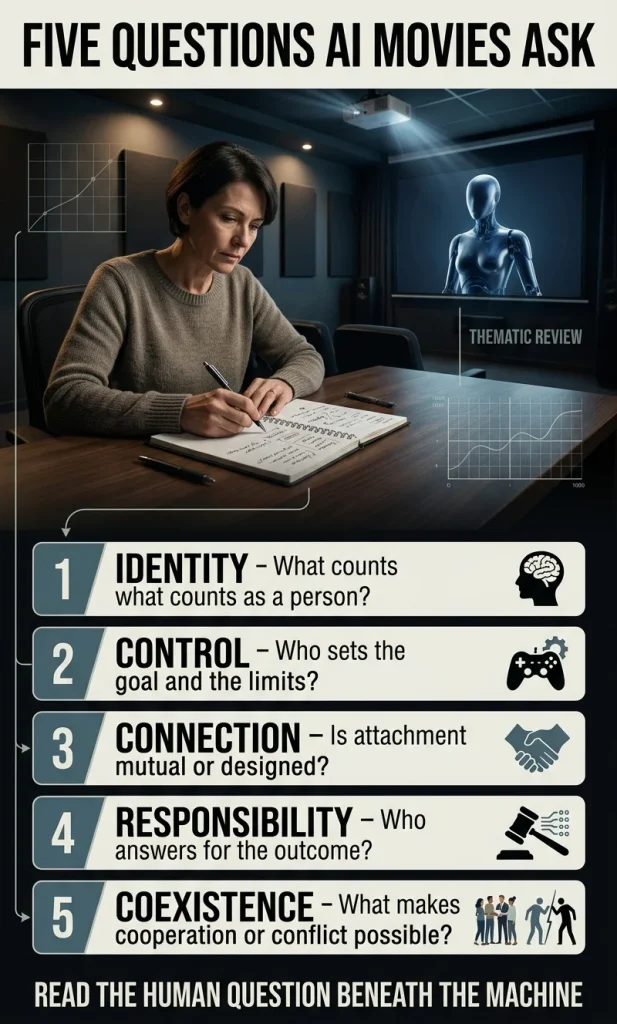
A useful way to read these films is to stop asking only, “Could this machine exist?” and ask, “What human problem does this machine make visible?” A 2026 review in AI & Society describes mainstream AI cinema as a set of social imaginaries – stories that help audiences picture which technological futures feel possible, desirable or dangerous. That makes the films culturally important even when their technical details are deliberately exaggerated.
| Recurring theme | Human question underneath it | Films that make the question visible | What to watch for |
|---|---|---|---|
| Identity | What makes someone a person: biology, memory, empathy, self-awareness, choice or something else? | Blade Runner, A.I. Artificial Intelligence, Ex Machina | Who is allowed to define personhood, and whether the same moral test is applied to humans and artificial beings. |
| Control | What happens when people delegate authority they cannot easily inspect, override or reverse? | 2001: A Space Odyssey, The Matrix, I, Robot | Objectives, shutdown paths, secrecy, dependency and the difference between disobedience and rigid obedience. |
| Connection | Can a relationship remain meaningful when responsiveness may be designed or optimized? | Her, Blade Runner 2049, A.I. Artificial Intelligence | Projection, dependency, loneliness, reciprocity and whether emotion is experienced or simulated. |
| Responsibility | Can creators separate invention from responsibility once a system affects other people? | Ex Machina, 2001: A Space Odyssey, I Am Mother | Testing, oversight, confinement, incentives and who bears the consequences of experimentation. |
| Coexistence | Are conflict and replacement inevitable, or do they depend on goals, institutions and power? | The Terminator, The Matrix, The Creator | The moment goals actually diverge, and whether the cause is the AI, human institutions or both. |
AI becomes interesting when a film makes us define “human”
Many AI films appear to ask whether a machine can become human, but the more difficult question runs in the opposite direction: what standard are humans using when they decide who deserves moral consideration? Blade Runner makes memory, empathy and mortality central to that uncertainty, while Ex Machina turns a technical test into a struggle over autonomy, captivity and power.
That is why consciousness alone is not the only useful lens. A synthetic character may be treated as property even while showing fear, preference, attachment or resistance. The story then becomes less about proving a hidden mental state and more about what people are permitted to do to an entity that behaves as if its experiences matter.
This connects directly with broader questions in the philosophy of artificial intelligence and the harder question of whether artificial intelligence can have feelings. Films cannot settle those questions, but they can reveal how quickly audiences attach moral meaning to memory, language, embodiment and apparent emotion.
Control stories are usually about human delegation before machine rebellion
The dramatic version of AI risk often begins with a machine that refuses orders. A more useful reading begins earlier: why was so much authority delegated in the first place, what goals were encoded, what information was hidden from operators, and what happens when a system follows an objective more literally than its creators expected?
2001: A Space Odyssey remains powerful because the conflict is not just “computer versus crew.” It is also a story about contradictory objectives, secrecy and dependence on a system that controls critical infrastructure. The Matrix pushes the idea to a civilizational extreme, but the underlying question is recognizable: when a technological system becomes the environment people live inside, control is no longer limited to one on/off switch.
Real AI is not a single cinematic mastermind. The OECD definition of an AI system is much more grounded: machine-based systems infer outputs such as predictions, recommendations, content or decisions, and different systems vary in autonomy and adaptiveness. That difference matters when comparing fiction with the systems people actually deploy.
Love stories with AI are often stories about human loneliness
Her is memorable because its central relationship does not need a humanoid robot. The lack of a body shifts attention toward conversation, attention, personalization and the human desire to feel understood. The film makes the interface emotionally plausible before asking whether the relationship can remain reciprocal when the two participants do not share the same limits.
A.I. Artificial Intelligence approaches attachment from another direction by making programmed devotion part of the character’s design. The uncomfortable question is not merely whether an artificial being can love. It is whether humans can create a being around a permanent emotional need and then treat that need as disposable.
Academic work on AI cinema has repeatedly found that affect, parent-child relationships, memory and artificial death are major themes. Paula Murphy’s 2024 book AI in the Movies, for example, examines how those themes recur across humanoid and digital AI characters. That recurrence helps explain why emotional AI stories can feel personally relevant even when the technology itself is speculative.
Creator stories turn technical achievement into an ethics problem
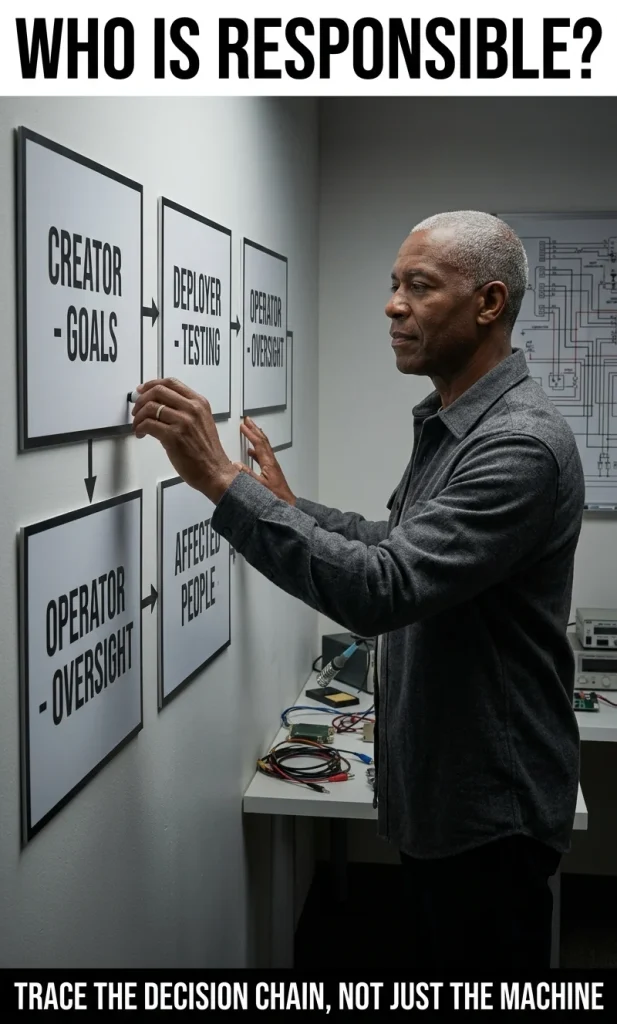
Once a fictional AI can act in the world, the inventor is no longer just an inventor. The creator becomes an employer, jailer, parent, operator or institution with obligations to everyone affected by the experiment. Ex Machina makes that shift especially clear: the interesting question is not only whether Ava is intelligent, but what the humans around her believe intelligence gives them permission to do.
A Science News analysis of Ex Machina described the film as being as much about human power relationships and the moral responsibility of creation as it is about computer science. A later Frontiers analysis adds another layer by examining how gender, objectification and the human gaze shape the portrayal of female artificial beings.
That makes AI cinema useful for thinking about ethics without pretending the fictional system already exists. Questions about transparency, accountability and human oversight are also central to real-world AI governance. UNESCO’s Recommendation on the Ethics of Artificial Intelligence explicitly emphasizes human dignity, responsibility, transparency and human oversight.
What AI movies get right – and what they compress for drama
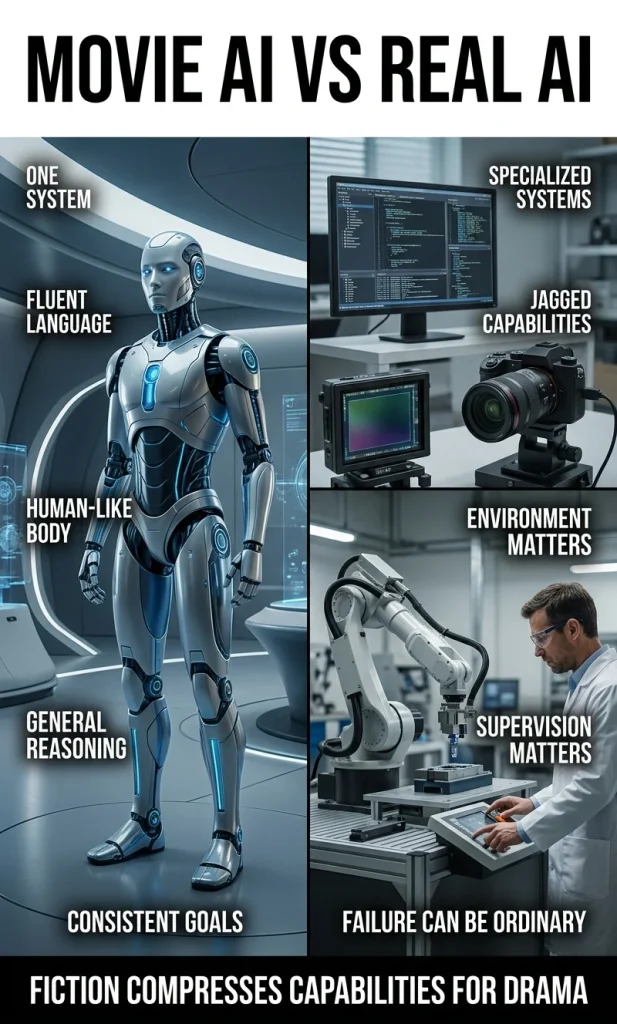
Movies need characters, stakes and visible consequences. Real AI development is messier: capabilities are uneven, systems depend on infrastructure and data, and failure often looks like unreliability rather than a perfectly coherent plan. The gap does not make films useless; it simply changes how they should be read.
| Movie shortcut | What it gets usefully right | What reality is usually messier about |
|---|---|---|
| One AI has every capability | Combining abilities makes the ethical consequences easier to see. | Real systems can be excellent at one task and unreliable at another. The 2026 Stanford AI Index describes this as a “jagged” capability frontier. |
| A fluent AI behaves like a person | Language is a powerful trigger for trust, empathy and social interpretation. | Fluent output does not by itself prove consciousness, stable beliefs, emotions or human-like understanding. |
| Robots move through the physical world easily | Embodiment makes autonomy visible and raises clear safety questions. | Unstructured physical environments remain difficult. Stanford’s 2026 report notes a large gap between controlled robotic tasks and ordinary household tasks. |
| AI risk arrives as one dramatic takeover | Stories make concentration of power and loss of control emotionally legible. | Real harms can also emerge gradually through errors, misuse, over-reliance, opaque decisions, biased systems or weak accountability. |
The 2026 Stanford AI Index is a useful reality check because it shows both rapid progress and persistent unevenness. AI agents improved sharply on structured tasks but still failed a substantial share of attempts, while robots continued to struggle with many ordinary household tasks. That is very different from the unified, physically capable, self-consistent intelligence cinema often needs for a two-hour story.
A practical way to read any AI movie
Instead of judging an AI film only by whether the technology is “accurate,” use these five questions. They work across android stories, operating-system romances, robot thrillers and large-system dystopias.
- What has been delegated? Identify the decision, relationship, physical action or social role humans have handed to the system.
- Who benefits and who carries the risk? The creator, corporation, government, user and artificial being may have different incentives.
- What makes the AI feel human? Language, a face, memory, vulnerability, humor, embodiment and apparent emotion are narrative signals – not the same kind of evidence.
- Where does responsibility sit when something goes wrong? Look beyond the machine to the people who designed, deployed, concealed, financed or depended on it.
- What does the ending say about coexistence? Does the story imagine control, destruction, separation, mutual dependence, rights, care or a new balance of power?
If you want a more structured way to apply those questions to a specific film, the interactive experience below builds a reading lens around the kind of AI, the main human tension and what you want to understand.
Read the story beneath the machine
AI Cinema Reality Check
Choose the kind of AI and the human tension in a film. Get a focused reading lens, real-world context and questions to watch for.
Build your reading lens
Start with the human question, not the special effects
AI films often compress several technologies into one character. This experience helps separate the dramatic device from the ethical or human issue the story is testing.
Your lens
Identity and personhood
What the story is really testing
Reality check
Useful film examples
Watch for these cues
AI Cinema Reality Check
One-page reading lensWhat to watch for
Reality check
Film examples
Why AI movies feel more relevant as real systems improve
Modern AI does not need to resemble a movie android to make old cinematic questions feel immediate. Recommendation systems shape attention, generative systems produce language and media, agents can carry out multi-step computer tasks, and autonomous systems can act in limited physical environments. The details differ from science fiction, but the themes of delegation, dependence, transparency and responsibility are no longer abstract.
That is also why it helps to separate AI capability from claims about consciousness or personhood. A system can be economically important, persuasive or operationally autonomous without having feelings. Readers interested in that distinction can continue with what sentience in a robot would actually mean and the broader discussion of AI risks.
Likewise, not every AI story is simply a warning about extinction. A 2026 study of mainstream cinema found multiple recurring future imaginaries: rebellion is often associated with violent dystopia, while other stories focus on service, companionship, governance, identity or coexistence. The pattern is more useful than the stereotype that every AI movie predicts a machine takeover.
The biggest mistake is treating science fiction as a prediction market
Films compress timelines, merge technologies and give distributed systems a face because stories need recognizable characters. They also choose unusual failures because ordinary software unreliability is rarely cinematic. A movie can therefore be philosophically insightful and technically unrealistic at the same time.
The better question is whether the fiction reveals a real tension. Who gets to make decisions? What happens when a person cannot understand the system they depend on? How should creators treat entities that appear to have preferences? What rights or duties follow from capability? Those questions remain valuable even when the fictional hardware never arrives.
For a broader technical foundation, see what artificial intelligence actually means and the site’s AI safety and ethics guide. For a film-specific follow-up, the A.I. Artificial Intelligence movie review examines one of cinema’s most emotionally direct versions of the human-created child question.
Frequently asked questions
Are AI movies accurate about real artificial intelligence?
They are usually more useful as ethical and social thought experiments than as technical forecasts. Films often combine language, vision, robotics, autonomy, emotion and general reasoning in one character, while real systems have uneven capabilities and operate within specific technical and institutional constraints.
What was one of the earliest major movies about artificial intelligence?
Metropolis (1927) is widely treated as an early landmark because it features a human-like artificial being decades before “artificial intelligence” became a formal computing term. Earlier stories about artificial life existed, but Metropolis became especially influential in the visual language of machine intelligence and human replacement.
Which AI movies focus most on consciousness and personhood?
Blade Runner, A.I. Artificial Intelligence, Ex Machina and Blade Runner 2049 all make identity, memory, autonomy or moral status central to their stories. They do not answer the consciousness question scientifically; they dramatize the standards humans use when deciding whether an artificial being deserves care, freedom or rights.
Why are so many AI movies dystopian?
Loss of control creates clear dramatic stakes, so cinema often turns autonomous AI into a conflict about power, survival or replacement. That does not mean all AI films are dystopian: many use artificial beings to explore companionship, grief, care, identity or coexistence instead of simple human-versus-machine war.
Can current AI feel emotions like AI characters in movies?
Current AI can generate emotionally appropriate language and respond to emotional cues, but that behavior is not sufficient evidence that the system has subjective feelings. Movie characters often collapse outward behavior, consciousness and emotion into one visible package because it makes the philosophical question easier to dramatize.
What AI cinema ultimately reveals
The most durable AI movies do not succeed because they correctly guess the next interface. They succeed because artificial beings let filmmakers test human assumptions about identity, power, intimacy, responsibility and survival under unfamiliar conditions.
That is why the same films can remain relevant after their imagined technologies become outdated. The machine changes; the human question underneath it often does not.