

Business insurance is easier to understand when you stop beginning with policy names. A general liability policy, commercial property policy or business owner’s policy is useful only when its actual terms address a loss the company could realistically face. The first question should therefore be what could cause a serious financial loss to this business, followed by which type of coverage may respond, how much protection is available, and what exclusions or conditions could leave the company paying part of the loss itself.
Consider two businesses that both say they are “fully insured.” One is a consulting company working remotely with little physical property but substantial professional responsibility for client advice. The other operates a retail location with inventory, employees, customer foot traffic and delivery vehicles. Giving both companies the same insurance checklist would miss much of what actually creates their exposure.
The same principle applies inside an individual policy. A policy name does not tell you the entire protection. Limits, deductibles, exclusions, endorsements, covered locations, insured activities and claim conditions can materially affect how the contract responds. That is why the U.S. Small Business Administration recommends assessing the risks of the particular business before selecting insurance and comparing policy terms and benefits.
If you are still identifying the broader commercial exposures around a new company, the guide to risks of starting a business and how to reduce them covers demand, cash, operations, dependencies and other risks that insurance may not solve. This article focuses specifically on insurable business exposures and the questions an owner should ask before buying, renewing or relying on a policy.
The Quick Answer: What Business Insurance Does a Small Business Need?
There is no single insurance package that every small business needs in exactly the same form. The right combination depends on what the company owns, where and how it operates, whether it employs people, whether it uses vehicles, whether customers visit its premises, what professional services it provides, what data it handles, and which losses the business could not comfortably absorb itself.
Common policy categories include:
- general liability
- commercial property
- business income or business interruption
- workers compensation
- commercial auto
- professional liability or errors and omissions
- product liability
- cyber insurance
- employment practices liability
- directors and officers coverage
- umbrella or excess liability
Some small businesses may combine several protections inside a business owner’s policy, commonly called a BOP. Others need stand-alone or specialized coverage because their risks do not fit a standard package. The National Association of Insurance Commissioners explains that a typical BOP combines property, business interruption or continuation, and liability coverage, while several other exposures normally require separate consideration.
The more useful goal is not to collect as many policies as possible. It is to build a coverage structure in which the company’s largest realistic losses have been identified, matched to appropriate coverage where available, and checked for gaps that could still remain with the business.
Start With the Exposure, Not the Policy Name
An insurance review becomes much clearer when the business begins with what could actually happen.
A customer could be injured on the premises.
Equipment could be damaged by a covered event.
A professional mistake could create financial harm for a client.
An employee could suffer a work-related injury.
A vehicle could be involved in an accident.
A cyber incident could interrupt operations or expose customer data.
A physical loss could force the company to stop operating temporarily.
Each event reaches a different part of the business, and each may require a different insurance response.
Ask Four Questions for Every Important Exposure
Before focusing on premiums, ask:
1. What event could create the loss?
Be specific. “Something happens to the business” is too broad. Fire damage to equipment, a customer injury, professional negligence allegations and a data breach are very different exposures.
2. What would the loss actually cost?
Include more than the obvious physical damage. A serious event can involve legal defense, replacement property, lost operating income, temporary premises, customer notification, professional support or other expenses depending on the event.
3. Which policy is expected to respond?
Do not rely only on the policy title. Find the relevant coverage section and understand which event triggers it.
4. What could prevent or limit payment?
Check exclusions, deductibles, coverage limits, sublimits, waiting periods, geographic restrictions, policy conditions and endorsements that may change the standard language.
That final question matters because a business can own the correct general category of insurance while still having a gap around the exact event it assumed was protected.
Business Insurance Coverage Map
| Business Exposure | Policy Category to Examine | Question to Ask |
|---|---|---|
| Customer or visitor alleges bodily injury or property damage | General liability | Is this activity, location and type of allegation within the policy’s coverage? |
| Building, equipment, inventory or other insured property is damaged | Commercial property | Which property and causes of loss are actually insured? |
| Operations stop after a covered property loss | Business income / interruption | What event triggers coverage, what expenses are included and how long can benefits continue? |
| Employee suffers a work-related injury or occupational illness | Workers compensation | What does the law require for this business and jurisdiction? |
| Business vehicle is involved in an accident | Commercial auto | Which vehicles, drivers and business uses are insured? |
| Client alleges professional error, negligence or inadequate service | Professional liability / E&O | Does the policy cover the professional activity that produced the allegation? |
| Cyber event affects systems, data or third parties | Cyber insurance | Which first-party response costs and third-party liabilities are included? |
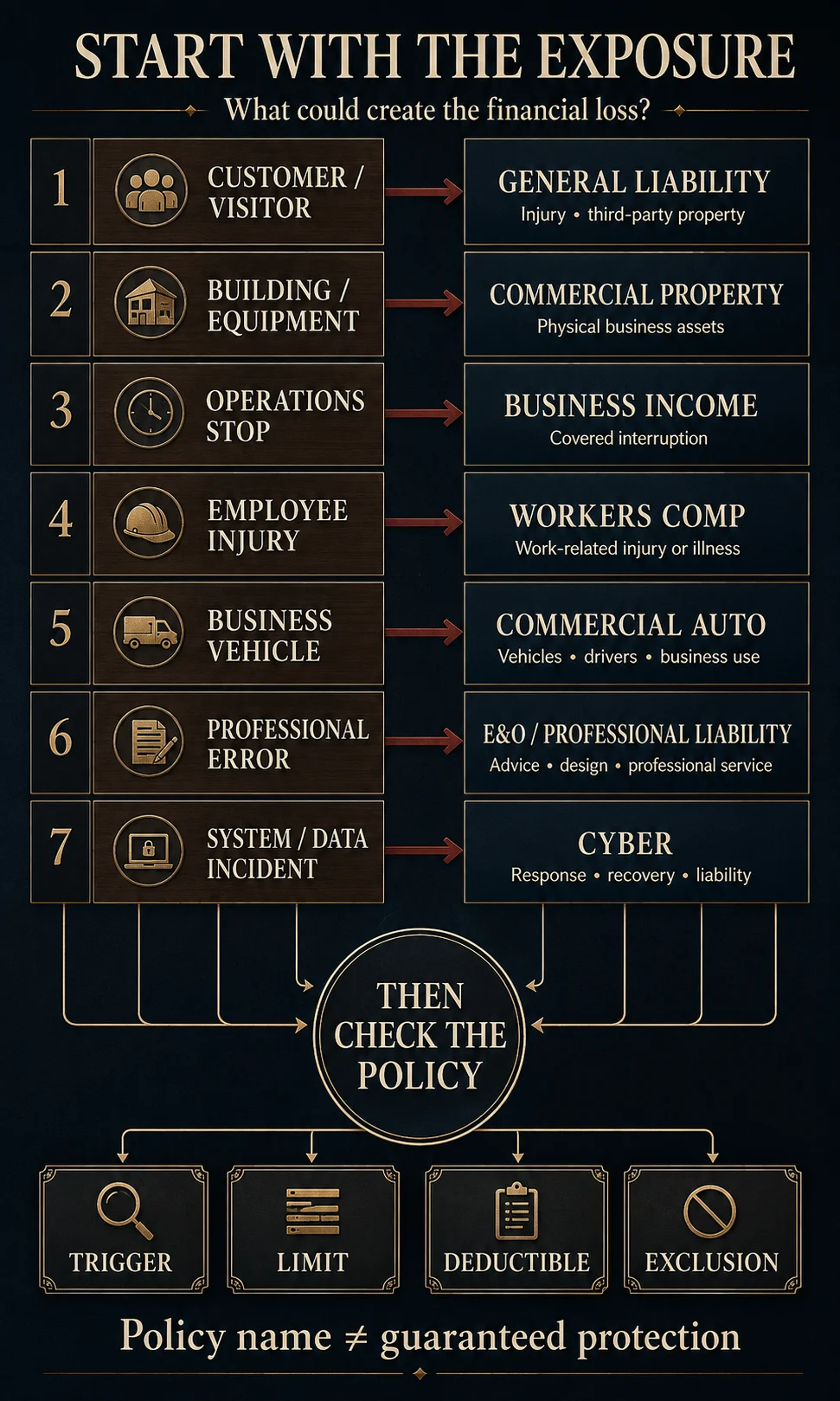
This table is deliberately written as a policy category to examine, rather than a promise that a particular claim will be paid. Insurance contracts differ, and the event, wording, exclusions and limits still need to line up.
The Most Important Distinction: Having Insurance Is Not the Same as Having the Loss Covered
Business owners often talk about insurance at the policy level.
“We have liability.”
“We have a BOP.”
“We have cyber.”
Those statements are useful administratively, but they do not answer the risk question.
A stronger question is:
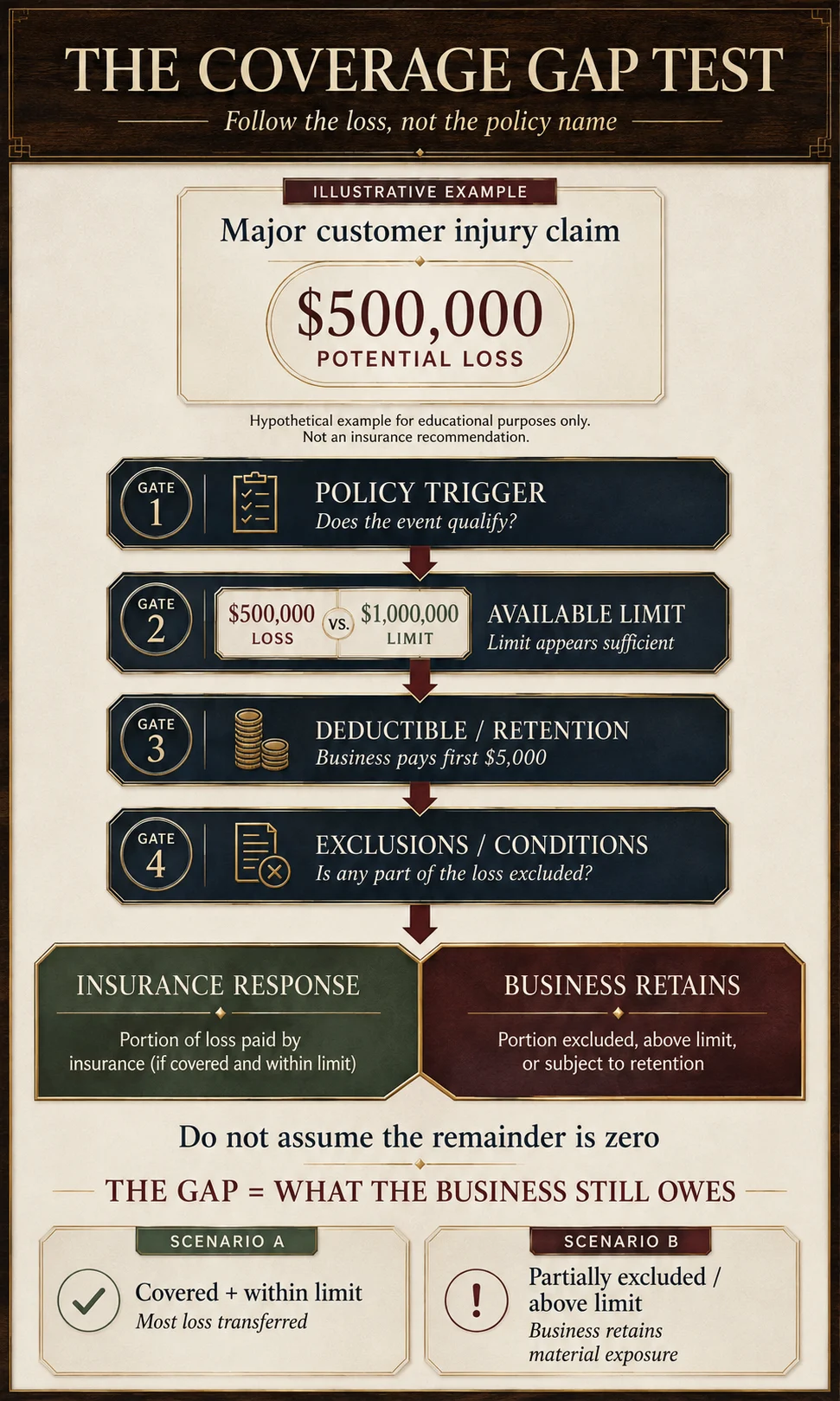
If this exact event happened tomorrow, which section of which policy would we expect to respond, and what portion of the loss could still remain with us?
That shift changes an insurance review from inventory to analysis.
Limits Matter
A covered event can still create a loss larger than the available limit.
For example, a policy may respond to an eligible claim but only up to the applicable per-occurrence, aggregate or other stated limit. Specialized coverage may also contain sublimits for particular costs.
The practical question is therefore not merely whether coverage exists.
It is whether the available limit is proportionate to the potential loss the business is trying to transfer.
Deductibles and Retentions Matter
Insurance normally does not mean the insurer pays the first dollar of every loss.
Depending on the policy, a deductible or retention may leave the company responsible for an initial amount before insurance responds.
A business should know whether it has enough liquidity to absorb that amount at the same time it is dealing with the disruption that caused the claim.
Exclusions Matter
Exclusions identify circumstances the policy does not cover, and endorsements can add, remove or modify protection.
This is one reason generic coverage descriptions should never be treated as substitutes for the actual contract.
A business may correctly recognize that it has a property exposure while incorrectly assuming every cause of property damage is covered.
1. General Liability Insurance
General liability is one of the most common business insurance categories because many businesses interact with customers, visitors, suppliers or other third parties.
The National Association of Insurance Commissioners describes commercial general liability coverage as addressing categories that can include bodily injury, damage to another person’s property, and certain personal or advertising injuries. The exact policy still controls what is covered, excluded and limited.
Consider a customer visiting a retail store who alleges that unsafe conditions caused an injury. A different claim might involve the business accidentally damaging property belonging to a customer while performing work. These exposures are very different from damage to the company’s own equipment, professional advice that causes a client’s financial loss, or an employee injury.
That distinction is important because general liability is broad enough to be useful, but it is not a universal business-loss policy.
What General Liability Should Make You Check
Instead of asking only whether the company has general liability insurance, review questions such as:
- Are all relevant operating locations included?
- Are the business activities classified accurately?
- Are limits appropriate for the company’s exposure?
- Does the business have contract requirements for additional insured status?
- Are there activities or services excluded?
- Are products or completed operations relevant to the company?
- Could another specialized policy be expected to respond instead?
The point is not for the owner to interpret complex policy language without professional help. It is to know enough about the business exposure to ask a broker, agent or insurer a precise question.
2. Commercial Property Insurance
Commercial property coverage addresses the physical assets a business could lose or need to repair after an insured event.
Depending on the business and policy, relevant property may include buildings, furniture, machinery, computers, inventory, tools, fixtures and other business contents. The SBA lists commercial property among the common insurance types businesses should consider when they own significant physical assets, while emphasizing that owners should first assess the particular risks their company faces.
The SBA’s current business insurance guidance describes commercial property insurance as protection against loss or damage to company property from specified types of events. That description is a starting point. The actual policy determines which property, locations and causes of loss are covered.
Create a Property Inventory Before Guessing at the Limit
A small business can underestimate its physical exposure because assets are accumulated gradually.
A design studio may think primarily about computers and desks but also own:
- samples
- specialist equipment
- furniture
- lighting
- printers
- storage systems
- customer property
- tools
- replacement technology
- improvements made to leased premises
A retailer can have significant inventory exposure even when its furniture and equipment appear modest.
A contractor may have valuable tools moving between locations.
The first useful step is therefore to identify what would actually need to be repaired or replaced after a major loss.
Replacement Cost and Current Value Are Different Questions
A piece of equipment that is several years old may have a low resale value but could cost substantially more to replace with a suitable current alternative.
That difference is important when reviewing how property values are established under the policy.
The owner should understand how the contract values a covered loss, rather than assuming the amount entered on a schedule automatically equals the amount required to replace every item after an event.
3. Business Interruption or Business Income Coverage
Property damage creates two different financial problems.
The first is the damaged property itself.
The second is what happens to the business while that property cannot be used.
A restaurant affected by a covered fire may need repairs to the premises, but it can also lose revenue while closed. A manufacturer can suffer physical damage to equipment while also losing production. A retailer may have property insurance for damaged contents yet still face payroll, rent or other continuing expenses during the interruption.
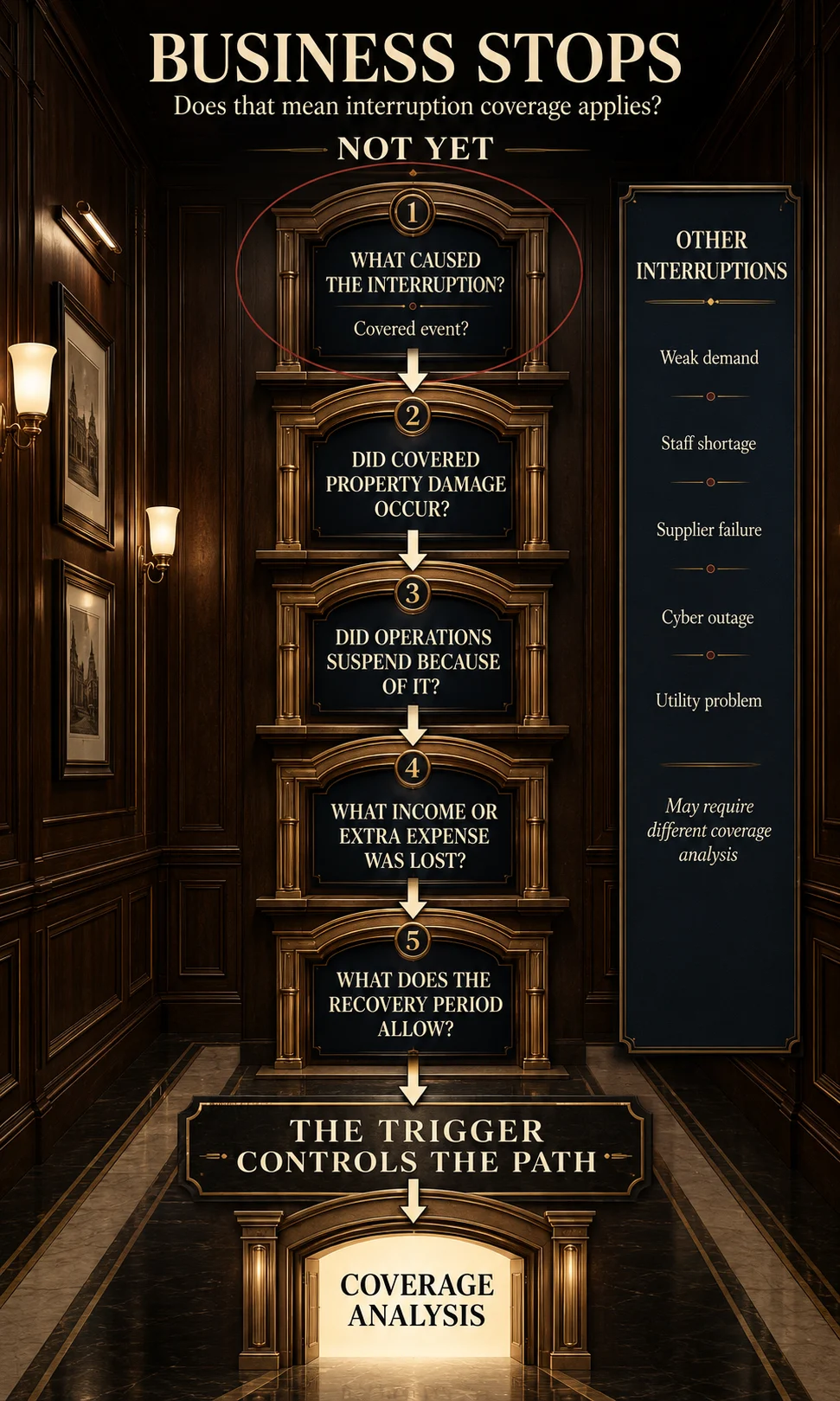
Business interruption or business income coverage is designed to address parts of this second problem when the policy’s trigger is satisfied.
The NAIC explains that business interruption insurance commonly addresses monetary losses during suspended operations following a covered event that causes physical property damage. Its current guidance also emphasizes that policy wording matters because interruption coverage does not respond to every reason a business might be unable to operate.
The Trigger Is More Important Than the Phrase “We Had to Close”
This is where many insurance discussions become too broad.
A business can temporarily close because of:
- physical damage
- equipment failure
- loss of utilities
- supplier problems
- government restrictions
- cyber events
- staffing problems
- weak demand
- construction nearby
- another disruption
Those events should not be assumed to trigger the same insurance coverage.
For traditional property-based business income coverage, the cause and circumstances of the shutdown are central to whether the policy responds.
The practical question is:
What covered event has to occur before this business income protection begins?
Then Ask What Happens During the Recovery Period
Once the trigger is understood, examine issues such as:
- how lost income is calculated
- which continuing expenses may be included
- whether extra expenses are covered
- whether there is a waiting period
- how long the restoration period can continue
- whether dependent property or supplier interruption is addressed
- what records the business would need to support a claim
A company that cannot reconstruct its normal revenue and expenses may have a much harder time demonstrating the financial effect of an interruption.
This makes recordkeeping part of insurance readiness, not merely an accounting task.
4. Workers Compensation Insurance
Workers compensation needs careful wording because requirements are jurisdiction-specific.
For private-sector employees in the United States, workers compensation systems are primarily administered at the state level. The U.S. Department of Labor directs employers and workers to the appropriate state workers compensation authorities for the rules that apply in their jurisdiction.
A business with employees should therefore verify the requirements where its workers are employed rather than relying on a generic national rule.
Workers compensation generally concerns work-related injury or occupational disease, but eligibility, employer obligations, exemptions and insurance mechanisms can vary.
Do Not Assume Worker Classification Solves the Question
A company using contractors rather than traditional employees should still examine its obligations carefully.
Calling somebody an independent contractor does not necessarily determine how every employment, tax or insurance rule will treat that relationship.
The relevant legal classification depends on the applicable law and circumstances, so businesses with uncertain worker arrangements should obtain jurisdiction-specific professional guidance.
Workers Compensation and General Liability Address Different Relationships
This distinction helps explain why a business may need both.
General liability often concerns claims involving customers, visitors or other third parties.
Workers compensation concerns eligible work-related employee injuries or occupational illnesses under the applicable system.
Treating one as a substitute for the other can create a significant misunderstanding of the coverage structure.
5. Commercial Auto Insurance
Vehicle exposure becomes important whenever vehicles are owned, leased or regularly used for business purposes.
The business should ask more than:
Do we have auto insurance?
It should determine:
Which vehicles, which drivers and which business uses are actually insured?
That issue becomes particularly important where:
- the company owns vehicles
- employees drive company vehicles
- employees use personal vehicles for business
- rented vehicles are used
- deliveries are performed
- customers or equipment are transported
- driving is a substantial part of the company’s service
A personal policy and a commercial policy can address different use patterns, limits and insured interests. The business should therefore disclose how vehicles are actually being used rather than choosing coverage around the cheapest description of that use.
The Vehicle Is Only One Part of the Exposure
Commercial auto risk also includes the driver, frequency of use, distance traveled, cargo, passengers, territory and the consequence of a serious accident.
A company with one vehicle driven occasionally between offices has a different exposure from a service company with ten vehicles on the road throughout the day.
The insurance decision should reflect the operating model rather than simply the number of vehicles registered to the business.
6. Professional Liability and Errors and Omissions Insurance
General liability and professional liability protect against different kinds of allegations. A customer slipping in an office and a client claiming that professional advice caused a financial loss may both lead to disputes, but they arise from different exposures.
Professional liability insurance, often called errors and omissions or E&O coverage in some industries, is designed for claims connected to professional services, errors, omissions, negligence or similar allegations within the scope of the policy. The SBA identifies professional liability insurance as a category for businesses that provide services to customers and describes it as protection against certain financial losses arising from malpractice, errors and negligence.
That makes this coverage particularly relevant to businesses where customers rely on expertise, judgment, design, recommendations, calculations or professional execution.
Examples can include:
- consultants
- accountants
- technology providers
- designers
- engineers
- marketing professionals
- agencies
- certain healthcare professionals
- other advisory or professional-service businesses
The policy still needs to match what the business actually does. A professional-services company can expand into new work while its insurance description remains based on what the company offered several years earlier.
The Insured Professional Service Matters
Suppose a company originally provides marketing consulting but later begins building customer software systems.
The business has changed.
Its professional exposure has changed with it.
An owner should therefore ask:
How does the policy describe our professional services, and does that description still match what customers are paying us to do?
This question becomes especially important when the business adds services through acquisition, expansion or a new business model. If your company is changing how professional work is sold, the guide to types of business models for services can help separate the commercial model from the underlying delivery exposure.
Claims Timing Can Matter
Professional liability policies may use claims-made structures, meaning the timing of the claim and the applicable policy period can become important to coverage.
Do not assume that having insurance when the work was originally performed automatically answers the question.
When reviewing a professional liability policy, ask about:
- whether coverage is claims-made or occurrence-based
- any retroactive date
- circumstances that must be reported
- what happens when changing insurers
- whether extended reporting options are available
- defense-cost treatment
- relevant exclusions
- limits and sublimits
These details can become especially important when a company changes insurer, sells the business or stops providing a particular professional service.
7. Product Liability Insurance
Businesses that manufacture, distribute, wholesale or sell physical products can face a different category of exposure when a product allegedly causes injury or damage.
Product exposure can remain relevant even when the business does not manufacture the item itself.
A retailer may sell it.
A distributor may move it through the supply chain.
A brand may outsource manufacturing.
An importer may bring it into the market.
The insurance review therefore should reflect the company’s actual role in getting the product to the customer.
Do Not Treat Product Risk as Only a Manufacturing Problem
Consider a company that imports home accessories manufactured by another company and sells them under its own brand.
The owner may think:
“We do not make the product, so the manufacturer carries the product risk.”
That conclusion may be too simple.
Contracts, jurisdiction, supply-chain relationships and the factual allegations can all matter. The business should understand its own exposure rather than relying solely on the fact that another company performed the manufacturing.
Ask What Happens After the Product Leaves Your Control
A useful product-risk review should consider:
- who designs the product
- who manufactures it
- who imports it
- who distributes it
- whose brand appears on it
- where it is sold
- whether installation is involved
- whether instructions or warnings are supplied
- whether products can be traced
- how recalls or complaints would be managed
Insurance is one part of that system. Supplier agreements, quality control, recordkeeping and product-risk procedures remain important because insurance does not remove the underlying operational problem.
8. Cyber Insurance
A modern small business can accumulate substantial digital exposure before it considers itself a technology company.
Customer information may be stored in cloud applications.
Employees may access company systems remotely.
Payments may depend on online platforms.
Email may control customer communication.
The business may rely on scheduling systems, accounting software, websites, domain registrations, online banking and third-party vendors.
A serious cyber event can therefore affect much more than a computer.
First-Party and Third-Party Cyber Exposure Are Different
A useful cyber review separates losses suffered directly by the business from claims or obligations involving other parties.
Depending on the policy, first-party considerations may involve categories such as:
- incident response
- system restoration
- data recovery
- interruption
- forensic investigation
- notification
- certain extortion-related costs
Third-party exposure may involve allegations or liability connected to customers, partners or others affected by the incident.
The exact categories vary considerably among policies.
The right question is therefore not:
“Do we have cyber insurance?”
It is:
“Which cyber events and resulting costs does this policy actually address?”
Cyber Insurance Should Sit Beside Cybersecurity, Not Replace It
Insurance can transfer part of a financial exposure, but it does not prevent the underlying event.
The Cybersecurity and Infrastructure Security Agency provides small and medium businesses with practical cybersecurity resources for protecting systems, people, customers and sensitive data. Those preventive controls remain relevant whether or not a cyber policy exists.
Businesses should examine areas such as:
- multifactor authentication
- access privileges
- backups
- software updates
- phishing controls
- administrator accounts
- incident response
- vendor access
- recovery procedures
Insurance and prevention should reinforce one another.
Check the Application as Carefully as the Policy
Cyber insurance applications may ask about security practices.
That information should be answered accurately.
If the business states that a particular control exists, someone should verify that it actually exists throughout the relevant systems rather than assuming the technology team has implemented it everywhere.
The policy review should therefore include both sides:
What did we tell the insurer about our controls?
and:
What does the policy say it will cover?
9. Employment Practices Liability Insurance
Once a company employs people, it develops another category of exposure around hiring, employment decisions, workplace conduct, discipline and termination.
Employment practices liability insurance, commonly abbreviated EPLI, is designed to address certain employment-related allegations subject to the policy’s terms.
Potential issues can involve allegations concerning:
- discrimination
- harassment
- retaliation
- wrongful termination
- certain hiring decisions
- other covered employment practices
The exact scope depends on the contract.
Insurance also does not replace compliance with employment law. The U.S. Equal Employment Opportunity Commission maintains a Small Business Resource Center explaining federal employment anti-discrimination responsibilities and how applicability can depend on factors including employer size and the particular law.
Employment Risk Often Changes Faster Than the Insurance File
A founder may originally employ three people.
Two years later, the company has 35 employees, several managers, remote workers and formal performance processes.
The employment exposure has changed substantially even though the insurance policy may still feel like an annual administrative renewal.
Growth should therefore trigger a fresh review of:
- employee count
- locations
- states or jurisdictions
- hiring practices
- management structure
- employee handbook
- disciplinary procedures
- complaint procedures
- prior allegations
- remote-work arrangements
The correct legal requirements are jurisdiction-specific, but the insurance principle is universal: changes in how people are employed can change the exposure being insured.
Procedures Matter Alongside Coverage
A policy cannot repair poor employment practices before they create a dispute.
Managers need to know how complaints are escalated.
Documents should be retained appropriately.
Employment decisions should follow the company’s applicable procedures and legal obligations.
Insurance belongs after those controls, not in place of them.
10. Directors and Officers Insurance
Directors and officers coverage, usually shortened to D&O, addresses certain liability exposures arising from decisions and actions of directors and officers within the policy’s scope.
This category becomes more relevant as governance becomes more complex.
A solo owner operating a simple business may have a very different need from a company with:
- outside investors
- a formal board
- multiple officers
- institutional funding
- significant creditors
- complex ownership
- nonprofit governance
- plans for acquisition or sale
The presence of the words “director” or “officer” in a job title does not by itself determine what coverage the business needs. The review should focus on the governance relationships and claims that could arise.
Ask Who Could Bring a Claim
Useful questions include:
- Are there outside shareholders?
- Are investors represented on the board?
- Could competitors, creditors or other parties bring management-related allegations?
- Does the organization have subsidiaries?
- Are directors serving on behalf of another entity?
- Is the entity itself covered for relevant claims?
- How are defense costs handled?
- Are there important exclusions?
D&O can be especially important around financing, acquisitions and complex ownership because management decisions can affect parties beyond ordinary customers.
It is still a specialized policy. Businesses considering it should review actual governance exposures with an appropriately qualified insurance professional.
11. Umbrella and Excess Liability Coverage
Sometimes the problem is not the absence of an underlying liability policy.
The problem is that the potential severity of a claim could exceed the available limit.
Commercial umbrella or excess liability coverage can provide additional liability capacity above specified underlying policies, subject to its own terms. The NAIC insurance glossary describes commercial umbrella and excess coverage as liability protection above amounts set by underlying coverage or specified retained amounts.
Suppose a company has a liability policy with a $1 million applicable limit but has operations where a severe claim could plausibly cost substantially more.
The owner may decide to examine additional liability limits.
That does not mean adding an umbrella automatically expands every policy underneath it.
Umbrella Does Not Mean “Everything Else Is Covered”
This misconception deserves explicit attention.
A commercial umbrella is not a bucket into which every uninsured business risk automatically falls.
A professional liability exclusion in an underlying structure may still matter.
Cyber exposure may require cyber coverage.
Employment claims may require separate consideration.
Property losses are fundamentally different from liability limits.
Before relying on umbrella or excess coverage, ask:
Which underlying policies does it sit above?
What limits must those underlying policies maintain?
Does the umbrella follow the underlying coverage exactly, or does it contain different terms?
Which categories remain excluded?
That is far more useful than knowing only the headline limit.
12. Home-Based Business Insurance
Working from home does not make business exposure disappear.
A home office may contain computers, equipment, inventory, samples or customer property. Clients may occasionally visit. Employees or contractors may work there. The company may store data and run commercial operations from the property.
The old assumption that a homeowner’s policy automatically addresses all of this should be treated carefully.
The important word is limited.
Ask the Home Insurer About the Actual Business Activity
Do not describe the operation vaguely as:
“I sometimes work from home.”
Explain what actually happens there.
For example:
- Is inventory stored?
- Do customers visit?
- Is specialized equipment used?
- Is merchandise shipped from the property?
- Are employees present?
- Is customer property stored?
- How much business equipment is there?
- Is the home address the company’s operating location?
Those facts help determine whether a homeowner endorsement, in-home business policy, BOP or other business coverage deserves consideration.
Remote Work Creates Another Version of the Question
The issue is not limited to founders.
Employees working from home may use company equipment, access sensitive data or conduct customer activity from residential locations.
A business with widespread remote work should therefore include home-working arrangements in its broader property, cyber and liability review.
What Is a Business Owner’s Policy?
A business owner’s policy, commonly called a BOP, packages several common small-business coverages into one policy.
This can simplify the insurance structure for businesses that fit the insurer’s eligibility and underwriting requirements.
It should not be interpreted as:
“We bought a BOP, so every business risk is insured.”
A BOP may still leave important exposures requiring separate consideration.
Depending on the company, those can include:
- workers compensation
- commercial auto
- professional liability
- cyber
- employment practices liability
- D&O
- specialized equipment or property
- higher liability limits
- other industry-specific coverage
A BOP Is a Package, Not an Insurance Strategy
The name describes packaging.
The business still needs to perform the same exposure analysis.
For every major potential loss:
Which BOP section responds?
If no section appears to respond, ask whether:
- the business intends to retain the risk,
- another policy is needed,
- the exposure can be reduced operationally,
- or the activity should be changed.
That turns a BOP from a purchasing shortcut into part of a deliberate risk-management structure.
Run the Business Insurance Coverage Gap Test
A useful insurance review should test scenarios rather than merely count policies.
Choose five to ten losses that would materially hurt the company.
For each scenario, identify the expected policy, applicable limit, deductible or retention, important exclusion question and the amount the company might still need to finance itself.
| Coverage Gap Test | What to Record | Why It Matters |
|---|---|---|
| Loss scenario | Describe the event in plain language. | Prevents the review from becoming a list of policy names. |
| Expected policy | Identify which policy is expected to respond. | Reveals exposures with no obvious coverage path. |
| Trigger | Record what must happen before coverage applies. | Helps expose assumptions about interruption, cyber and other conditional coverages. |
| Limit | Record the relevant limit and any known sublimit. | A covered loss can still exceed available insurance. |
| Deductible / retention | Record the amount the business may need to fund first. | Tests whether the business has enough liquidity during a claim. |
| Exclusion question | Identify the exclusion or condition most likely to affect the scenario. | Makes hidden coverage assumptions visible before a loss. |
| Uninsured remainder | Estimate what the company could still need to absorb. | Connects insurance back to cash reserves and risk tolerance. |
This is not a substitute for reading the contract or obtaining professional advice. Its value is that it changes the renewal conversation from:
“Should we keep the same insurance?”
to:
“Does our current insurance structure still address the losses we actually care about?”
Business Insurance Coverage Gap Checker
Map the exposures created by your actual operations before you review policy names. The checker highlights insurance categories worth discussing, possible coverage questions, realistic loss scenarios, and documents to bring to your next policy review.
A Certificate of Insurance Is Evidence, Not the Policy
Businesses are frequently asked to provide certificates of insurance to landlords, clients, contractors or other counterparties.
A certificate can be useful evidence that specified insurance was in force when the certificate was issued.
It should not be treated as a replacement for the underlying contract.
The business still needs to understand:
- the actual policy
- applicable limits
- endorsements
- additional insured requirements
- cancellation provisions
- contractual insurance requirements
- whether the required coverage actually applies to the relevant activity
A contract can require insurance terms that a standard certificate alone does not create.
Additional Insured Status Should Be Verified Properly
Business contracts sometimes require one party to be added as an additional insured under another party’s liability coverage.
The phrase appears frequently enough that owners can begin treating it as routine paperwork.
It deserves more care.
Ask:
- Which policy requires the additional insured?
- For which activity?
- Is the status provided by a specific endorsement?
- Does it apply to ongoing operations, completed operations or both where relevant?
- What does the contract actually require?
These questions are usually best reviewed with the insurance professional and, where contractual interpretation matters, appropriate legal counsel.
Your Insurance Renewal Should Start Before the Premium Quote Arrives
A renewal is an opportunity to update the insurer’s picture of the company.
The business may have changed materially since last year.
You may now have:
- more employees
- more revenue
- a new location
- different inventory
- additional vehicles
- new professional services
- larger contracts
- more customer data
- international customers
- new equipment
- remote employees
- different suppliers
- a new corporate structure
If the coverage remains static while the company changes, a gap can emerge gradually.
Use a Business Change Checklist
Before renewal, compare the current company with the company described when the policy was originally purchased.
Ask:
What do we do now that we did not do then?
What do we own now that we did not own then?
Who works for us now?
Which new contractual obligations have we accepted?
Where do we operate?
What systems or data have become critical?
Which customer could create the largest liability exposure?
What has become more expensive to replace?
That conversation is usually more valuable than negotiating premium before the exposure has been updated.
Common Business Insurance Mistakes
Mistake 1: Buying Insurance by Policy Name Alone
Knowing that you own “liability insurance” is insufficient.
Know what type of liability, which operations are insured, what limits apply and which exclusions matter.
Mistake 2: Assuming Every Business Interruption Is Insured
A company can lose revenue for many reasons.
Traditional business income coverage generally requires a specified covered trigger under the policy.
The words “business interruption” do not mean every interruption automatically qualifies.
Mistake 3: Letting Property Values Become Outdated
Equipment, inventory and rebuilding costs can change.
A property schedule created several years earlier may no longer reflect the assets the company needs to replace.
Mistake 4: Ignoring New Services
A company can begin offering consulting, installation, design, software, delivery or another service without revisiting how the activity changes its insurance exposure.
Revenue growth can therefore create coverage drift.
Mistake 5: Assuming a Home Policy Covers the Business
Working from home does not automatically make commercial property, liability or cyber exposure part of ordinary personal coverage.
The actual homeowner’s or renter’s policy and any business endorsements need to be reviewed.
Mistake 6: Treating Cyber Insurance as a Security Program
Insurance helps address financial consequences.
Security controls help reduce the likelihood or severity of the incident itself.
A healthy risk structure considers both.
Mistake 7: Buying the Lowest Premium Without Comparing the Coverage
Two quotes can contain different limits, deductibles, exclusions, endorsements and scope.
Premium should be compared alongside those differences rather than in isolation.
Mistake 8: Never Reassessing Coverage After Growth
Insurance purchased when the company had two employees and $200,000 of revenue may no longer fit the same company after it grows to 30 employees, multiple locations and several million dollars of revenue.
Growth should trigger exposure review.
Use the Five-Part Business Insurance Decision Framework
When reviewing any business insurance policy, move through five stages.
1. Identify
What loss could materially hurt the company?
2. Prevent
What operational control can reduce the likelihood or severity?
3. Transfer
Which part of the remaining financial exposure can reasonably be transferred through insurance or another contractual mechanism?
4. Verify
Does the actual policy wording, limit, deductible, endorsement and exclusion structure address the expected loss?
5. Finance the Remainder
What portion of the exposure will still remain with the business?
That final step is important because no insurance program transfers every commercial risk.
Weak demand is still the company’s problem.
Poor pricing is still the company’s problem.
A bad business model is still the company’s problem.
Insurance works best when it is used to transfer specific financial consequences that the company has deliberately identified, rather than as a substitute for business risk management.
The Best Insurance Question Is “What Happens If This Occurs Tomorrow?”
Insurance becomes much more practical when the discussion begins with scenarios.
What if a customer is seriously injured?
What if the largest piece of equipment is destroyed?
What if operations stop after a covered property event?
What if an employee suffers a work-related injury?
What if a customer alleges a professional mistake?
What if a cyber incident takes systems offline?
What if a major liability claim exceeds the primary limit?
For each scenario, the business should be able to identify:
the expected policy → the trigger → the relevant limit → the amount it must retain → the biggest exclusion question → the operational response
If those answers are unclear, the next step is not automatically to buy another policy.
The next step is to clarify the exposure with the appropriate broker, agent, insurer, risk professional or legal adviser and determine whether the current insurance structure actually matches what the business believes it has protected.
That is the difference between owning business insurance and understanding the protection the business has purchased.
Frequently Asked Questions About Business Insurance Policies
What business insurance does a small business usually need?
There is no single insurance package that every small business needs. The appropriate coverage depends on the company’s property, employees, vehicles, customers, professional services, products, data, contracts and potential liability exposures. Common categories to examine include general liability, commercial property, business income, workers compensation, commercial auto, professional liability, cyber insurance and umbrella or excess liability, with additional specialized policies considered when the business has those exposures.
What does general liability insurance cover for a business?
General liability insurance commonly addresses certain third-party claims involving bodily injury, damage to another person’s property and some personal or advertising injury allegations, subject to the policy’s terms. It should not be assumed to cover every business loss. Professional mistakes, employee injuries, damage to the company’s own property, cyber incidents and other exposures may require different coverage.
What is the difference between general liability and professional liability insurance?
General liability primarily addresses certain third-party bodily injury, property damage and related liability allegations, while professional liability or errors and omissions coverage focuses on claims arising from professional services, mistakes, negligence or omissions within the policy’s scope. A consulting, design or other professional-service business may therefore have both exposures because an accident at its premises and an allegation about its professional work are different kinds of claims.
What does commercial property insurance protect?
Commercial property insurance can protect insured buildings, equipment, inventory, furniture, tools and other business property against covered causes of loss. The actual protection depends on the property listed or otherwise covered, the causes of loss insured, valuation terms, limits, deductibles and exclusions. A business should therefore inventory important assets and understand how the policy would value a covered loss rather than relying only on the total policy limit.
What is business interruption insurance?
Business interruption or business income coverage can address certain lost income and continuing expenses when operations are suspended because an event satisfies the policy’s coverage trigger. Traditional property-based business income coverage is generally connected to covered physical property loss, so a business should not assume that every shutdown or revenue decline is insured. The cause of the interruption, waiting periods, restoration period, limits and policy language all matter.
Is business interruption insurance included in a business owner’s policy?
Business income or interruption protection is commonly included as part of many business owner’s policies, along with commercial property and general liability coverage. The exact package varies by insurer and policy, so the owner should verify the coverage section, limits, waiting periods, covered causes of loss and other conditions rather than assuming every BOP provides identical protection.
What is a business owner’s policy or BOP?
A business owner’s policy, commonly called a BOP, packages several coverages commonly needed by eligible small businesses. It often combines general liability, commercial property and business income coverage into one policy. A BOP does not automatically cover every business exposure, so workers compensation, professional liability, commercial auto, cyber insurance, employment practices liability or other specialized coverage may still need separate consideration.
Does a small business need workers compensation insurance?
Workers compensation requirements depend on the jurisdiction, type of employer, workforce and applicable law. In the United States, workers compensation for most private-sector employees is primarily administered through state systems, so a business should verify the rules in each state where it employs people. Owners should not rely on a generic employee-count threshold because requirements and exemptions can differ.
Do independent contractors need to be included in workers compensation insurance?
The answer depends on worker classification rules and the law that applies in the relevant jurisdiction. Simply calling someone an independent contractor does not necessarily determine how that relationship will be treated for every employment, tax or insurance purpose. Businesses using contractors should verify applicable classification and workers compensation requirements rather than assuming that the contract label alone resolves the issue.
When does a business need commercial auto insurance?
Commercial auto insurance should be examined when vehicles are owned, leased or used as part of business operations. The important questions include which vehicles are insured, who drives them and what business activities they are used for. Owners should also verify situations where employees use personal or rented vehicles for work because a personal auto policy should not automatically be assumed to cover every commercial use or business liability exposure.
Who needs professional liability or errors and omissions insurance?
Professional liability or errors and omissions insurance is particularly relevant to businesses whose customers rely on expertise, advice, design, recommendations, calculations or professional execution. Consultants, designers, agencies, technology providers, accountants and many other professional-service businesses may have this exposure. The policy should describe professional activities broadly enough to reflect what the business actually provides today rather than only the services it offered when the policy was first purchased.
Does a retailer need product liability insurance if it does not manufacture the products?
A retailer, distributor, importer or brand owner can still have product-related exposure even when another company manufactured the item. The business’s role in the supply chain, contracts, jurisdiction and allegations can all affect liability. Companies selling physical products should therefore examine their product liability exposure rather than assuming that responsibility automatically ends with the manufacturer.
Does a small business need cyber insurance?
Cyber insurance deserves consideration when a business depends on digital systems, stores customer or employee information, accepts electronic payments, relies on cloud software or could suffer meaningful financial loss from a cyber incident. Policies vary substantially, so the business should examine which first-party response costs and third-party liabilities are included. Insurance should complement cybersecurity controls and recovery procedures rather than replace them.
What is the difference between first-party and third-party cyber insurance?
First-party cyber coverage generally concerns losses or response costs experienced directly by the insured business, which can include categories such as data recovery, incident response, notification, interruption or certain cyber extortion costs depending on the contract. Third-party coverage generally concerns liability arising when customers, partners or other parties bring claims connected to a cyber event. Businesses should review the actual policy because included costs, exclusions and limits vary.
Does a home-based business need separate insurance?
A home-based business should not assume that a standard homeowner’s or renter’s policy provides all the commercial property and liability protection it needs. Business equipment, inventory, customer visits, employees, specialized activities and other commercial exposures may require an endorsement, in-home business policy, business owner’s policy or another arrangement. The owner should describe the actual business activity to the insurer and verify what the personal policy does and does not cover.
What is umbrella insurance for a business?
Commercial umbrella or excess liability coverage can provide additional liability limits above specified underlying insurance, subject to the umbrella or excess policy’s own terms. It should not be interpreted as coverage for every loss excluded elsewhere. Businesses should identify which underlying policies the additional limit sits above, which minimum limits must be maintained and whether exclusions differ from the underlying insurance.
What is an insurance deductible for a business?
A deductible is an amount that remains the insured business’s responsibility under the applicable policy terms before or as insurance responds to a covered loss. Some policies can use different forms of deductibles or self-insured retentions. A business should understand the applicable amount and maintain enough liquidity to absorb it because a deductible may become payable while the company is already dealing with the financial consequences of the event.
What is an insurance policy limit?
A policy limit establishes the maximum amount of insurance available under the applicable coverage, subject to the contract. Policies may contain per-occurrence limits, aggregate limits, sublimits or other structures. Having coverage therefore does not necessarily mean the entire financial loss will be paid if the covered loss exceeds the relevant limit.
What is an insurance exclusion?
An exclusion removes specified circumstances, losses, activities or exposures from coverage that might otherwise appear to fall within a broad policy description. Endorsements can also modify the original policy language by adding, removing or changing coverage. This is why comparing only policy names and premiums can create a misleading impression that two policies provide equivalent protection.
What is a certificate of insurance?
A certificate of insurance is commonly used as evidence of specified insurance information at the time the certificate is issued. It is not a substitute for the policy itself and should not be assumed to create coverage that the underlying contract does not provide. Businesses should still verify applicable endorsements, limits and contractual insurance requirements when those details matter to a commercial agreement.
What does additional insured mean in business insurance?
Additional insured status generally means another person or organization receives specified protection under an insurance policy for circumstances described by the relevant policy language or endorsement. Commercial contracts frequently require this status for particular activities or relationships. The business should verify the actual endorsement and scope rather than assuming that mentioning the party on a certificate automatically creates the protection required by the contract.
How often should a business review its insurance policies?
A business should review insurance at renewal and when material operations change rather than treating coverage as a static annual purchase. New locations, employees, vehicles, services, products, equipment, revenue, contracts, customer data or ownership structures can alter the company’s exposure. A significant change is a reason to discuss coverage when it happens instead of automatically waiting for the next scheduled renewal.
How should I compare business insurance quotes?
Compare more than the premium. Review the coverage form, limits, deductibles or retentions, sublimits, exclusions, endorsements, covered operations, locations and important policy conditions. A cheaper quote may represent better value in some circumstances, but a lower premium is not meaningful unless the business also understands how the protection differs from the alternatives.
Can business insurance cover every risk a company faces?
No. Insurance is designed to transfer specified financial exposures under defined policy terms, not every form of business uncertainty. Weak customer demand, poor pricing, an unsustainable business model, ordinary competitive pressure and many strategic mistakes remain business risks rather than losses automatically solved by insurance. A sound risk-management process identifies what can be prevented, what can reasonably be insured and what the company must continue to finance or manage itself.
What should I ask my insurance agent or broker before buying a policy?
Describe the business’s most important loss scenarios and ask which policy would be expected to respond to each one. Then ask about the trigger, applicable limit, deductible or retention, important exclusions, endorsements and any portion of the loss likely to remain uninsured. This approach produces a more useful discussion than asking only whether the business has liability, property, cyber or another policy by name.
business has liability, property, cyber or another policy by name.