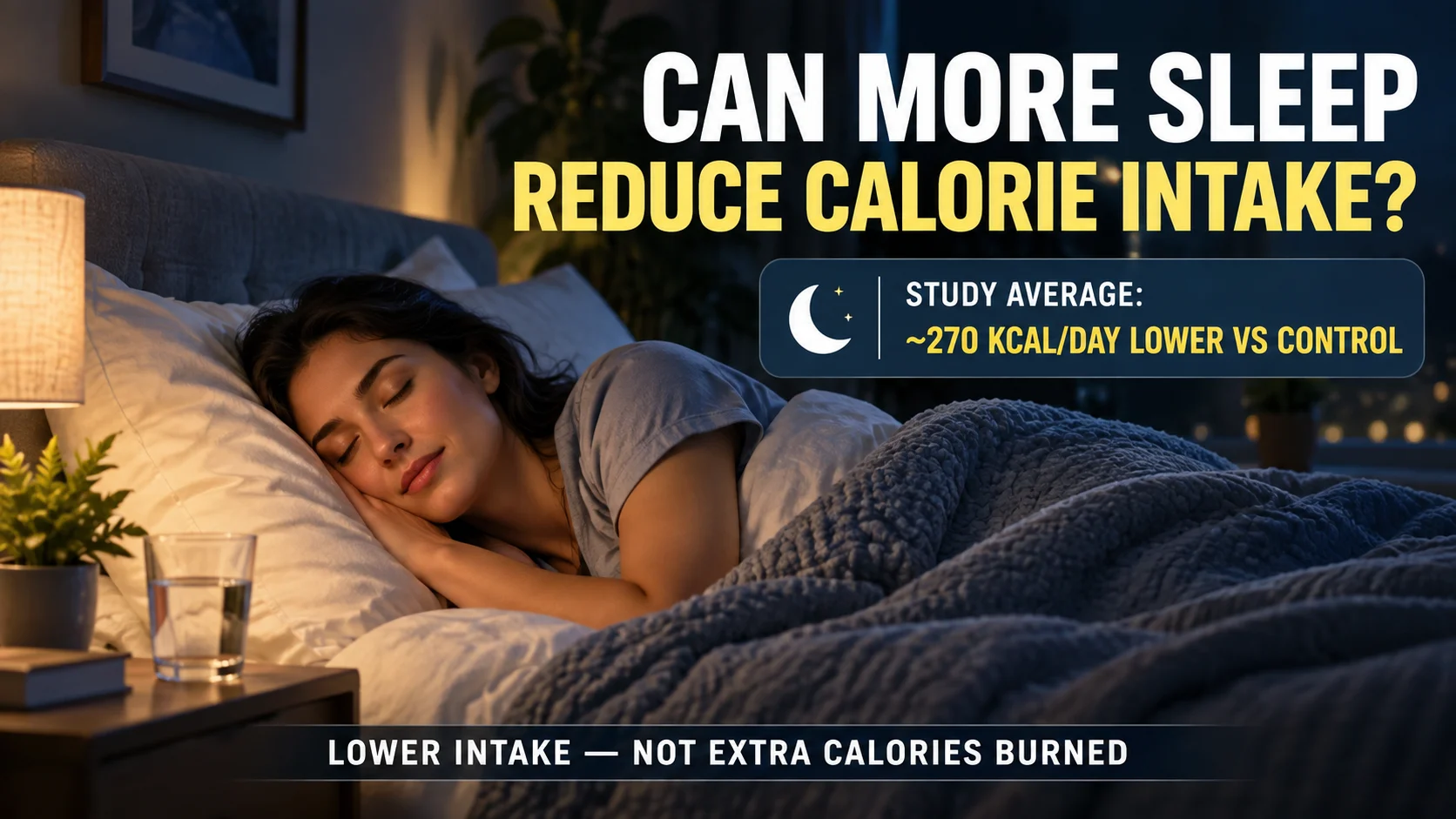

Sleeping longer may reduce how much some short-sleeping adults eat, but the often-quoted “nearly 300 calories a day” figure is a study average, not a guaranteed personal result. In a randomized trial, adults with overweight who usually slept less than 6.5 hours increased their sleep by about 1.2 hours and consumed about 270 fewer calories per day than the control group over two weeks.
The useful takeaway is not that sleep “burns” 270 calories. The trial found lower energy intake, while total energy expenditure did not change significantly, so the likely benefit was that better-rested participants ate less without being prescribed a diet.
What the “270 calories” study actually found
The result comes from a randomized clinical trial of 80 adults ages 21 to 40 with BMI values from 25.0 to 29.9 who habitually slept less than 6.5 hours per night. Participants lived normally at home and were not given a prescribed diet or exercise program. The sleep-extension group received individualized sleep-hygiene counseling intended to extend time in bed to 8.5 hours, while the control group continued its usual sleep pattern.
| Study detail | What it means |
|---|---|
| 80 adults with overweight and habitual sleep under 6.5 hours | The result applies most directly to people resembling this group, not to every adult. |
| Sleep increased by about 1.2 hours per night | The intervention created a meaningful sleep change rather than a few extra minutes. |
| Energy intake was about 270 kcal/day lower than control | This was a between-group effect, not a promise that each person will eat exactly 270 fewer calories. |
| No significant treatment effect on total energy expenditure | The study points toward eating less, not suddenly burning hundreds of extra calories during sleep. |
| Intervention lasted two weeks | Long-term weight effects cannot be calculated by multiplying 270 by months or years. |
The JAMA Internal Medicine trial objectively assessed energy intake using energy-expenditure and body-energy-store measurements rather than relying only on food diaries. That strengthens the finding, but the sample and short intervention still limit how far the number should be generalized.
Why more sleep could change how much you eat
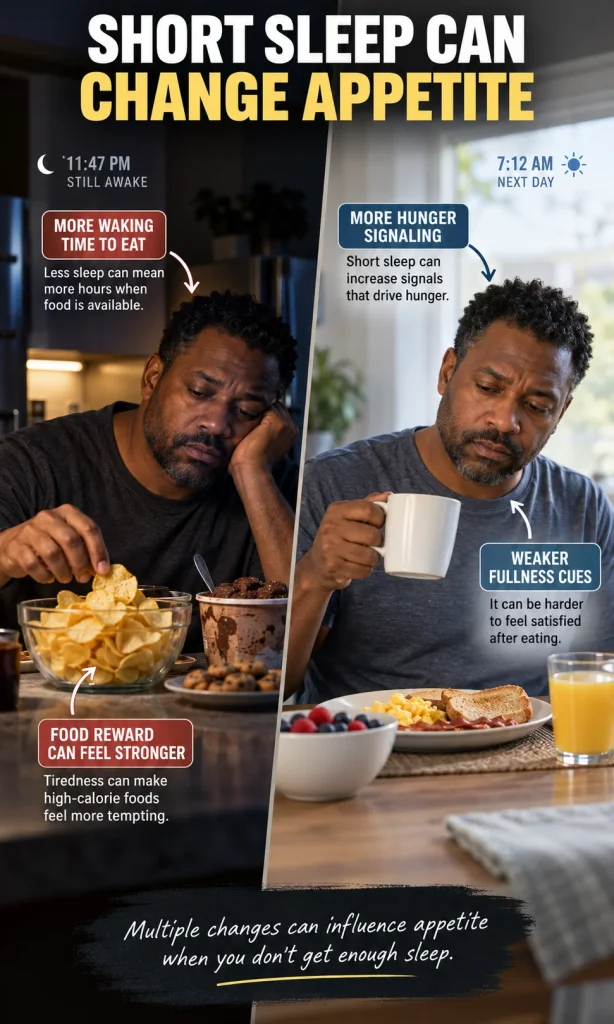
Sleep affects systems that help regulate hunger, fullness, reward and food choice. The National Heart, Lung, and Blood Institute notes that sleep deficiency can disturb hormones involved in hunger and satiety, including ghrelin and leptin. A tired brain also has more waking hours in which food is available, while fatigue can make convenient, energy-dense food more appealing.
No single mechanism explains every person’s response. Some people may notice fewer late-night snacks, some may feel less intense hunger the next day, and others may see little obvious appetite change. The important point is that sleep can influence eating behavior through several pathways at once rather than acting like a calorie-burning exercise.

Sleep Extension Check
See your current sleep gap, a realistic bedtime target, and how closely your situation matches the study behind the “270 calories” headline.
You are below your selected sleep target.
Calculated from your wake time and selected sleep target.
The original trial involved adults ages 21-40 with overweight who usually slept under 6.5 hours.
The trial’s ~270 kcal/day result was a group average over two weeks. This experience intentionally does not multiply that number into personal weight-loss claims.
Sleep Extension Check - Personal Summary
A decision aid for sleep duration - not a diagnosis, calorie prescription or weight-loss forecast.
What the study found
In an 80-person randomized trial, adults with overweight who habitually slept under 6.5 hours increased sleep by about 1.2 hours and had about 270 kcal/day lower energy intake than control over two weeks. Energy expenditure did not significantly change.
Your study-match context
The trial population may only partly resemble you, so its calorie result should not be treated as your expected outcome.
Practical next steps
- Keep wake time reasonably stable.
- Move bedtime earlier in 15-30 minute steps if needed.
- Track sleep duration, late-night eating, hunger and daytime alertness for 2-4 weeks.
- Seek medical advice for loud snoring, gasping, severe daytime sleepiness or persistent insomnia.
Educational use only. Healthy sleep depends on duration, quality, timing, regularity and untreated sleep disorders.
The study did not prove that everyone will lose weight by sleeping more
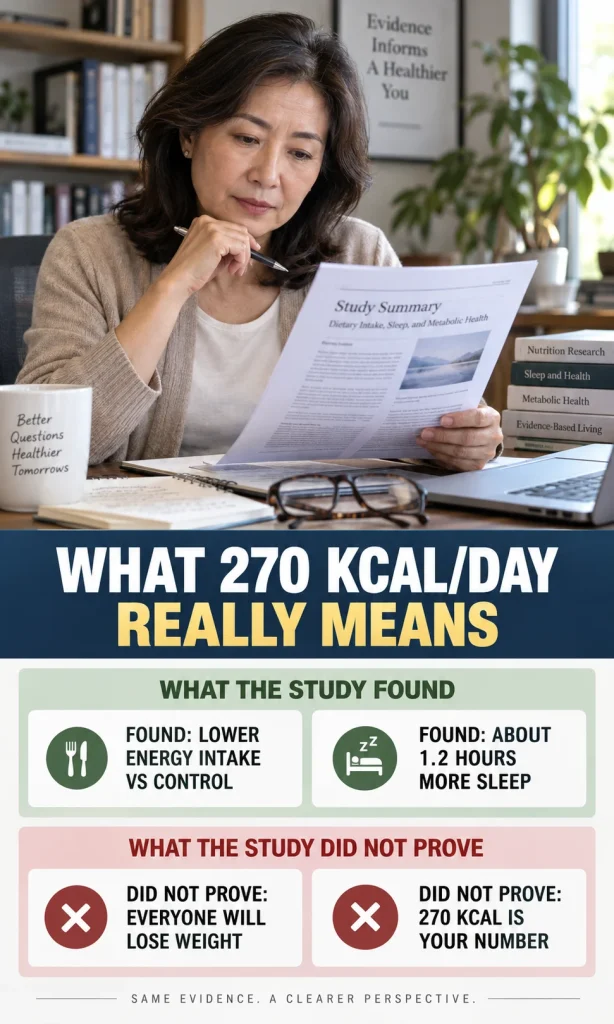
The headline number becomes misleading when it is treated as a universal rule. Participants were young-to-middle-aged adults with overweight who were already short sleepers. Someone who already sleeps enough, has a sleep disorder, takes appetite-affecting medication, works rotating shifts, or has another medical condition may respond differently.
- Do not multiply 270 calories into a long-term weight-loss forecast. Energy balance adapts over time, and the study lasted only two weeks.
- Do not assume 8.5 hours is the required sleep target for everyone. The intervention used an 8.5-hour time-in-bed goal to help participants extend sleep.
- Do not interpret the result as permission to ignore diet quality or activity. Sleep is one part of weight management, not a replacement for nutrition and movement.
- Do not force extra time in bed when sleep quality is poor. Persistent insomnia, loud snoring, gasping, marked daytime sleepiness or suspected sleep apnea deserves medical evaluation.
How much sleep should an adult aim for?
For healthy adults, a widely used clinical recommendation is at least 7 hours of sleep per night on a regular basis. Individual needs vary, and healthy sleep also depends on quality, timing, regularity and the absence of untreated sleep disorders – not duration alone.
The AASM and Sleep Research Society consensus statement recommends 7 or more hours for adults, while the NHLBI emphasizes that sleep quality and regularity matter alongside duration. If your current average is well below that range, extending sleep gradually is a more defensible target than chasing a specific calorie reduction.
A practical way to test whether sleep extension helps you
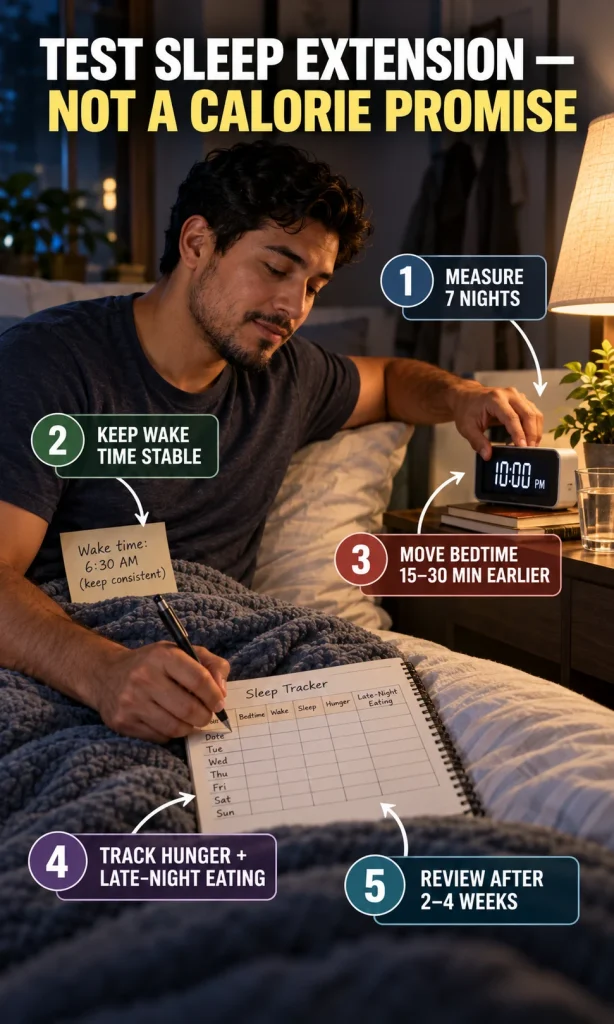
Treat sleep extension as a behavior experiment, not a calorie prescription. Keep your wake time reasonably stable, move bedtime earlier in small increments, and watch whether hunger, late-night eating, daytime energy and food choices change over several weeks.
- Measure your real baseline. Use at least 7 nights, including workdays and days off, rather than guessing from one good night.
- Choose a realistic wake time. Work backward to create enough time in bed for your target sleep duration.
- Move bedtime earlier gradually. A 15- to 30-minute shift is often easier to sustain than suddenly adding two hours.
- Protect the last hour before bed. Reduce bright light, stimulating work and late caffeine if they are delaying sleep.
- Track behavior, not just body weight. Note late-night snacks, morning hunger, afternoon cravings, energy and sleepiness.
- Review after 2 to 4 weeks. If you cannot extend sleep despite enough time in bed, look for insomnia, schedule conflicts or symptoms of a sleep disorder.
A short daily walk can support both general health and sleep routines, and it may be easier to sustain than trying to overhaul everything at once. See our guide to the benefits of walking and easy ways to make it a habit.
What matters more than the exact calorie number
The most useful result of this research is that sleep can change energy intake in ordinary life without participants being told to diet. That makes sleep an appealing support behavior because it may reduce one source of friction: trying to manage appetite while chronically tired.
Still, sleep does not determine food quality. If better rest reduces cravings but your meals remain low in protein, fiber or minimally processed foods, weight-management progress may still be difficult. For a broader nutrition reset, use our guide on how to clean up your diet rather than chasing one isolated calorie target.
When more sleep is not the main solution
If your sleep duration is already adequate but you remain very sleepy, wake repeatedly, snore loudly, gasp during sleep or struggle to function during the day, adding more time in bed may not solve the underlying problem. Sleep apnea, insomnia, restless legs, circadian-rhythm disorders, medications, alcohol use and medical conditions can all reduce sleep quality or alter appetite.
Seek medical advice when sleepiness affects driving or safety, when breathing pauses are witnessed, or when sleep problems persist despite enough opportunity to sleep. Weight changes that are rapid, unexplained or accompanied by other symptoms also deserve clinical assessment rather than self-experimentation alone.
Bottom line
Sleeping longer is not a guaranteed way to cut 300 calories every day, but the underlying randomized trial gives good reason to take chronic short sleep seriously in weight-management plans. For adults who routinely sleep too little, creating enough time for at least 7 hours of regular, good-quality sleep is a sensible health target even if their personal calorie intake changes by far less than 270 calories.
Frequently Asked Questions
1. Does sleeping more burn 270 extra calories?
No. The trial found a lower daily energy intake in the sleep-extension group compared with control, while total energy expenditure did not significantly change. The result is better described as “participants ate less,” not “sleep burned 270 calories.”
2. How much more sleep did the participants get?
The sleep-extension group increased sleep by about 1.2 hours per night on average. Their counseling aimed to extend time in bed to about 8.5 hours, but that does not mean every adult needs exactly 8.5 hours.
3. Can I use 270 calories a day to estimate my weight loss?
No. The 270-calorie figure was an average between-group effect in a short trial. Long-term energy balance adapts, and individual sleep, appetite, body composition, activity and health conditions differ.
4. Is seven hours of sleep enough?
Seven hours is a commonly recommended minimum for healthy adults, but individual needs vary. Sleep quality, timing, regularity and untreated sleep disorders also matter.
5. What if I spend enough time in bed but still feel exhausted?
Persistent sleepiness despite enough sleep opportunity can point to poor sleep quality, schedule problems, medication effects or a sleep disorder. Discuss persistent symptoms with a qualified healthcare professional.