

Growing up under rigid rules can leave adults unusually alert to criticism, hesitant to make choices, or unsure whether their own needs are reasonable. Those patterns are possible adaptations to a childhood environment, not proof that your parents caused every difficulty you have now or that you have a disorder. The useful question is which response still shows up today and whether it helps you.
Strictness by itself does not tell the whole story. Firm limits paired with warmth, explanation, and room for age-appropriate independence differ from control built on fear or humiliation; the American Psychological Association’s overview of parenting styles makes that distinction. Research links authoritarian parenting with some less favorable emotional outcomes, but associations do not establish an individual person’s cause or destiny.

What might carry into adult life?
| Earlier experience | Possible adult response | What to notice now |
|---|---|---|
| Mistakes brought harsh criticism | Perfectionism or excessive checking | Does a small error feel like a threat to your worth? |
| Disagreement was punished | Difficulty saying no | Do you agree before considering your own limits? |
| Choices were made for you | Decision hesitation | Do you seek permission for ordinary decisions? |
| Affection seemed conditional | Fear of disappointing others | Does approval feel necessary before you can relax? |
These examples are prompts for reflection, not a checklist that diagnoses your upbringing. Some people from strict homes become confident and self-directed; others struggle for reasons that also include temperament, relationships, culture, later experiences, and current stress. A community study spanning adolescence through later adulthood found worse average socialization outcomes associated with authoritarian parenting in its sample, while its authors also discussed cultural and contextual limits: read the research and its limitations.
Why the old response can feel automatic
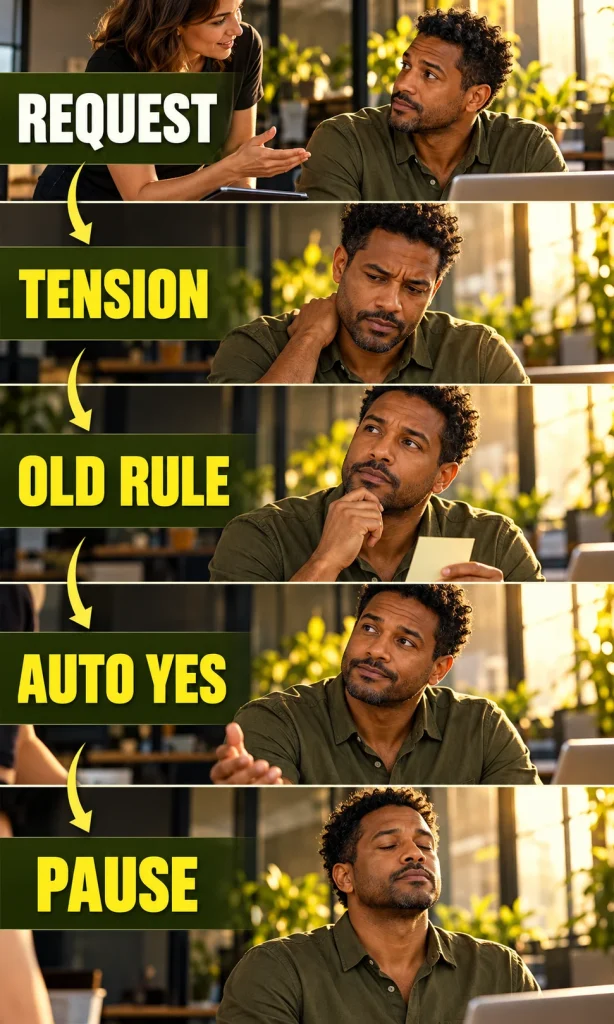
A child who learns that speaking up leads to conflict may become skilled at reading other people’s reactions. That skill can remain useful in some settings, yet become costly when every harmless disagreement feels dangerous. The adult may understand intellectually that saying “I need time to think” is safe and still feel an immediate urge to comply.
Look for the sequence rather than judging yourself: situation, body reaction, thought, action, and aftermath. For example, a manager asks for an extra task; your shoulders tighten; you think “they’ll be angry if I refuse”; you say yes; then you feel resentful and exhausted. Naming the sequence gives you a point where you can try something different.
Pattern Reflection Studio
Notice an old rule, then plan one safe, small alternative.
Your answers stay in this browser tab. This exercise is not a diagnosis or clinical assessment.
How to change one pattern without forcing a confrontation
- Name a specific moment. Choose a recent low-stakes example, not a verdict on your whole childhood.
- Separate past rule from present reality. Write what you learned, then ask what the current person actually said or did.
- Try a small alternative. Pause before answering, express a mild preference, or decline one manageable request.
- Review the outcome. Record what happened, how uncomfortable it felt, and whether your feared result occurred.
Small experiments can build confidence without requiring you to label a parent or settle every memory. If a boundary could expose you to retaliation, financial harm, or violence, prioritize safety and support rather than trying an unsupervised experiment. You can explore negative self-talk or perfectionism and mental health as separate patterns without assuming either proves a particular cause.

When support would help
Consider a licensed mental health professional if anxiety, shame, relationship conflict, or avoidance repeatedly interferes with work or daily life. Therapy can help examine learned beliefs and rehearse safer choices; its aim is not to force forgiveness or estrangement. If you are currently being threatened or harmed, contact a local emergency service or domestic violence support service appropriate to your location.
Frequently asked questions
Does strict parenting always harm someone?
No. The degree of warmth, flexibility, safety, and autonomy matters, as do cultural context and other relationships. You cannot predict an individual’s adult outcome from a parenting label alone.
Can I have a good relationship with my parents and still change these habits?
Yes. You can practice choosing, resting, or setting limits without deciding that every part of your childhood was harmful. A changed adult response does not require a single judgment about your family.
Is being afraid of mistakes a diagnosis?
No. Fear of mistakes is an experience shared across many situations and has many possible causes. Seek a qualified assessment if it causes substantial distress or impairment.
Next step: Choose one low-stakes situation this week. Notice the rule you hear in your head, pause, and decide whether the rule still fits the life you have now.