


A successful shade garden starts by matching plants to the actual light pattern, soil moisture and root competition in the site, not by buying anything labeled “shade tolerant.” The same low-light yard can contain dry shade under mature trees, damp shade beside a wall, bright open shade and brief periods of hot afternoon sun, and each condition asks for a different planting strategy. Read the site first, then build the design around plants that fit it.
The fastest way to improve a shady bed is to separate two questions that are often mixed together: how much direct light reaches the bed, and how much water remains available to roots. A dark-looking area is not automatically moist, and a cool north-facing wall is not the same environment as soil packed with thirsty tree roots.
Start by reading the site, not shopping for plants
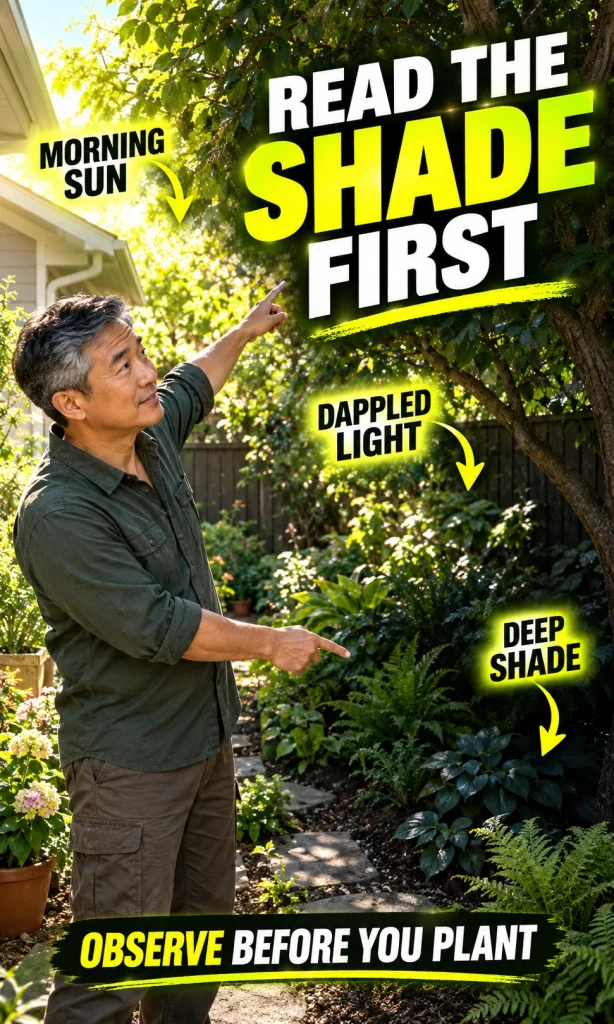
Observe the bed at several points during the day before you commit to a plant list. Morning light, midday light and late-afternoon light do not have the same intensity, and the pattern can change as buildings, deciduous canopies and seasonal sun angles shift. NC State Extension’s guidance on visualizing shade patterns is a useful reminder that direct observation is more accurate than assuming a spot is “full shade” because it looks dim at one moment.
Also identify what creates the shade. A building can block direct sun without taking water from the soil, while a mature tree can reduce light and compete aggressively for moisture at the same time. RHS shade-gardening guidance makes this distinction clear: tree shade is often associated with drier soil because roots are using the same water your new plants need.
Pay attention to when the strongest light arrives. A bed that receives gentle morning sun may support plants that scorch in equally long exposure to intense afternoon sun, especially in hot climates. Instead of treating “three hours of sun” as a complete diagnosis, record the time, intensity and season as well as the duration.
Then check the soil below the surface rather than judging by color alone. A bed can look dry on top while holding plenty of moisture lower in the profile, so use the same root-zone thinking described in how long soil should stay wet after watering. If the site stays wet for long periods, drainage may matter more than shade tolerance.
Under trees, the root system is part of the design brief. Many important absorbing roots occupy the upper soil layers, so deep digging, trenching or changing soil depth around established trees can create unnecessary stress. Illinois Extension’s explanation of tree root zones is useful background before planting beneath mature canopies.
Finally, note the available width and height, existing paths, roof overhangs, downspouts, fences and places where people actually move. Shade gardens often fail visually because plants were chosen one by one without enough space for their mature size or a clear route through the bed. A few minutes measuring the site prevents years of crowding and awkward maintenance.
| Site condition | What it usually means | Design priority | Main failure to avoid |
|---|---|---|---|
| Dappled shade + average moisture | Moving light, broad plant choice | Layer foliage, flowers and ground cover | Ignoring hotter sun patches |
| Dry shade under trees | Low light plus root competition | Use robust dry-shade plants and minimal soil disturbance | Digging heavily through established roots |
| Damp shade | Low evaporation, heavier soil or naturally moist position | Choose moisture-compatible plants and protect drainage | Using plants that need dry, airy roots |
| Deep or dense shade | Very limited direct light | Prioritize foliage, texture and structure | Expecting sun-level flowering |
Use light and moisture together to choose the planting palette
Plant labels are useful, but they are only a starting point because terms such as partial shade, open shade, filtered shade and deep shade are not applied identically in every guide. The more reliable approach is to combine your observed light pattern with moisture, drainage, climate and root competition. That is the same “right plant, right place” logic behind good garden planting design.
Dry shade usually needs plants that can tolerate both reduced light and inconsistent water. Under a mature canopy, focus on species adapted to root competition and avoid assuming that adding more irrigation will solve everything; the tree, soil structure and drainage still control how much moisture remains available. Depending on your climate, suitable plant groups may include tough woodland perennials, certain ferns, epimedium-type ground covers, hellebores, sedges and locally appropriate native understory plants.
Damp shade supports a different palette. Ferns, moisture-loving perennials, primula-type plants, astilbe-type plants and other woodland species can work well where the soil stays reliably moist but not stagnant, while waterlogged ground needs plants specifically adapted to saturated conditions. The RHS shade collection also separates dry-shade and damp-shade combinations rather than treating shade as a single category.

Design the structure before filling every gap
Once the site conditions are clear, design the bed from large decisions to small ones. Start with the view from the house, patio or main path, then decide where the eye should stop, where the garden should open up and which existing tree, wall or shrub should act as the visual anchor. A shade border becomes easier to read when its structure is intentional rather than a collection of unrelated plants.
Use mature size, form and texture as design tools. NC State Extension’s landscape-design guidance emphasizes growth habit, mature size, form, texture and seasonal interest because those characteristics determine how plants occupy space. In shade, where flower color may be less continuous, foliage shape and contrast often carry more of the visual work.
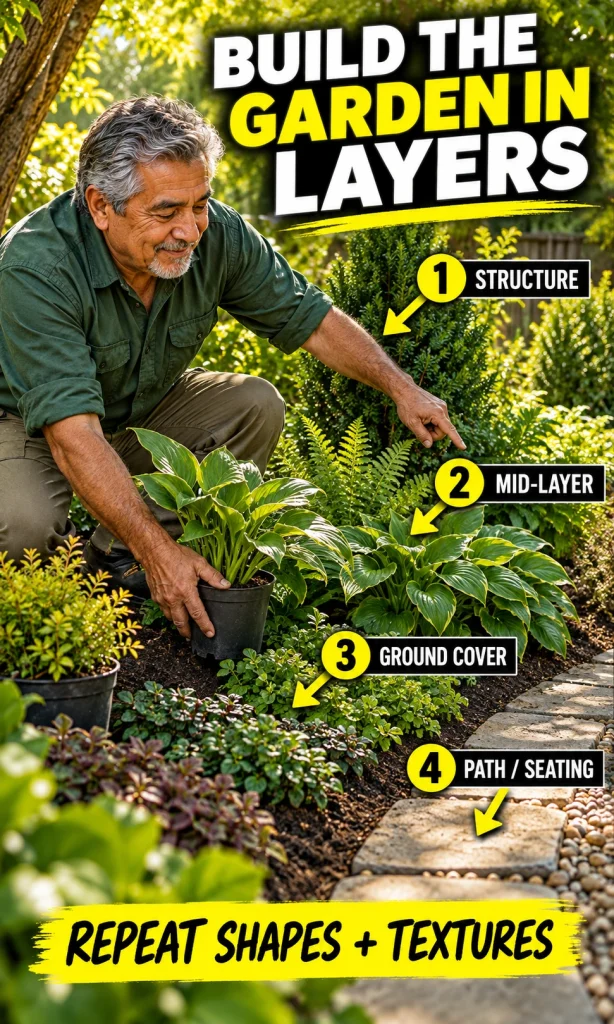
Repetition creates calm. Repeat a few leaf shapes, foliage tones or plant groups through the bed instead of buying one of everything, and let paths or edging provide a simple frame. If the area is small, the same principle used in small garden designs applies: clear sightlines and disciplined repetition usually feel more spacious than too many competing details.
Build the garden in layers, but do not force every bed to contain every layer. A narrow strip might need only a structural plant plus ground cover, while a wide woodland edge can support shrubs, mid-height perennials, lower foliage plants, bulbs and a path. Leave access for pruning, watering and cleanup before the plants grow together.
- 1. Define the function: planting bed, quiet seating area, transition path, screen or focal corner.
- 2. Place structural anchors: existing trees, shrubs, large foliage plants or architectural elements.
- 3. Add the mid-layer: plants that connect tall structure to the front of the bed.
- 4. Add ground cover: use compatible low plants to reduce bare soil and visually connect groups.
- 5. Add seasonal accents: bulbs and flowering perennials should support the structure, not replace it.
- 6. Protect access: keep stepping points, path edges, irrigation access and maintenance routes usable.
Plant under trees without fighting the tree
The soil beneath a mature tree is not an empty bed waiting to be improved. It is already occupied by a living root system, so avoid broad excavation, deep tilling and heavy grade changes. Where roots are dense, smaller plants and smaller planting holes are often more practical than forcing large root balls into the site.
Do not bury the tree trunk or root flare under a deep mound of new soil or mulch. Mulch can help reduce evaporation and suppress weeds, but keep it pulled back from trunks and crowns, and use a depth appropriate to the material and climate. If a tree is valuable or the root zone is unusually dense, professional arborist advice is safer than aggressive bed construction.
Water new plants according to the root zone, not just the visible surface. Fresh transplants can need regular establishment watering even when they are ultimately drought tolerant, but constantly wet soil can create a different set of problems. If you are unsure how your soil behaves, start with the basics in soil types for beginners and check drainage before changing the watering schedule.
Shade garden design ideas that make the space feel brighter
Use contrast before chasing flower color. Pale foliage, variegation, silver-green leaves, glossy surfaces and light-colored flowers can catch limited light, while coarse and fine textures placed together create depth. Keep the strongest contrast where you want attention rather than scattering bright accents everywhere.
Add one clear route through or past the planting. A stepping-stone path, narrow gravel line or simple edge gives the eye a direction and makes maintenance easier, while a bench can turn shade into a useful destination rather than a leftover corner. If the garden feels technically correct but still emotionally flat, the principles behind why some gardens feel alive are worth applying here too: movement, layers, rhythm and a reason to enter the space matter.
Use hardscape sparingly but deliberately. A pale pot, small seat, stone edge or simple vertical feature can become a focal point without demanding sun, and lighting can extend the usefulness of the area after dusk. In persistently damp shade, choose surfaces with traction and avoid creating drainage traps beside paths or walls.
Vertical elements can help narrow shade gardens feel larger. A trellis, wall-trained plant or tall narrow shrub can pull the eye upward, but verify that the chosen climber actually tolerates the available light; many climbers naturally seek brighter conditions and perform poorly in deep shade. Use height where it is horticulturally appropriate, not merely because the wall is empty.
Common shade-garden mistakes
- Buying by the word “shade” alone: moisture, heat, drainage and root competition still decide whether a plant succeeds.
- Ignoring afternoon sun: a short period of intense late-day sun can damage plants that tolerate gentler morning exposure.
- Over-amending under mature trees: repeated digging and grade changes can disturb an established root system.
- Planting too densely: use mature width, not nursery-pot size, when setting spacing.
- Expecting constant flowers in deep shade: build the design around foliage, form and seasonal succession.
- Keeping unsuitable lawn: where turf repeatedly thins from low light, a path, mulch zone or compatible ground cover may be a better use of the space.
- Watering by schedule instead of condition: check the root zone and drainage before adding more water.
Use Shade Match Studio before you buy plants
If the site has mixed conditions, use the interactive experience below to combine direct-sun hours, sun timing, soil moisture, drainage and root competition into a practical shade profile. It does not invent a universal plant score; it gives you a condition category, design priorities, risk flags and the next checks to make locally.
Shade Match Studio
Combine light, soil moisture and root competition before you buy plants.
Describe the site
Use what you can observe today. The result is a practical condition profile, not a universal plant-rating system.
Shade profile
Priorities for this site
Watch this first
Plant roles to shop for
These are plant roles, not a climate-specific species list. Verify hardiness, heat tolerance, local invasive status and mature size before buying.
Next-action sequence
General garden-planning guidance only. Confirm plant suitability for your climate, site, tree species and local regulations before planting.
How to plant the bed
Lay out plants in their pots before digging. Step back from the main viewing point, check spacing at mature size and move repeated groups until the rhythm feels deliberate. This is the easiest time to correct a design that looks spotty, crowded or accidentally symmetrical.
Dig only as much as the root ball requires, especially near trees, and loosen circling container roots where appropriate for the species. Set plants at the correct depth for their crowns or root flares rather than burying them to match an uneven soil surface. Backfill with the site soil unless a specific plant or soil problem justifies a different approach.
Water thoroughly after planting and monitor the root zone through the establishment period. The goal is consistent access to moisture without removing all air from the soil, so change frequency when rain, temperature and drainage change. Shade can slow evaporation, but tree roots can pull moisture rapidly; both can be true in the same bed.
Finish with mulch where it suits the planting, keeping it away from stems, crowns and trunks. Then edit the garden over time instead of filling every visible gap on day one. A good shade garden becomes denser and more coherent as plants mature, so deliberate negative space at planting is often a sign of correct spacing rather than an unfinished design.
FAQ
Can a garden grow in full shade?
Yes, but plant choice becomes narrower as direct light decreases. In deep shade, prioritize plants adapted to low light and design with foliage, texture and structure rather than expecting the flower performance of a sunny border.
What is the biggest mistake when starting a shade garden?
The biggest mistake is treating all shade as the same condition. Measure light timing, check soil moisture and drainage, and identify tree-root competition before choosing plants.
Is dry shade harder than damp shade?
It can be more restrictive because plants must tolerate both reduced light and limited available water, often with tree-root competition. Damp shade has its own limits, especially where drainage is poor or the soil becomes waterlogged.
Should I improve the soil under a mature tree?
Avoid deep cultivation, trenching and major grade changes around established roots. Small planting pockets and surface mulch are often less disruptive; for valuable trees or dense root zones, get arborist guidance before making major changes.
How do I make a shade garden look less dark?
Use contrast strategically: pale or variegated foliage, light-colored flowers, glossy leaves, contrasting leaf sizes and a simple light-toned path or focal element. Keep the palette disciplined so the brighter features have somewhere to lead the eye.
When is the best time to plant a shade garden?
The best planting window depends on local climate and the species involved, but moderate weather generally reduces establishment stress. Avoid planting during periods of extreme heat, frozen soil or saturated ground, and make sure you can provide establishment water when rainfall is unreliable.
Decision summary
Do not design a shade garden around darkness alone. Diagnose light pattern + moisture + drainage + root competition, choose plants that fit that combination, and then build visual structure with mature size, foliage contrast, repetition and clear access. When those fundamentals are right, shade stops being a limitation and becomes a usable design condition.