

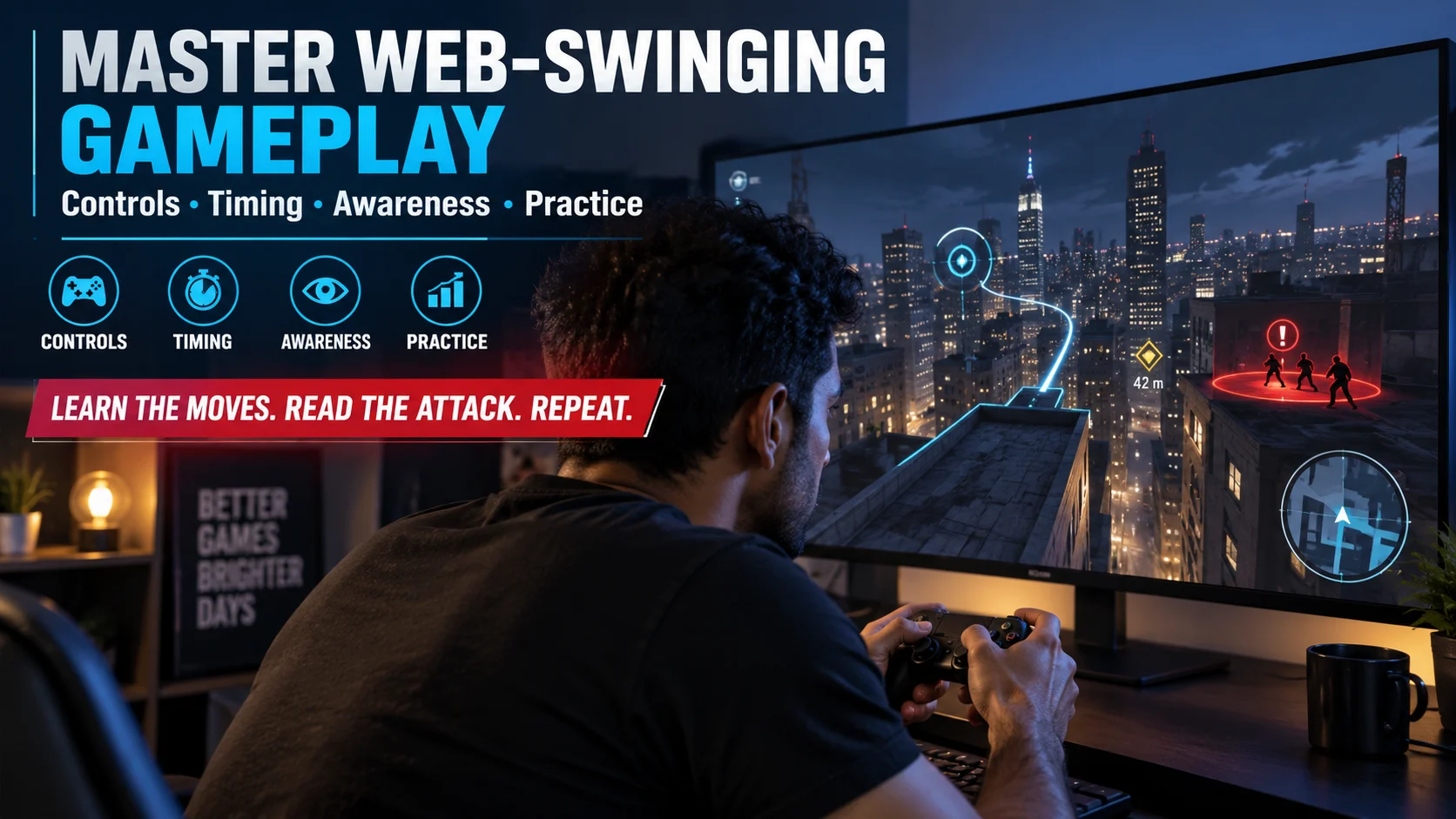

Getting better at Spider-Man video games is less about pressing buttons faster and more about controlling movement, reading attacks, and knowing when to use each ability. Learn traversal and basic combat separately first, then combine them once the controls begin to feel automatic.
Spider-Man games reward rhythm. When swinging, dodging, attacking, using gadgets, and moving the camera all compete for your attention, rushing usually creates more mistakes than speed.
Learn the Controls Before Trying to Play Fast

The quickest improvement usually comes from removing hesitation from the basic controls. You should be able to move, turn the camera, dodge, jump, attack, and begin traversal without looking down at the controller.
Do not try to memorize every advanced combination at once. Start with the actions you perform constantly and build outward from them.
Focus first on:
- basic movement and camera control;
- jumping and aerial movement;
- web-based traversal;
- standard attacks;
- dodging or defensive reactions;
- targeting nearby enemies;
- using the abilities or gadgets available in your game.
Spend a few minutes moving around an open area without worrying about missions. Swing between buildings, change direction deliberately, climb or run across surfaces, land where you intended, and recover when a movement does not go as planned.
That simple practice makes combat easier because movement no longer consumes all of your attention.
Treat Web-Swinging as a Rhythm, Not a Race
Web-swinging becomes smoother when you stop treating every swing as a separate button press. Watch the character’s position, the height of nearby buildings, the direction you want to travel, and the moment when releasing a swing carries your momentum forward.
A common beginner mistake is constantly correcting direction. The player swings, oversteers, loses momentum, corrects again, and ends up fighting the controls.
Instead, look farther ahead.
Choose the next part of your route before finishing the current movement. A clean sequence usually feels more controlled because each swing prepares the next one.
When practicing traversal, work on one goal at a time:
- Direction: Reach the street or rooftop you intended.
- Height: Learn when your movement gains or loses altitude.
- Momentum: Avoid unnecessary stops between movements.
- Landing: Finish accurately rather than crashing into whatever is closest.
- Recovery: Learn how to continue smoothly after a poor swing or missed landing.
Speed develops naturally once these pieces become consistent.
Keep the Camera Working With You
Many difficult moments are actually camera problems disguised as combat problems.
If you cannot clearly see the enemy preparing an attack, the direction of the next traversal point, or what is happening behind the character, you are forced to react late. That often leads to frantic dodging and uncontrolled movement.
Try to keep the camera pointed toward the next important piece of information rather than simply following the character.
During traversal, look toward the route ahead. During combat, keep the largest immediate threat within view. When several enemies surround you, reposition instead of staying in a bad camera angle and hoping to react to attacks you cannot properly see.
Good camera control gives you more time to make decisions.
Read the Attack Before You Dodge
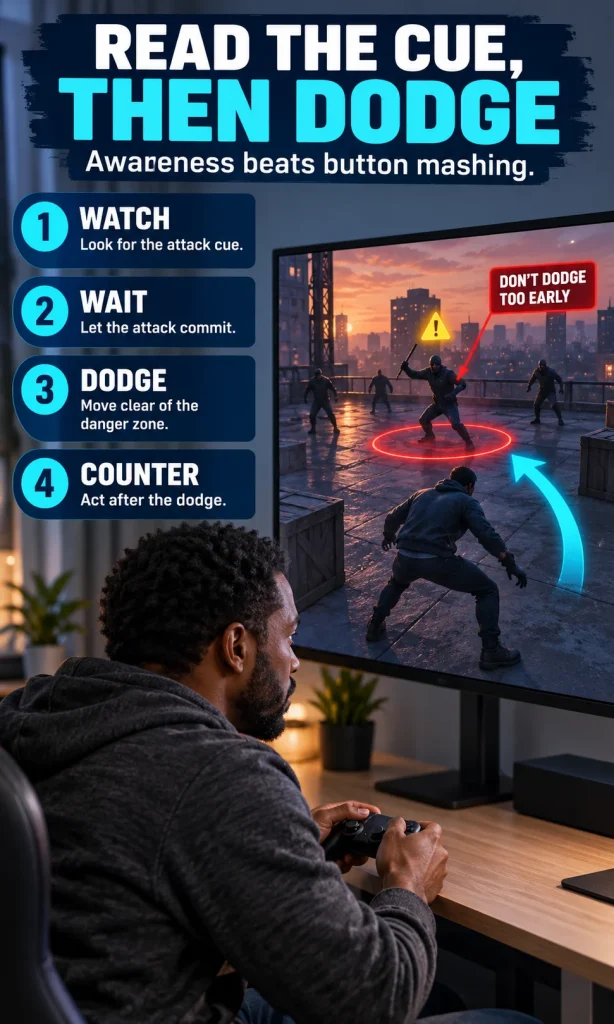
One of the biggest differences between random button mashing and controlled combat is timing.
When an enemy begins an attack, identify the warning first. Then react. Dodging repeatedly before an attack arrives may leave you moving in the wrong direction when the real threat finally comes.
Think of defensive play as a short sequence:
Watch -> wait -> react -> reposition -> counter.
The exact defensive options differ between Spider-Man games, but the principle remains useful. An attack cue gives you information. Use that information before committing to another action.
When you take damage, avoid immediately blaming slow reactions. Ask what happened just before the hit.
Did you fail to see the enemy?
Did you dodge too early?
Were you trapped against a wall?
Were you continuing a long attack when you should have disengaged?
Was the camera pointing away from the danger?
Finding that cause improves your next attempt much faster than simply pressing the dodge button more often.
Do Not Finish Every Combo Just Because You Started It
Long attack combinations can feel powerful, but finishing every sequence is not always the best decision.
Spider-Man’s mobility is one of the biggest advantages in these games. Use it. If the situation changes during an attack, break away, reposition, and attack again from a better angle.
A clean fight often involves moving between short bursts of offense rather than standing in one place until every nearby opponent is defeated.
This is particularly useful when several enemies are attacking simultaneously. Staying mobile makes it easier to separate threats, maintain visibility, and avoid becoming surrounded.
Use the Environment Instead of Ignoring It
A Spider-Man game rarely limits you to standing on the ground and trading punches. Walls, rooftops, vertical space, objects, web interactions, and environmental opportunities can change how an encounter plays.
Before rushing into a group, look around.
You may be able to approach from above, separate one enemy from the group, move to another level, create distance, or use the environment to control where the fight happens.
The useful question is not simply, “How quickly can I defeat this enemy?”
Ask, “Where should I be standing when this fight begins?”
Positioning can make an encounter dramatically easier before the first attack is thrown.
Learn One New Ability at a Time
Unlocking several abilities can create the impression that you need to use all of them immediately. That usually produces the opposite result: you remember none of them reliably.
Choose one unfamiliar move or ability and deliberately use it during several encounters. Once you can recognize a good opportunity for it without thinking too much, add another.
A useful progression is:
basic movement -> basic defense -> basic offense -> one special ability -> combinations.
This approach builds dependable habits instead of a large collection of moves you rarely remember under pressure.
Use Aerial Combat Deliberately
Taking an enemy into the air can give you temporary separation from threats on the ground, but being airborne is not automatically safe.
Pay attention to what remains below you and what can still reach you. Use aerial attacks because they improve your position or isolate an enemy, not merely because the animation looks impressive.
After an aerial sequence, decide where you want to land.
Landing in the middle of several enemies can erase the advantage you just created. Landing away from the group, continuing traversal, or moving immediately into another controlled action usually gives you more options.
Practice Difficult Encounters Instead of Avoiding Them
A difficult encounter is useful because it exposes whichever skill is weakest.
If you repeatedly fail in the same place, change what you are observing. Do not simply repeat exactly the same approach and hope that your reactions become faster.
Ask:
| What keeps happening? | What to practice |
|---|---|
| You lose track of enemies | Camera positioning and movement |
| You get hit during attacks | Shorter attack sequences and earlier disengagement |
| You dodge constantly | Waiting for clearer attack cues |
| Traversal feels uncontrolled | Direction, release timing, and landing |
| You forget abilities | Practice one ability repeatedly |
| You get surrounded | Positioning and vertical movement |
| You panic during busy fights | Slow down and prioritize the nearest threat |
The goal is to identify the mistake that happens before the failure.
Fix that earlier decision and the entire encounter often becomes easier.
Adjust the Difficulty When You Are Learning
Lowering the difficulty is not a bad way to learn a new control system. It can give you enough time to understand attack cues, experiment with abilities, practice movement, and develop muscle memory without every mistake immediately ending the encounter.
Once the controls feel comfortable, increase the challenge if you want more demanding timing and combat.
The important point is to use difficulty deliberately. If you are trying to learn movement, give yourself room to learn movement. If you are already comfortable with the controls and want to sharpen reactions, increase the pressure.
Stop Button Mashing When the Screen Gets Busy
The moments when the screen becomes chaotic are exactly when deliberate play matters most.
Instead of trying to attack everything, decide what needs attention first. It may be an enemy preparing an attack, a dangerous position, a ranged threat, or simply the need to create space.
A practical priority order is:
- avoid the immediate threat;
- regain visibility;
- reposition;
- identify the next target;
- attack when you have control again.
That short reset can turn a messy encounter into a manageable one.
Practice Movement and Combat Separately
If you struggle with both traversal and fighting, attempting to improve both simultaneously can make progress difficult to notice.
Spend a short session concentrating only on moving around the city. During another session, concentrate on combat fundamentals. Once each feels comfortable independently, begin linking them together.
For example, practice entering a fight from movement, attacking briefly, leaving the group, repositioning through traversal, and re-entering from another direction.
That transition between movement and combat is where Spider-Man gameplay begins to feel fluid.
Use Repetition, but Make Every Attempt Different
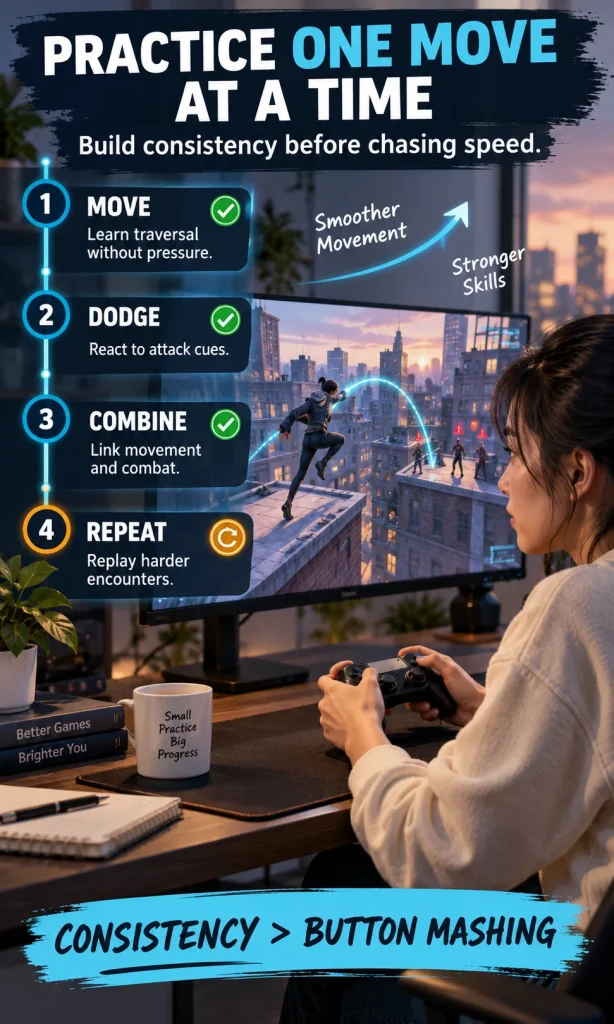
Practice works best when you know what you are trying to improve.
Repeating the same encounter twenty times without changing anything may reinforce the same mistake. Instead, give each attempt a purpose.
On one attempt, concentrate on dodging accurately.
On another, focus on keeping every enemy visible.
Then try using one particular ability correctly.
Finally, combine those skills while increasing your pace.
The improvement comes from deliberate repetition rather than repetition alone.
The Fastest Way to Improve
If you want a simple training sequence, use this:
Step 1: Spend several minutes moving around without fighting.
Step 2: Practice camera control while moving.
Step 3: Enter an easy encounter and concentrate only on recognizing attack cues.
Step 4: Add controlled dodging and repositioning.
Step 5: Practice one attack combination until it feels natural.
Step 6: Add one special ability or gadget.
Step 7: Combine movement, defense, and attacks during harder encounters.
Step 8: When something goes wrong, identify the decision immediately before the mistake.
This approach is usually more effective than trying to memorize every possible move from the beginning.
Why Spider-Man Games Become Easier With Practice
Spider-Man games ask you to manage several things simultaneously: movement, camera direction, enemy awareness, defensive timing, positioning, and offensive choices. Early on, each one demands conscious attention.
Practice gradually turns the basic actions into habits. Once you no longer have to think about every movement or button press, you have more attention available for reading the encounter itself.
That is when the gameplay begins to feel faster even though you may actually be making fewer inputs.
You are not merely reacting more quickly. You are recognizing situations earlier.
Frequently Asked Questions
Do I need to memorize every Spider-Man combo?
Why am I bad at web-swinging even though I know the controls?
Why do I keep getting hit even when I dodge frequently?
Is button mashing effective in Spider-Man games?
Should beginners lower the difficulty?
What should I practice first?
Final Takeaway
The fastest way to get better at Spider-Man video games is to control first and accelerate later. Learn movement until it feels natural, keep the camera working for you, read attacks before reacting, practice abilities one at a time, and treat every failed encounter as information about what to improve next.
Once the basic actions become automatic, Spider-Man gameplay stops feeling like a collection of buttons and starts feeling like one continuous flow of movement, awareness, and decision-making.