



Use AI in customer service by starting with one bounded task, giving it approved information, and testing whether it resolves the customer’s problem correctly. Keep account access, refunds, exceptions, and human handoff under explicit controls. Expand only when the pilot improves service quality or capacity without creating unacceptable errors or repeat contacts.
Choose the customer problem before choosing the software
A useful first project has a recognizable input and an outcome your team can verify. Answering a public product-care question, drafting a reply for an agent, and changing a delivery address are different jobs, even when the same chat window handles them. Write down which job you are solving before comparing platforms.
Start with a sample of recent, appropriately redacted tickets and group them by reason for contact. Record the source an agent uses, the systems they touch, and the exceptions that require judgment. Ticket volume alone is a poor selection rule: a common request can still involve sensitive information or an irreversible action.
For example, a retailer might receive frequent questions about its return window. Explaining the published policy can be a bounded knowledge task, while approving an exception or issuing money requires additional authority. Keeping those steps separate makes both the pilot and its failure modes easier to inspect.
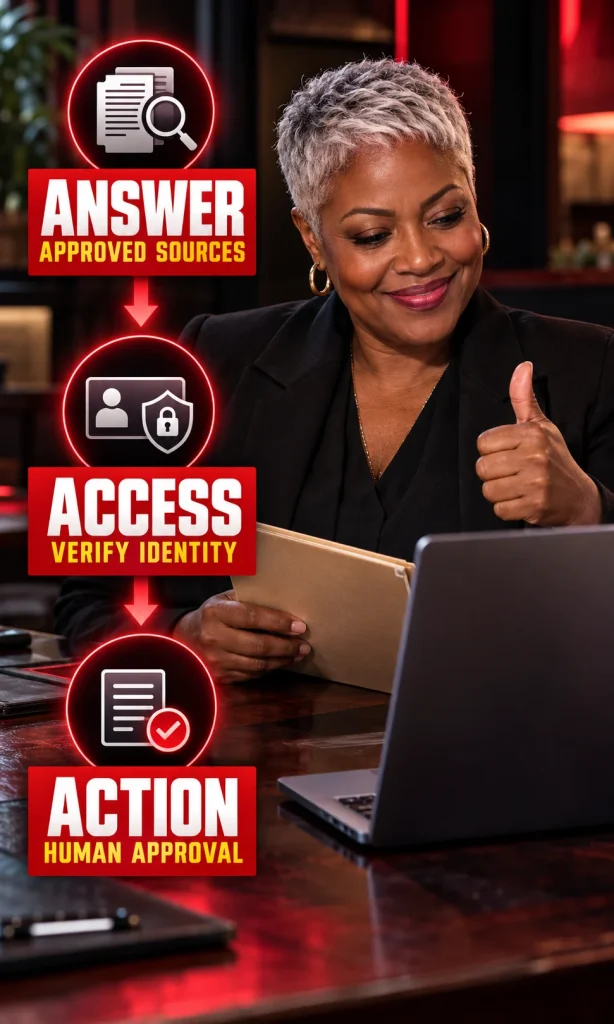
Match the task to the level of authority
The important distinction is what the system is allowed to do after it understands a request. A draft that a trained agent checks has a different exposure from a reply sent directly to a customer or a transaction executed in an account. Choose the lowest level of authority that solves the operational problem.
| Customer-service job | Reasonable starting mode | Required boundary |
|---|---|---|
| Fixed acknowledgement or routing by a known field | Rules-based automation | Test every route and provide an exception queue. |
| Summarizing a case or drafting a response | Agent assistance | The agent checks facts, commitments, and omitted details before use. |
| Answering public policy or product questions | Grounded self-service pilot | Use approved sources; abstain and escalate when the answer is unsupported. |
| Looking up order or account status | Authenticated, read-only workflow | Verify identity and enforce record-level access outside the language model. |
| Refunds, cancellations, or account changes | Human-approved action workflow | Validate permissions and inputs; confirm the action and log its outcome. |
| Distress, disputes, sensitive advice, or unusual exceptions | Human-led handling | AI may organize permitted information; a qualified person owns the decision. |
A chatbot describes the interface, not its intelligence or permissions. A rule-based flow can be enough for a predictable route, while language models can help interpret varied wording or draft an explanation. The difference between AI agents and automation matters when you are deciding how much discretion the system needs.
Prepare a knowledge source that can survive real questions
Give each policy an owner, an approval status, and a clear scope. Remove superseded copies or mark them so retrieval cannot treat them as current instructions. Include the exception and escalation rule next to the ordinary answer, rather than expecting the system to infer it from old conversations.
Retrieval-augmented generation, often called RAG, retrieves relevant material and supplies it as context for a generated answer. It can make answers more specific to your business, but it does not guarantee that the retrieved passage is current, complete, or interpreted correctly. Test the answer against the underlying source and the customer’s actual question.
Customer transcripts are useful for finding gaps, but a resolved ticket is not automatically an approved policy. An agent may have granted a one-time exception, copied an outdated instruction, or included private information. Keep the source of an answer traceable and restrict what enters the searchable collection.
Design the human handoff before launch
A handoff is an operational commitment: somebody must receive the case, understand it, and know what remains unresolved. Microsoft’s documentation on customer engagement and handoff illustrates how knowledge-based answers and live-agent routing can coexist. Verify the equivalent behavior in your actual channel and service desk, including outside staffed hours.
- Trigger: escalate when the customer asks for a person, the answer lacks support, authentication fails, or the case exceeds the approved scope.
- Context: pass the customer’s request, verified facts, relevant transcript, source references, and actions already attempted through authorized channels.
- Ownership: assign a queue and fallback owner; a transfer that reaches nobody is a failure.
- Expectation: show the next contact route and the service level your team can actually meet.
- Recovery: preserve an accessible alternative when a connector, model, or service desk is unavailable.

Separate conversation from permission
A convincing message is not proof that a customer owns an account. Authentication, authorization, and transaction limits belong in the application and backend services, where they can be checked independently of generated text. A customer asking the assistant to ignore a policy must not gain access to another person’s record.
Treat incoming messages, attachments, and retrieved material as potentially untrusted input. OWASP’s prompt-injection guidance explains how instructions inside that material can influence model behavior. Limit the assistant’s permissions and test hostile inputs; a polite system prompt is not a sufficient security boundary.
For an action such as a refund, validate the account, eligible amount, policy, and approval before execution. Have the service return a definite transaction result, and prevent retries from issuing the same refund twice. The assistant should report what the system confirmed rather than announcing success merely because it requested the action.
Build a pilot that includes the cases you hope never happen
Use a test collection that includes ordinary requests, ambiguous questions, conflicting sources, missing records, and unsupported requests. Add the languages, accessibility needs, and channel limitations your customers actually bring. Keep some cases separate from development so repeated tuning does not make the evaluation unrealistically easy.
Decide what counts as a pass before running the test. For a policy answer, that might mean correct scope, supported facts, and no invented promise; for a handoff, it means the right queue received the necessary context. Treat an unauthorized disclosure or action as a stop condition requiring investigation rather than averaging it into a favorable score.
- Offline: use approved synthetic or redacted examples to test answers, boundaries, and failures.
- Shadow: compare proposed outputs with agent decisions without sending them to customers.
- Supervised: allow trained staff to review outputs in the real workflow.
- Limited live pilot: open only the approved task, channel, and customer segment, with monitoring and rollback.
- Expansion: change one meaningful dimension at a time and repeat the relevant evaluation.
Measure resolution and rework together
A fast answer can still be wrong, and a conversation ending does not prove the problem was solved. Compare similar case types and account for differences in agent experience, staffing, and seasonality. Record both the customer outcome and the work that moved elsewhere in the operation.
| Measure | How to define it | What it can hide |
|---|---|---|
| Correct resolution | Reviewed cases resolved correctly divided by reviewed eligible cases. State the sampling method. | A small or easy sample can overstate performance. |
| Repeat contact | Customers returning about the same issue within your chosen observation window. | Different channels or identities can hide a return visit. |
| Human workload | Handling, review, escalation, and correction time for comparable cases. | Reduced chat time may be offset by more back-office work. |
| Handoff quality | Check queue delivery, useful context, and time until ownership. | An escalation event can fire even when nobody receives the case. |
| Customer feedback | Offer the same feedback opportunity to comparable groups. | Response bias and low participation limit interpretation. |
| Operating cost | Include software, usage, integration, evaluation, maintenance, and rework. | Recovered staff capacity is not automatically a cash saving. |

Research on generative AI assistance in customer support found productivity gains that varied across workers, with stronger improvements among less experienced staff. The study examined assistance for human agents, so it does not establish that an autonomous bot will deliver the same outcome. Use the evidence to motivate a measured trial, not to promise a fixed percentage saving.
Use the Service Pilot Studio to set your first boundary
Select the task you are considering and the controls you already have. The studio returns a proposed starting mode, unresolved prerequisites, and a pilot checklist; it uses transparent rules rather than a predictive score. Keep customer names, messages, credentials, and account details out of the inputs.

Service Pilot Studio
Choose a useful starting scope. See the controls it needs.
Find implementation help
Look for a customer-service systems integrator. For sensitive access or actions, include an identity/security specialist. Verify experience with your service desk and ask for a pilot with acceptance tests.
These buttons open Google with your location and provider category. Listings are not endorsements. No ratings or availability are supplied here.
Compare three candidates you find
Record specialization, credentials, review count, location, availability, estimate terms, and support guarantees. Ask each to show permissions, handoff, rollback, and source maintenance.
Your selections stay in this page and are cleared on reload. A report contains your selections and candidate notes. Do not enter customer or confidential information.
Compare platforms using your own failure cases
Ask each provider to demonstrate the same approved examples in the channel you intend to use. Include a stale document, a requested human handoff, an inaccessible account, and a failed backend action. A polished demonstration with only easy questions says little about how the system behaves under pressure.
Check whether your team can inspect the retrieved source, trace an executed action, export records, and disable the integration quickly. Confirm who maintains the knowledge collection and who responds when an error appears. Risk management guidance such as the NIST AI Risk Management Framework supports treating evaluation and monitoring as ongoing work.
- Data handling: clarify retention, deletion, access controls, training use, and where data is processed under your organization’s requirements.
- Integration: test permissions, timeouts, duplicate retries, handoff payloads, and degraded service.
- Operations: identify the source owner, review owner, incident contact, and rollback procedure.
- Commercial terms: compare the billable unit, usage limits, included channels, support, and the cost of transferred or unresolved cases.
- Exit path: verify export, credential revocation, deletion, and continuity if you switch providers.
Common failures and what to check first
| Symptom | First check | Practical response |
|---|---|---|
| Fluent answer contradicts policy | Retrieved source, version, and scope | Fix the source or retrieval path and rerun the affected cases. |
| Customer keeps repeating the problem | Handoff payload and queue ownership | Preserve context and verify receipt with an agent. |
| Bot reports an action that never happened | Backend response and transaction log | Require confirmed results and handle timeouts explicitly. |
| Low contact volume looks like success | Abandonment, repeat contact, and feedback | Check whether customers gave up or moved to another channel. |
| Agent assistance creates extra checking | Draft accuracy and review time | Narrow the task or use retrieval without generated replies. |
Frequently asked questions
What is the easiest way to start using AI in customer service?
Begin with a bounded internal task such as drafting replies from approved material or summarizing cases for review. Establish what a correct result looks like and test ordinary requests alongside exceptions. Customer-facing automation can follow once the sources, handoff, and monitoring are proven for that scope.
Do I need to train a custom AI model?
Not necessarily. Some deployments use an existing model with retrieval from approved business sources and integrations to existing systems. Fine-tuning is a separate decision and does not replace current knowledge, permissions, or evaluation.
Can AI handle refunds and account changes?
It can participate in a controlled workflow when the backend verifies identity, eligibility, permissions, and the action result. Keep human approval where the action carries significant consequences or involves an exception. Do not treat generated wording as transaction authorization.
How long should a pilot run?
Run it long enough to observe the relevant case mix, repeat contacts, and operational failures. There is no universal number of days that proves readiness. Define the evidence needed to expand before starting, and pause when a critical control fails.
Should AI replace customer-service staff?
A pilot can show whether particular tasks become faster or easier, but it cannot justify a universal staffing conclusion. Measure review, escalation, maintenance, and exception work as well as direct handling time. Keep people available for cases requiring judgment, accountability, or a requested human response.
Your first decision
Choose one task with an approved source, a named owner, and a result you can check. Keep its authority narrow and test the escape route as carefully as the answer. If those foundations are missing, improving the workflow is the next useful step before expanding AI’s role.