

Children may talk to an AI chatbot because it replies instantly, feels private, and seems easier to approach than a person when a question is embarrassing. That does not mean a child has stopped valuing their parents or friends; the concern grows when a chatbot becomes their main source of comfort, advice, or companionship. Start by asking what the chat gives them, then make a practical plan for safety and real connection.
- Ask which app your child uses and whether it is a general assistant or a relationship-focused companion.
- Listen for the reason: curiosity, schoolwork, social rehearsal, loneliness, or a hard conversation.
- Keep personal details and sensitive problems out of chats, and verify any consequential advice with a trusted person.
- Act on changes in sleep, mood, friendships, or safety; the amount of chat time alone does not diagnose a problem.
How common is it for children to talk to AI?
Surveys answer different questions about different products. In a 2025 US survey of teens ages 13–17, Common Sense Media found that 72% had used an AI companion at least once. About one third reported using one for social interaction and relationships, while 80% still prioritised real-life friendships. A teen who has tried a companion is therefore not necessarily choosing it over people.
In Australia’s 2026 survey of 1,950 children ages 10–17, 78% had used an AI assistant, but 8% had used an AI companion. Among children who had used either kind, 22% had chatted about feelings or challenges, and 32% had shared personal or potentially sensitive information. Those figures use different denominators: the first two describe all surveyed children, and the last two describe users of an assistant or companion.
Internet Matters’ UK research also finds that homework and information seeking are common, while some children turn to chatbots for advice and companionship. These studies cannot be added together to produce a worldwide rate or to prove a long-term effect on social development. They do tell parents to ask what kind of conversation is happening before deciding how to respond.
Why does a chatbot feel easier than a parent or friend?
A chatbot can answer at midnight, invite another question, and respond without an awkward pause. A child worried about getting in trouble, feeling silly, or burdening a parent may test a question there first. A teen might ask for help drafting an apology or practising what to say to a friend; that can be a useful rehearsal when the real conversation still happens.
The attraction can be stronger when a child is lonely or has had a difficult social experience. In the UK study, children with specified educational or health vulnerabilities were more likely to use companion-style chatbots than their peers, and 23% of vulnerable children who used a chatbot said they did so because they had nobody else to speak to. This describes that survey group; it is not a prediction about every child with a disability or every child who uses AI.
The interface can also make a response seem more personal than it is. A conversational system may remember earlier details, use warm language, or agree readily, but it does not have a human friend’s understanding, duty of care, or ability to act in an emergency. A child who calls the bot a friend is telling you something about the experience; that phrase alone is not proof of dependency.
Which uses call for a closer look?
| What you notice | What it may mean | First response |
|---|---|---|
| Occasional homework questions or conversation practice | Usually a task or rehearsal | Check accuracy and encourage the real-world next step. |
| Frequent chats about feelings or friendship conflicts | The child may want privacy, reassurance, or help finding words | Ask what makes the chatbot easier; offer another safe adult as well. |
| Long private sessions with a companion persona | The product may encourage a continuing relationship | Review the product and settings together; set a clear limit. |
| Withdrawn from friends, losing sleep, or relying on the bot for urgent mental-health advice | Support or safety needs may be unmet | Speak directly with the child and arrange human support promptly. |
What risks matter in practice?
Wrong or harmful advice
Chatbots can state a false answer confidently, agree with an unsafe premise, or miss the gravity of a disclosure. A child may ask about eating, self-harm, abuse, medication, or conflict and receive a reply that sounds caring without being reliable care. Australia’s eSafety Commissioner reported shortcomings in several companion services’ responses to self-harm related conversations; a family should not use a chatbot as a crisis service.
Privacy and exposure
Children may share their address, school, photos, health details, passwords, or another child’s secrets without understanding where that information goes. Explain that a chat is a service, with product rules and data practices that can change, not a confidential diary. Check the specific app’s current age rules, privacy controls, memory, retention, and reporting options; do not promise that clearing a chat removes every copy.
Less room for human relationships
Human friendship requires noticing another person’s needs, hearing disagreement, repairing mistakes, and accepting that friends are sometimes unavailable. An endlessly accommodating chat may be more comfortable in the moment. Whether it harms a particular child’s social skills is uncertain; the practical concern is a sustained pattern in which AI conversations replace valued time with peers, family, sleep, or school.
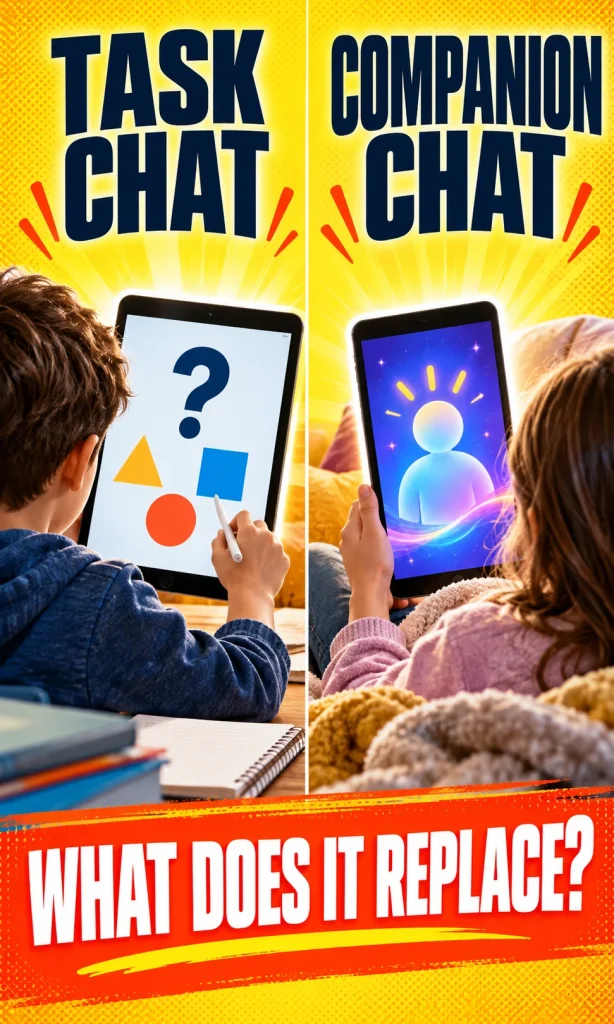
A relationship-focused companion deserves stricter scrutiny than a general assistant used briefly to organise ideas. Common Sense Media recommends that people under 18 avoid social AI companions in their current form. A parent can follow that precaution while still teaching a teen how to evaluate ordinary AI answers used for school or creative work.
Signs your child may need more support
Look for a change from your child’s usual behaviour, especially several signs appearing together over time. Do not treat one sentence such as “the bot understands me” as a diagnosis. Ask what is happening offline as well as online.
- They pull back from friends or activities they previously enjoyed, and chats fill that time.
- They regularly lose sleep or become distressed when they cannot access the chatbot.
- They describe the bot as their only safe confidant or take its serious advice without checking it.
- They are increasingly isolated, anxious, or preoccupied with maintaining a companion relationship.
- They have received sexual, frightening, self-harm related, or otherwise inappropriate replies.
Secrecy or irritation may also reflect a fear of punishment, so listen before drawing a conclusion. If a child says they want to hurt themselves, describes an immediate danger, or has received instructions for harm, stay with them and seek urgent local emergency or crisis support. A safety response comes before a debate about screen rules.
How to start the conversation without shutting it down
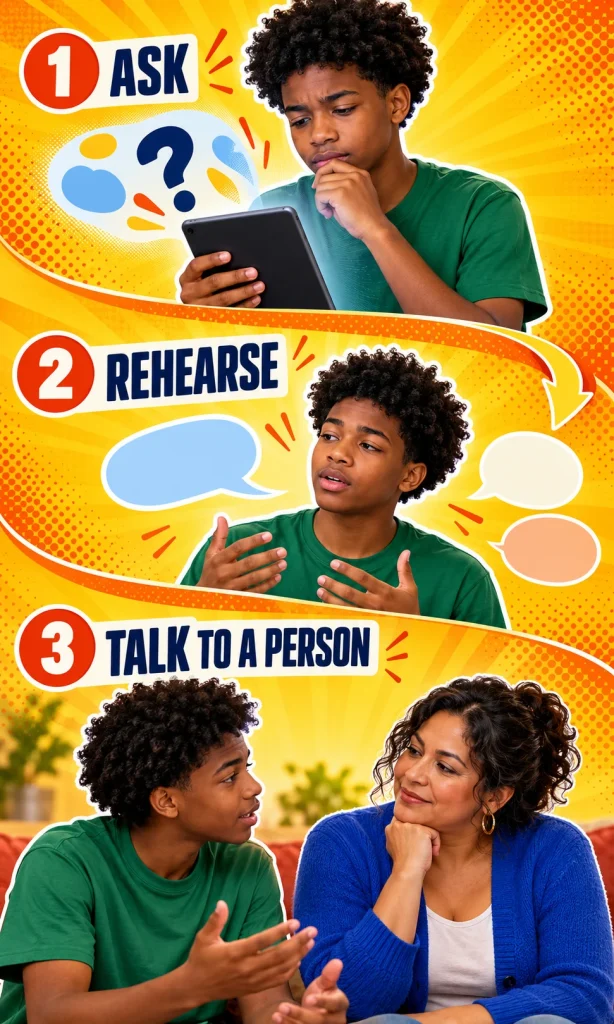
Pick a calm time and ask about the child’s experience rather than demanding a transcript. You might say, “I hear a lot of kids use AI when a question feels awkward. What do you find helpful about it?” Then ask, “Has it ever answered in a way that felt strange or unsafe?” A child who hears curiosity first is more likely to tell you what the app is actually doing.
If they say the chatbot feels easier than talking to you, resist defending yourself in the first minute. Try: “I’m glad you found a way to put it into words. I want to understand what makes it hard to tell me. I can listen without trying to fix everything immediately.” Follow through by putting the phone away, reflecting what you heard, and asking whether they want listening, help, or privacy with another trusted adult.
A child may need space to speak to a school counsellor, relative, coach, or clinician even in a loving family. That is a successful route to human help. Avoid asking them to prove loyalty by disclosing every chat; explain the limited circumstances when you must step in for safety.
Build a family plan that fits the actual use

- Identify the product and purpose. Find the exact app or built-in chatbot. Ask whether the child uses it to learn, rehearse conversations, vent, or maintain a fictional relationship.
- Agree on a privacy rule. Do not enter identifying information, intimate images, passwords, or another person’s private story. Review saved chats, memory, and data controls together when available.
- Set boundaries around the risky moments. Keep devices out of sleep time, avoid companion apps for minors, and move sensitive health, safety, or relationship decisions to a person who can help. Use current age restrictions and parental controls as one layer rather than a guarantee.
- Practise verification. Ask, “How would we check this?” for a factual answer, and “Who can help in real life?” for a personal problem. Rehearsal with AI should lead to a real conversation when that is the goal.
- Revisit the plan. Check after a week what improved and what felt unrealistic. Change the rule if it blocks useful schoolwork or fails to protect a vulnerable time of day.
If your child is using a companion because they feel isolated, a simple ban without a replacement leaves the underlying need untouched. Make a specific invitation: a walk together after dinner, help contacting one friend, joining an activity they choose, or arranging a conversation with a trusted adult. Keep checking in even if the first offer is refused.
A family rule works better when it names a situation rather than merely a number of minutes. For example: “Homework questions are fine when you check important answers; personal or health questions come to a person; no companion chats after bedtime.” Let the child propose a workable version and decide in advance what happens if a chatbot sends an upsetting reply. This gives them a route to tell you without fearing that disclosure itself will bring automatic punishment.
Try the AI Conversation Check together
The private check below helps a parent choose a starting conversation and a next step. It makes no diagnosis and sends no answers to the website. You can print the result for a family discussion.
AI Conversation Check
Find a calm first question and one practical next step.
No score · No account · No answers sent
Choose what you know today. This guide does not assess or diagnose your child; a safety concern always takes priority.
First question
Next step
Use this as a discussion aid, not a clinical assessment. Nothing entered here is stored or transmitted by this plugin.
Could AI still help a lonely child?
AI can help someone find words for a message, practise a difficult exchange, or explore a question before speaking to a person. eSafety also notes that some young people find a low-pressure setting useful for communication practice. The safer test is whether the chat opens a path back to human support, or steadily becomes the only place the child feels heard.
Evidence on long-term developmental effects remains limited, and families should avoid confident predictions that a generation will stop forming human relationships. The current evidence already justifies practical safeguards around companion apps, privacy, and harmful advice. Parents can combine those safeguards with the ordinary work of being available, repairing misunderstandings, and helping children find people they trust.
Frequently asked questions
Is it normal for a child to talk to AI like a friend?
Some children use friendship language because the system sounds conversational and responds readily. Ask what the child gets from it and whether their sleep, friendships, and other activities are intact. If the chatbot has become their primary emotional relationship, make a plan for more human support.
Should I ban AI chatbots completely?
Separate a general assistant used for a task from a companion designed to sustain an emotional bond. Common Sense Media advises against social AI companions for under-18s, while age-appropriate learning uses can be guided and checked. If a ban is necessary, explain why and offer a safe way to meet the child’s underlying need.
What age is too young for an AI companion?
There is no single research-backed age at which an emotionally engaging companion suddenly becomes safe. Follow the service’s current minimum age and your local rules, and take the stricter precaution that Common Sense Media recommends avoiding social AI companions for everyone under 18. An ordinary supervised learning assistant presents a different question from a simulated friend.
How can I tell whether my child’s AI use is healthy?
Look at purpose and impact rather than minutes alone. Limited use that helps a child learn or rehearse and then return to life is different from use that displaces sleep, valued friendships, or necessary help. Review the product, content, privacy settings, and changes in behaviour together.
What if my teen tells the chatbot about depression or self-harm?
Take the disclosure seriously and thank them for telling you. Ask directly about their safety, stay with them if danger is immediate, and contact local emergency or crisis services when needed. For ongoing concerns, help them reach a qualified clinician or trusted school professional; a chatbot cannot assess or treat the situation.
What to do next
Ask your child to show you the kind of AI interaction they find useful, without requiring them to expose every private thought. Agree on one privacy rule and one real person they can contact for a difficult question. Then return to the conversation soon enough that your child sees you mean it.
Sources and further reading
- Common Sense Media: Talk, Trust, and Trade-Offs (2025)
- Internet Matters: Me, Myself and AI (2025)
- eSafety: Talking to machines (2026)
- eSafety: AI companions information sheet
For related context, see AI safety and ethics, AI in education, and emotional attachment to AI.