
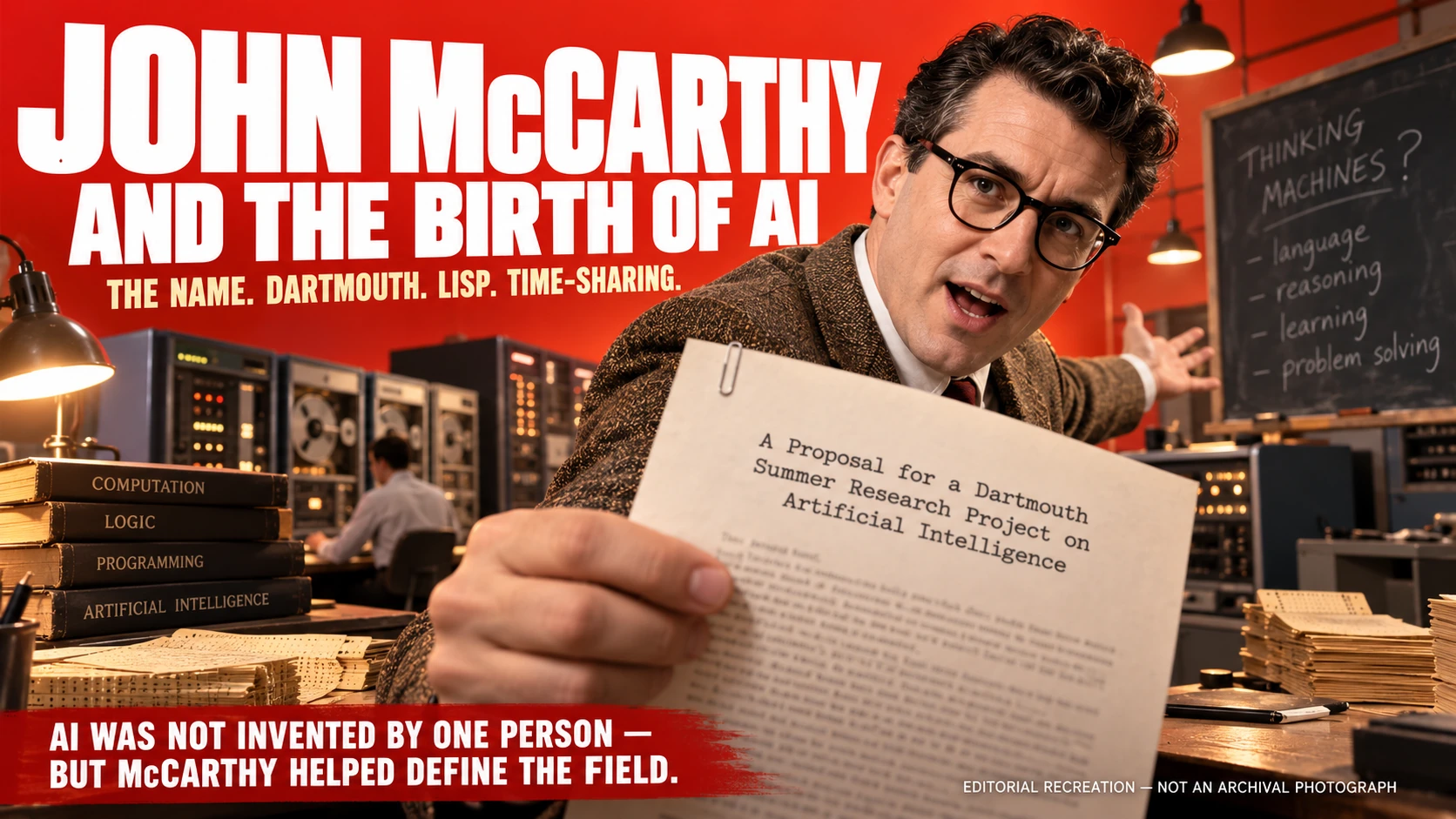

John McCarthy is one of the founding figures of artificial intelligence, best known for introducing the term artificial intelligence in a 1955 research proposal and helping organize the 1956 Dartmouth summer project that gave the new field a shared name and agenda. Calling him “the founder of AI” is useful shorthand, but it is not the whole history: AI grew from the work of several researchers, including earlier foundations laid by Alan Turing and major contributions from Claude Shannon, Marvin Minsky, Allen Newell, Herbert Simon, Arthur Samuel and others. McCarthy’s distinctive legacy is the combination of field-building, Lisp, time-sharing, and a long research program around logic and commonsense reasoning.
That distinction matters because “who invented AI?” sounds like a single-inventor question, while the history looks much more like the emergence of a scientific discipline. If you want the broader background first, start with what is artificial intelligence and then compare it with the site’s separate treatment of the inventor of artificial intelligence, which should own the multi-person origin question rather than duplicate this biography.
What John McCarthy actually contributed
The strongest historical claim is therefore not that McCarthy “invented AI” in the way one person might invent a device. It is that he helped give an emerging research movement a name, a forum, programming infrastructure and a durable intellectual program. Stanford describes him as a seminal figure who coined the term and shaped the field for decades, while the Computer History Museum credits him with major contributions to AI, Lisp and time-sharing.
| Contribution | When | Why it mattered | What not to overclaim |
|---|---|---|---|
| Named “artificial intelligence” | 1955 proposal | Created a durable label for a new research program centered on machine intelligence. | Naming the field did not mean inventing every idea behind it. |
| Dartmouth organizer and co-proposer | 1955-1956 | Helped turn scattered work on machine intelligence into a more recognizable research field. | Dartmouth was a watershed, not the first time anyone had studied machine intelligence. |
| Lisp | Late 1950s; published description in 1960 | Made symbolic structures, recursive functions and program-as-data ideas practical for AI research. | Modern AI is not simply Lisp-based symbolic AI. |
| Time-sharing advocacy | Late 1950s-1960s | Supported interactive access to expensive computers instead of one isolated batch job at a time. | He was a major advocate and contributor, not the sole inventor of every time-sharing system. |
| Logical and commonsense AI | 1950s onward | Pushed the idea that machines should represent facts, goals and context explicitly enough to reason about them. | Logic is one major AI tradition, not the only successful approach. |
Why the 1955 proposal and 1956 Dartmouth project mattered
The famous proposal was written in 1955 by John McCarthy, Marvin Minsky, Nathaniel Rochester and Claude Shannon for a summer research project at Dartmouth College. Its central conjecture was ambitious: aspects of learning and intelligence might be described precisely enough for machines to simulate them. The original proposal, preserved by Stanford, explicitly listed language, abstraction, problem solving, neural nets and machine improvement among the problems the group wanted to study.
Dartmouth’s own history describes the summer 1956 meeting as the point where the term “artificial intelligence” was debated and defined as the name of a scientific field. That does not erase earlier work. Alan Turing had already asked whether machines could exhibit intelligent behavior, Shannon had transformed information theory, and researchers were experimenting with neural and symbolic models before the meeting.
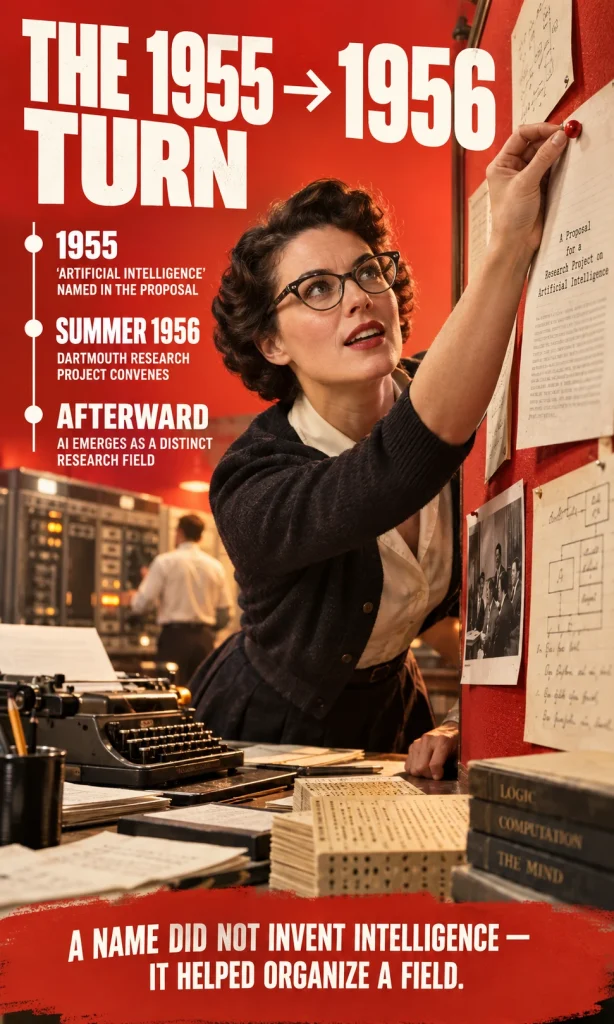
The practical importance of Dartmouth was organizational. A name gave researchers a way to gather different problems under one banner, argue over methods, attract students and funding, and build laboratories around a shared question. If you are new to the subject, the newcomer’s guide to artificial intelligence gives a broader path through the field after this historical starting point.
Why Lisp mattered to early AI
McCarthy’s next major contribution was not a theory about intelligence but a language for working with symbolic structures. His 1960 paper, “Recursive Functions of Symbolic Expressions and Their Computation by Machine”, described Lisp as a machine-independent system built around symbolic expressions and recursive functions. That fit early AI research unusually well because many problems involved representing and transforming symbols, rules, lists and expressions rather than only performing numerical calculations.
Lisp also blurred the distinction between program and data in a productive way: the language could represent programs in the same list-like structures it manipulated. That made experimentation with interpreters, symbolic reasoning and program transformation unusually natural. The later Lisp 1.5 manual, published by MIT Press, shows how the language became a practical research environment rather than just a mathematical notation.

None of that means modern machine learning is simply an extension of Lisp. Today’s data-intensive models often learn statistical patterns rather than rely on hand-written symbolic rules, and the relationship between symbolic AI and machine learning remains a major design question. For the distinction between the two ideas, see what is machine learning and what does it do.
Time-sharing changed how people worked with computers
Early computers were scarce and expensive, and many jobs were submitted in batches rather than explored interactively. McCarthy argued for time-sharing: dividing computer access so multiple users could work from terminals and appear to have responsive access to a shared machine. In a Computer History Museum oral history, he recalled wanting AI researchers to sit at a terminal, see what a program did, and improve it interactively.
That workflow mattered for AI because intelligent programs are hard to develop when every experiment requires a long batch-processing cycle. Faster interaction tightened the loop between idea, code, output and revision. Modern cloud computing is technically different from classic time-sharing, but the underlying expectation that many users can access shared computational resources interactively has a clear historical connection.
AI Origins Studio
Separate the shorthand from the history: explore what John McCarthy actually contributed, when it happened, and what each milestone does - and does not - prove.
Was McCarthy really “the founder” of AI?
He was one of AI’s principal founders, not the sole inventor. His unusual influence came from naming the field, organizing Dartmouth, creating Lisp, advancing time-sharing and leading logical-AI research.
1955 - A field gets a name
McCarthy led the proposal that used “artificial intelligence” as the name for a summer research project.
“Founding figure” is stronger history than “sole inventor.”
McCarthy’s contribution is large enough without flattening AI into a one-person origin story.
McCarthy’s deeper project: machines that can reason with knowledge
McCarthy’s long-term AI program was strongly logical. Rather than hiding all knowledge inside procedural code, he argued that important facts about the world could be represented declaratively and then used in reasoning. Stanford’s computer science memorial notes that this approach inspired decades of work on knowledge representation, default reasoning and context.
- Represent facts explicitly. An AI system should have statements about the world, not only opaque procedures.
- Reason toward goals. The machine should infer what action follows from its knowledge, current situation and objective.
- Handle incomplete knowledge. Everyday reasoning often requires sensible conclusions even when every exception cannot be listed in advance.
- Stay adaptable. A knowledge system should tolerate new facts and contexts without having to be rebuilt from scratch.
This led to work on commonsense reasoning, nonmonotonic logic, circumscription and formal context. The Stanford Encyclopedia of Philosophy describes McCarthy as the most influential figure in logical AI, while also noting that many modern machine-learning systems do not resemble his preferred logical architecture. That tension is still useful: it separates the broad goal of intelligent behavior from any single technical route to achieving it.
Why “father of AI” is shorthand, not literal authorship
AI’s early history is a network, not a straight line. Turing helped establish the computability framework and reframed machine intelligence as a testable behavioral question; Shannon helped create information theory and joined the Dartmouth proposal; Minsky helped shape early AI research; Newell and Simon built early symbolic problem-solving programs; Arthur Samuel developed self-improving game programs and popularized the term machine learning.

McCarthy’s role is still exceptional because he connected several layers at once: a name for the field, an influential organizing event, a language for symbolic work, interactive computing ideas, a major research laboratory and a long-running theoretical program. The more accurate phrase is therefore “one of the principal founders of artificial intelligence” rather than “the person who invented AI.”
How his ideas connect to AI in 2026
Modern AI includes statistical learning, neural networks, large-scale optimization, multimodal systems and large language models that differ sharply from McCarthy’s preferred logical methods. Yet several questions he treated as central are still recognizable: how should a machine represent knowledge, how can it reason about goals and context, what should count as intelligence, and how can interactive computing make experimentation faster?
His 2007 explanation described AI as the science and engineering of making intelligent machines, especially intelligent computer programs. That definition remains broad enough to include approaches McCarthy himself did not favor. For readers who want the modern picture rather than the biography, continue with the AI basics complete guide and the page on the emerging field of artificial general intelligence.
What to remember about John McCarthy
McCarthy’s historical importance comes from building a field, not from owning every idea inside it. He coined the name that stuck, helped convene the Dartmouth project, created Lisp, advanced interactive computing, helped establish major AI research institutions and spent decades trying to formalize how machines could represent knowledge and reason with common sense. Those achievements are substantial without turning a collective scientific history into a single-inventor story.
That is also the better way to read AI history. Instead of asking only who was “first,” ask which problem each researcher made tractable: naming the field, defining computation, representing knowledge, learning from data, building programs, scaling hardware, or connecting ideas into a research community. The article on philosophy of artificial intelligence continues that deeper question about what intelligent machines are actually supposed to mean.
Frequently Asked Questions
Did John McCarthy invent artificial intelligence?
No. He is one of AI’s principal founders and coined the term “artificial intelligence,” but the field emerged from many researchers and earlier ideas. His role was unusually influential because he combined field-building, programming-language design, computing infrastructure and a long-term research agenda.
When did John McCarthy coin the term artificial intelligence?
He used the term in the 1955 proposal for the Dartmouth Summer Research Project on Artificial Intelligence. The research project itself took place in the summer of 1956.
Why is the Dartmouth conference important in AI history?
It helped turn several lines of machine-intelligence research into a more recognizable field with a shared name and agenda. Historians often treat it as a formal starting point for AI as an organized discipline, not as the first appearance of every underlying idea.
What did Lisp contribute to artificial intelligence?
Lisp made symbolic expressions, lists, recursive functions and program manipulation convenient for researchers. Those properties matched the needs of early symbolic AI and helped make the language a long-lived research platform.
What did John McCarthy believe AI should do?
He emphasized systems that could represent facts, reason logically, pursue goals and handle commonsense knowledge. His approach is strongly associated with logical AI and knowledge representation.
Is modern AI based on McCarthy’s approach?
Only partly. Modern AI includes major statistical and neural approaches that differ from McCarthy’s logical program, but his questions about intelligence, knowledge, reasoning, goals and interactive computing remain part of the field’s intellectual foundation.