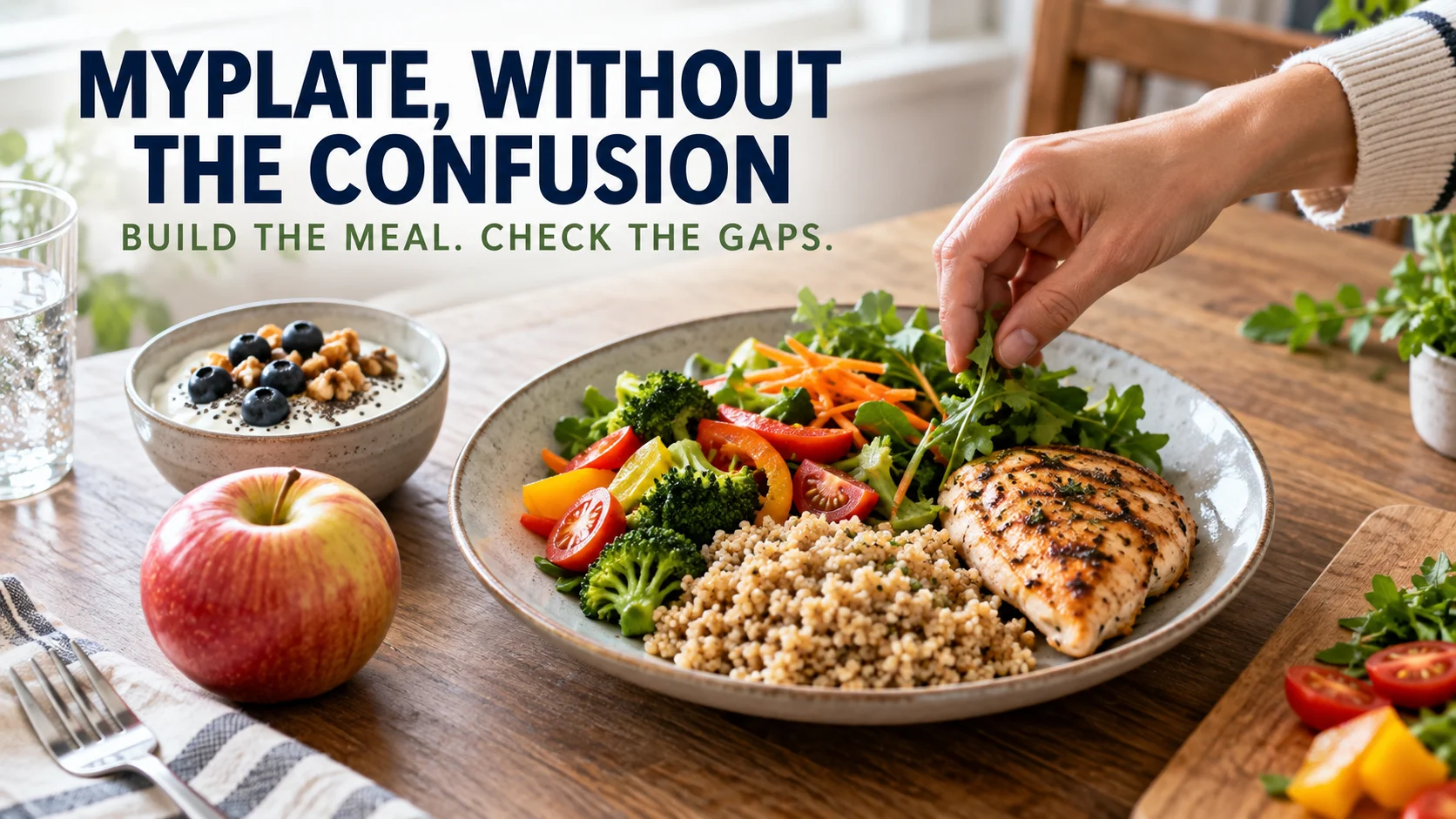

MyPlate is easiest to use as a visual check: make vegetables and fruit a major part of the meal, include a useful protein source, choose grains thoughtfully, and add dairy or an appropriate alternative when it fits. The important update is that MyPlate is no longer the whole story—the current 2025–2030 Dietary Guidelines for Americans place more emphasis on whole, nutrient-dense foods and reducing highly processed foods, so the plate graphic works best as a starting framework rather than a rigid formula.
If you are staring at a real lunch or dinner, do not begin by measuring every ingredient. First ask what is already doing the main jobs on the plate, then fix the most obvious gap.
What MyPlate actually shows
The familiar MyPlate graphic divides the main plate into four sections: vegetables, fruits, grains, and protein, with dairy shown separately. The classic MyPlate teaching message is that roughly half the plate should come from fruits and vegetables, while grains and protein share the other half.
That picture is useful because it gives you a fast visual check. It does not mean every meal has to look like four perfectly separated wedges, and it does not mean every food fits only one nutritional role.
| Part of the meal | What to look for | Practical examples |
|---|---|---|
| Vegetables | Color, variety, fiber-rich choices | Broccoli, leafy greens, carrots, peppers, cabbage, tomatoes |
| Fruit | Whole fruit more often than juice | Berries, oranges, apples, melon, bananas |
| Grains | Whole grains where practical | Oats, brown rice, whole-grain bread, barley |
| Protein foods | Variety and nutrient density | Fish, eggs, poultry, beans, lentils, tofu, nuts, seeds |
| Dairy or suitable alternative | A useful source of calcium and related nutrients | Milk, yogurt, cheese, lactose-free dairy, fortified soy alternatives |
If protein is the part you struggle to recognize, see foods with protein examples. For calcium-rich choices, the site also has a separate guide to best calcium foods.
What changed with the current federal nutrition guidance
The current federal Dietary Guidelines are the 2025–2030 edition. They emphasize whole, nutrient-dense foods-including protein, dairy, vegetables, fruits, healthy fats, and whole grains-and recommend reducing highly processed foods that are heavy in refined carbohydrates, added sugars, excess sodium, and less-helpful fats.
That does not make the MyPlate picture useless. It changes how you should read it. Instead of asking only, “Did I fill every section?”, ask a second question: “What is the quality of the food filling those sections?”
A grain section filled with a fiber-rich whole grain is different from one dominated by a highly refined snack food. A protein section based on beans, fish, eggs, tofu, poultry, or another nutrient-dense option is different from treating any processed meat as nutritionally interchangeable. The plate still helps with structure; food quality still matters.

Balanced Plate Reality Check
Mark what is already in your meal. The result shows what is covered, what may be missing, and the simplest next improvement.
What is in this meal?
Select the parts that are meaningfully present. Do not count a garnish as a full meal component.
Your meal check
Covered
Consider adding
Next easiest move
Start with the most obvious missing meal component.
A simple way to build a meal
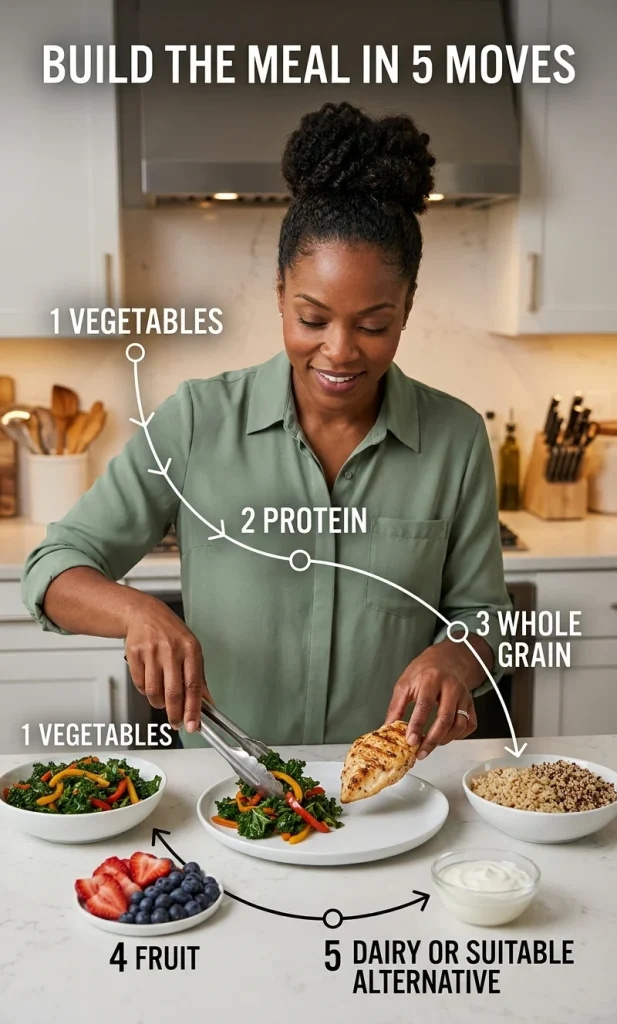
Start with the part of the meal that is hardest to add later: vegetables and protein. Once those are in place, add a grain or other carbohydrate source that suits the meal, then fruit or dairy where it makes sense.
- Anchor the meal with vegetables. They can be raw, roasted, steamed, stir-fried, frozen, canned, or mixed into a dish.
- Add a meaningful protein food. The protein does not have to be meat; beans, lentils, eggs, tofu, nuts, seeds, seafood, and poultry can all play that role.
- Choose the grain deliberately. Whole grains are useful when they fit the meal, but you do not need to force a grain into every plate.
- Add fruit when it helps complete the meal. Whole fruit is usually a more useful default than juice because it keeps the food structure and fiber.
- Use dairy or an appropriate alternative when it fits your diet. If you do not consume dairy, look at the nutrition profile of the substitute rather than assuming every plant beverage is nutritionally equivalent.
This approach is especially useful for family meals because it works without turning dinner into a nutrition worksheet. If you are planning meals for children, what is a healthy school lunch gives you another practical way to think about the same building blocks.
Mixed dishes still count
MyPlate becomes confusing when the meal is a curry, casserole, noodle bowl, soup, sandwich, burrito, or stir-fry because the food groups are not separated. The solution is not to abandon the framework. Break the dish into its functional parts.
A chicken-and-vegetable rice bowl, for example, already contains protein, vegetables, and grains. A bean burrito may combine protein, grains, vegetables, and dairy in one item. A vegetable soup may be rich in produce but still need a protein source or a more substantial side.
The practical question is not whether the plate looks like the MyPlate icon. It is whether the meal, once unpacked, has enough variety and nutrient-dense components to do the same job.
Where healthy fats fit
Healthy fats do not have their own classic MyPlate wedge, which is one reason the old plate graphic can feel incomplete. Foods such as nuts, seeds, olives, avocado, eggs, fish, and some dairy products can contribute fats while also fitting into other food categories or meal roles.
The current Dietary Guidelines explicitly include healthy fats in the broader “real food” pattern. So do not interpret the absence of a fat section on the MyPlate icon as a rule that a balanced meal should be fat-free.
MyPlate is not a portion prescription for everybody
The plate picture is a visual proportion guide, not a personalized medical diet. Actual food needs vary with age, body size, activity, pregnancy or breastfeeding, health conditions, medications, and goals.
That matters because two people can build plates with a similar visual balance and still need very different total amounts of food. The same person may also need different portions on a sedentary day than on a day with heavy training or physical work.
If you are trying to rebuild a routine rather than chase perfect portions, getting healthy eating habits back on track is a better next step than turning MyPlate into a strict measuring system.

Common MyPlate mistakes
Treating “half the plate” as a command to add fruit to every dinner
The classic visual groups fruits and vegetables together across about half the plate, but the exact split can vary. A savory dinner may be mostly vegetables with fruit eaten at breakfast or as a snack. The day matters more than forcing every plate to look identical.
Counting foods without checking quality
A meal can technically touch several food groups and still be dominated by highly processed foods. Use the plate to check coverage, then use ingredient lists and nutrition labels when packaged foods are doing most of the work. The guide to what information does a food label provide can help with that second check.
Assuming all dairy alternatives are nutritionally equal
They are not. Protein, calcium, vitamin D, added sugar, and fortification vary widely. If you use a plant-based substitute, compare the label rather than relying on the word “milk” on the front of the package.
Forgetting budget and convenience
Frozen vegetables, canned beans, oats, eggs, brown rice, seasonal fruit, and plain yogurt can all fit a balanced pattern without requiring expensive specialty foods. For a broader cost-focused approach, see healthy meal plans on a budget.
A better five-second plate check
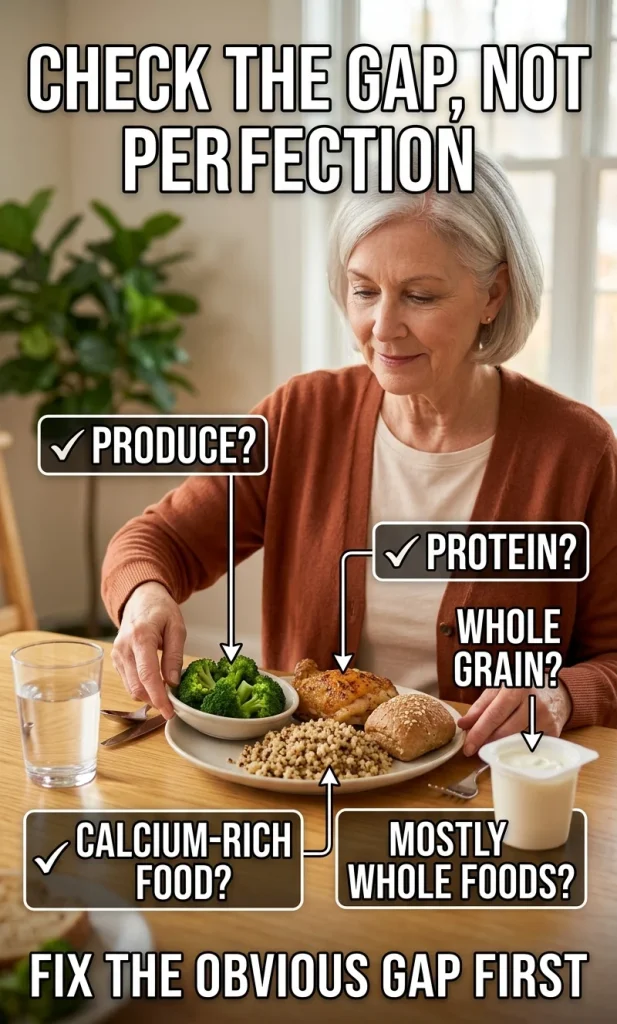
Before eating, look at the meal once and ask five short questions: Is there a substantial vegetable or fruit component? Is there a meaningful protein source? Is the grain or starch choice working for the meal? Is there a useful calcium-rich food somewhere in the day? Is the meal mostly built from recognizable, minimally processed foods?
If one answer is clearly “no,” fix that gap first. That is usually more useful than trying to make every plate geometrically perfect.
MyPlate works best as a pattern, not a pass-fail test
A healthy eating pattern is built across meals and days. Breakfast may be grain-, dairy-, and fruit-heavy; lunch may carry most of your vegetables; dinner may emphasize protein and vegetables. That can still be a balanced pattern even when no single meal looks exactly like the icon.
If you want a broader day-to-day framework, daily diet tips for eating healthy can help you turn the plate idea into a repeatable routine.
Frequently Asked Questions
What is MyPlate in simple terms?
MyPlate is a visual meal framework built around vegetables, fruits, grains, protein foods, and dairy. Its main value is helping you notice whether a meal is overly concentrated in one type of food and missing other useful food groups.
Is MyPlate still current in 2026?
MyPlate.gov is still available, but the current federal nutrition guidance is the Dietary Guidelines for Americans, 2025–2030. MyPlate can still be used as a simple visual framework, while the newer guidance adds stronger emphasis on whole, nutrient-dense foods and reducing highly processed foods.
Does half of every meal have to be fruits and vegetables?
The classic MyPlate visual uses fruits and vegetables for roughly half the plate, but it is better treated as a pattern than a geometric rule for every meal. Mixed dishes, cultural meals, snacks, and the balance of the whole day can all change how that proportion appears at a particular meal.
Where do healthy fats fit on MyPlate?
Healthy fats do not have a separate wedge on the classic MyPlate icon. They can come from foods such as nuts, seeds, avocado, olives, eggs, seafood, and dairy, and the current Dietary Guidelines include healthy fats within a broader whole-food eating pattern.
Can MyPlate work with bowls, curries, sandwiches, and casseroles?
Yes. Break the mixed dish into its main components and check which jobs are already covered: produce, protein, grains or starches, and calcium-rich foods where appropriate. Then add the missing component instead of trying to rearrange the meal into literal plate sections.