Treat “Prank Activity” here as a prank-game category rather than a verified commercial title. The best prank games make the joke easy to understand, give you enough control to create the payoff, and stay funny without burying the experience under repetitive levels, unsuitable humor, or constant interruptions.
If you are choosing one for yourself, children, friends, or a family game night, start with four checks: the type of humor, how the prank is performed, the age rating, and the way the game is monetized. Those details tell you far more than a cheerful store thumbnail or a promise of “endless laughs.”
Quick answer: which kind of prank game should you choose?
| If you want… | Look for… | Check before installing |
|---|---|---|
| Short, silly laughs | Reaction-based or chaos games | Ad frequency and repetition |
| A little thinking | Puzzle-prank games | Puzzle difficulty and hint system |
| Sneaking and timing | Mischief simulation or stealth-prank games | Controls, checkpoints, and failure penalties |
| Laughing with other people | Local or online social prank games | Actual multiplayer mode, player count, and moderation |
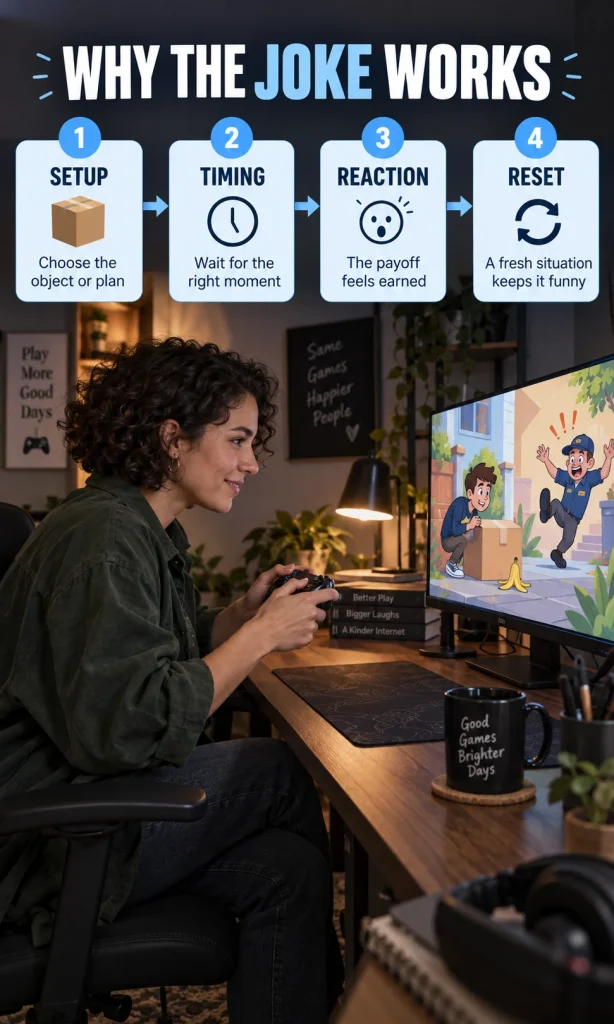
A prank game works when the setup, timing, reaction, and reset are all satisfying. If one part is weak – for example, the “prank” is just tapping a glowing object and watching the same animation again – the joke usually wears out quickly no matter how colorful the presentation looks.
What makes a prank game fun instead of annoying?
The strongest games give the player some authorship over the joke. You might choose an object, wait for a character to move into position, combine props, create a chain reaction, or decide when to trigger the payoff. That small amount of agency matters because laughter is more satisfying when you feel responsible for the timing rather than simply watching a canned scene.
Variety matters just as much. A good prank loop introduces a new location, reaction, rule, character behavior, or way to use familiar objects before the previous joke becomes stale. A weak loop often disguises repetition with new costumes or background art while asking you to perform essentially the same action.
The final ingredient is friction. Simple controls can be a strength in comedy games because the challenge should come from reading the scene and timing the trick, not wrestling with the interface. Ads, energy systems, excessive pop-ups, and long waits can destroy the rhythm faster than a difficult level does.
Choose the humor style before you choose the game
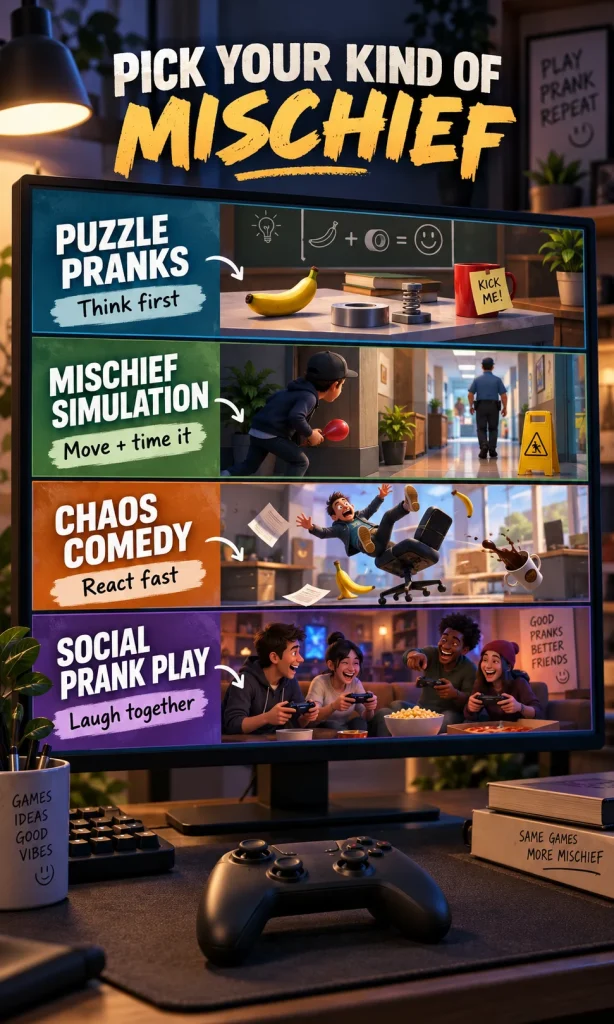
“Prank game” covers several very different experiences. Puzzle-prank games ask you to inspect a scene and find the unexpected solution, while mischief simulations let you move around a space and create trouble through objects and timing. Chaos games are more immediate, trading careful setup for exaggerated reactions, physics, or slapstick.
Social prank games add another layer because the fun comes partly from the people playing with you. If that is what you want, confirm that the store page actually lists local co-op, online multiplayer, or another shared mode; do not assume a funny game is automatically a party game. For more group-oriented choices, you can also compare the broader ideas in 21 of the best video games for couples.
For younger players, “funny” is not the same as “suitable.” Look at the official content rating, the reason for that rating, whether the game contains chat or user-generated content, and whether in-app purchases can be made easily. A harmless-looking cartoon can still contain crude humor, mild violence, advertising, or purchasing prompts that change whether it fits your household.
- Choose puzzle pranks if you enjoy spotting clues, experimenting with objects, and solving short scenes.
- Choose mischief simulation if you want freedom to move, hide, time actions, and cause chain reactions.
- Choose chaos or smash comedy if you want immediate reactions and do not mind a simpler gameplay loop.
- Choose social prank play if the laughter between players matters more than a deep campaign.
- Choose carefully for children by checking the official rating, ads, purchases, chat, and account requirements first.
Real prank-game examples show how different the category can be
Current mobile listings make the differences easy to see. Do Not Disturb Funny Prankster is built around provoking reactions from a grumpy virtual character, while Tricky Prank: Brain Quest uses short brain-teaser scenes and object interactions. The shared word “prank” does not mean they offer the same kind of play.
Other listings push the idea toward stealth, action, or multiplayer. Zoo Prank: Crazy Animals combines pranks with sneaking and action-oriented scenarios, while Sneak Squad: Partners in Prank explicitly promotes multiplayer prank play. Availability, ratings, monetization, and features can change, so use the official listing as the final check rather than treating any roundup as permanent.
The useful question is therefore not “Which prank game is the funniest?” It is “Which loop matches the way I like to play?” A puzzle fan may enjoy ten minutes of clever scene solving more than an hour of slapstick physics, while a group looking for party energy may prefer a shallower game that creates quick shared reactions.
Platform also changes the experience. Mobile prank games often suit short sessions and touch controls, but their monetization can be more intrusive; PC and console games may offer longer sessions or stronger controls but require a purchase and a larger time commitment. If you are specifically browsing mobile entertainment, 10 games you must play on your new iPhone gives you a wider set of ideas beyond prank-themed games.
Replay value is the final separator. A prank is funniest when you do not know exactly what will happen, so games with alternative solutions, different character responses, sandbox interaction, multiplayer variation, or genuinely new scenarios tend to last longer than games built around one correct tap per level.
| Prank-game style | Best for | Main risk | Good sign |
|---|---|---|---|
| Puzzle prank | Quick thinking | Obvious or repetitive answers | Multiple interactions and escalating logic |
| Mischief simulation | Exploration and timing | Clumsy controls | Readable AI behavior and flexible objectives |
| Chaos comedy | Instant laughs | Novelty fades quickly | Varied reactions, physics, or scenarios |
| Social prank | Friends and family | Weak matchmaking or unclear player modes | Clear local/online mode and player count |
What to check before you install or buy
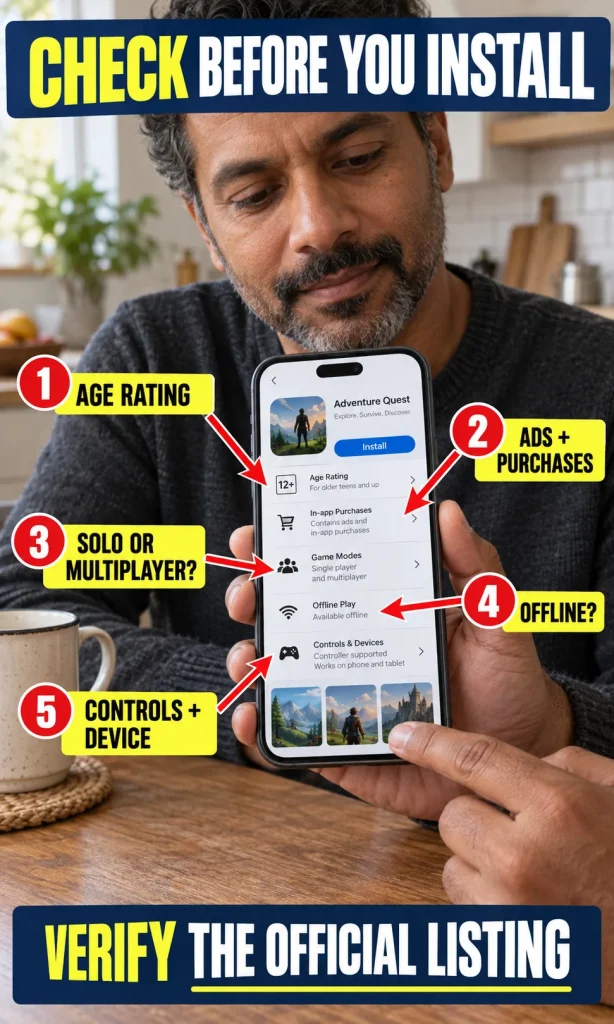
Start with the official store page instead of screenshots shared elsewhere. Confirm the supported device, age/content rating, single-player or multiplayer mode, offline capability, controller requirements, advertising, and in-app purchases. If one of those points matters to you and the listing is vague, treat that uncertainty as a reason to keep comparing.
Then look at how the game asks you to perform the prank. Touch-and-drag object puzzles can feel excellent on a phone but awkward on a controller, while free-movement stealth games need responsive movement and a camera that does not fight you. Simple controls are not a weakness when they serve the joke; unclear controls are.
Finally, separate “family-friendly presentation” from actual family fit. Check the rating reasons, purchasing settings, online interaction, privacy information, and the patience level of the people who will play. If the real goal is a relaxed group night rather than prank-specific humor, a broader party game may be the better match; our Mario Party Superstars review is one example of that different route.
Use the Prank Game Fit Studio before you start browsing
A store search can throw dozens of similarly named prank games at you, so it helps to decide what you actually want before comparing titles. The experience below turns your preferred humor, play setting, session length, device, and deal-breakers into a clear prank-game style to search for, without inventing a numerical “fun score.”
Find your prank-game style
Prank Game
Fit Studio
Match the kind of mischief to the way you actually like to play before you install or buy.
YOUR BEST-FIT STYLE
—
—
Why it fits
Check before installing
A GOOD SECOND OPTION
—
—
This experience recommends a prank-game style, not a specific title. Store listings, ratings, ads, purchases, modes, and availability can change, so verify the official listing before installing or buying.
When a prank game stops being funny
The most common failure is repetition disguised as progression. If every level asks you to find one highlighted object and triggers a nearly identical reaction, the game may be amusing for five minutes but offer little reason to continue. The same is true when a game constantly interrupts its comedic timing with ads, reward prompts, or forced waits.
Humor can also miss because it is personal. Slapstick, gross-out jokes, teasing, jump scares, and humiliation comedy do not land equally for everyone, and a content rating only gives you a floor for suitability rather than a promise that the tone will suit your group. Choosing by humor style is therefore just as important as choosing by difficulty or platform.
Frequently Asked Questions
Is Prank Activity a specific video game?
This page treats “Prank Activity” as a description of prank-style video game play rather than making unsupported claims about a single commercial title. Use the official store listing whenever you need to verify a specific game’s platform, modes, rating, purchases, or current availability.
What type of prank game is best for short sessions?
Puzzle-prank and reaction-based games usually fit short sessions well because each scene can deliver a setup and payoff quickly. Check that ads or loading screens do not take more time than the actual puzzle or joke.
How can I tell whether a prank game is suitable for children?
Check the official age/content rating and its reasons, then review ads, in-app purchases, chat, user-generated content, privacy information, and whether the humor itself fits your household. A colorful cartoon style alone is not enough to judge suitability.
Are prank games usually multiplayer?
No. Many prank games are single-player puzzle or simulation experiences, while some are built around multiplayer mischief. Confirm local co-op, online multiplayer, and player count on the official listing instead of assuming the mode from the game’s theme.
What makes a prank game replayable?
Replay value improves when the game gives you alternative solutions, different character reactions, flexible environments, multiplayer variation, or new rules rather than repeating one scripted interaction. Surprise is a major part of comedy, so predictable repetition works against the genre.
Next step: decide what kind of laugh you want
Choose the prank loop first, then verify the store details. If you want cleverness, start with puzzle pranks; if you want movement and timing, look at mischief simulation; if you want instant reactions, try chaos comedy; and if the people beside you are the main attraction, prioritize a real social mode over the word “prank” in the title.