



The best niche is not simply a topic you enjoy; it is a specific group of buyers with a recurring problem, a reason to act, and enough evidence that they will consider paying for a solution. Your target market can be broader than the niche you test first, but the first offer should usually be narrow enough that you can name the buyer, problem, trigger, alternatives, and route to reach them.
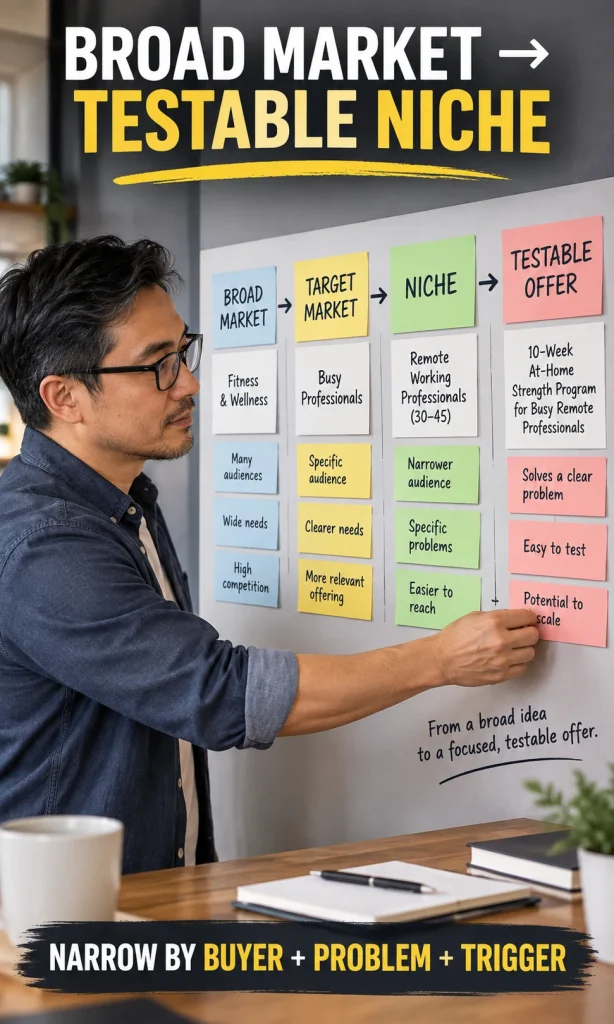
A useful way to think about the sequence is: market first, segment second, niche third, offer last. If you reverse that order and build the offer before you understand the buyer, you can end up polishing a product for a market that is difficult to reach or does not care enough to switch.
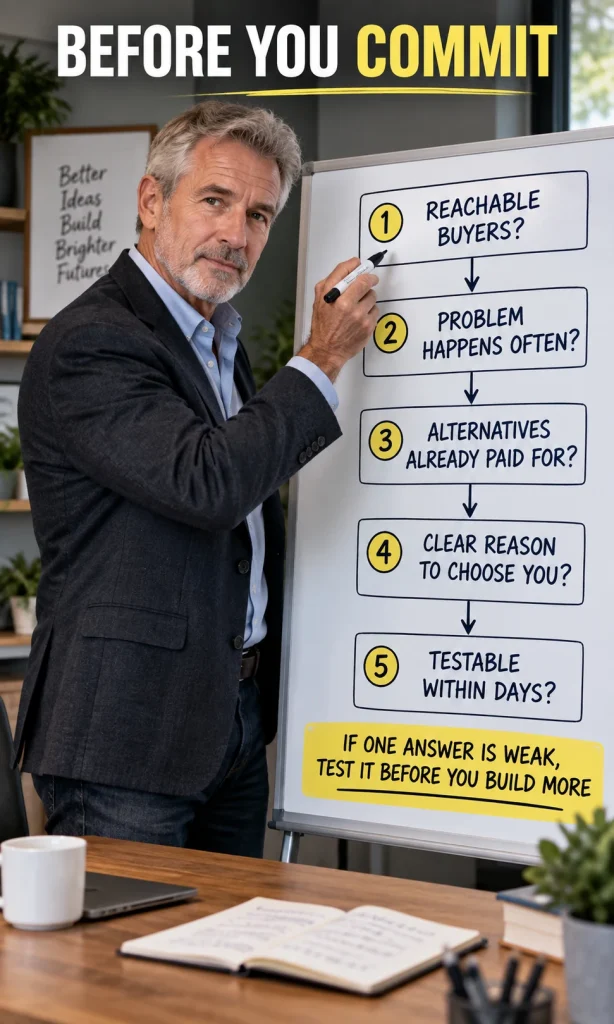
Your niche is ready for testing when you can answer five practical questions without relying on vague assumptions.
- Who is the buyer? Name the person, household, team, or business type that makes the purchase decision.
- What problem or desired outcome matters? Describe the job they are trying to get done in plain language.
- What triggers action? Identify the moment, event, frustration, deadline, cost, or risk that makes the buyer look for a solution.
- What do they use now? Include direct competitors, manual workarounds, internal solutions, and the option to do nothing.
- What evidence exists? Look for behavior – searches, inquiries, repeated complaints, existing spending, sign-ups, deposits, or sales – not enthusiasm alone.
Niche, target market, and target audience are not the same thing
A target market is the larger group of customers your business could realistically serve. A niche is a narrower part of that market where the customer, problem, context, or buying trigger is specific enough to shape a focused offer. A target audience is usually the subset you are addressing in a particular campaign, channel, or message.
That distinction matters because many weak niche statements are only demographic descriptions. “Women aged 30-45” is a segment, but it does not explain what they are trying to solve, why they would buy now, or why your offer is more relevant than the alternatives.
| Layer | Example | What it tells you |
|---|---|---|
| Broad market | Fitness and wellness | The general category, but not yet a practical buying decision. |
| Target market | Busy professionals who exercise at home | The broader group your business may serve. |
| Niche | Remote professionals who need short strength sessions without gym travel | The specific buyer-problem context you can research and test. |
| Target audience | Remote team leaders reached through a LinkedIn campaign | The people a particular message or campaign is addressing. |
Step 1: Start with a problem you can understand, not passion alone
Skills, experience, and genuine interest are useful because they reduce your learning curve and can make it easier to understand a customer’s language. They are not proof of demand. A better starting point is the intersection between what you can credibly deliver and a problem that real buyers already spend time, money, effort, or attention trying to solve.
List the customer problems you have seen directly through work, hobbies, client conversations, communities, or your own repeated experience. Then separate problems that are merely annoying from problems that create a meaningful cost, delay, inconvenience, missed opportunity, risk, or strong desired outcome.
If you are still evaluating whether the underlying idea deserves further work, use the process in how to know if your business idea is good before you invest heavily in branding or development.
Step 2: Define the buyer more precisely than an age range
Demographics can matter, especially for location, pricing, regulation, household needs, or media selection, but they are rarely enough on their own. Add behavioral and situational detail: what the customer is trying to accomplish, what they already use, what has failed, what they value, who approves the purchase, and what event makes the problem urgent.
For a consumer offer, the buyer and user may be the same person. For B2B, they may be different: a team uses the product, a manager champions it, procurement approves it, and finance pays for it. A niche becomes more useful when you know whose problem you are solving and whose decision you must win.
Step 3: Add the buying trigger
A target customer can fit your demographic profile and still have no reason to buy today. The buying trigger explains when the need becomes active. Examples include moving home, hiring a first employee, missing a deadline, reaching a new growth stage, receiving a diagnosis, starting a renovation, losing access to an existing supplier, or becoming frustrated enough with a workaround to look for something better.
Triggers make research more precise because they tell you where to look for customers and what language is likely to appear in search queries, communities, reviews, and sales conversations. They also prevent a common mistake: defining a niche so broadly that the marketing message has no immediate reason to exist.
Step 4: Measure demand with more than one kind of evidence
Market research should combine broad data with direct customer evidence. The U.S. Small Business Administration’s market-research guidance recommends examining demand, market size, location, saturation, pricing, and direct research methods such as interviews and surveys. For U.S. businesses, Census Business Builder can add demographic, economic, and business data by geography; outside the United States, use the equivalent official statistical source for your market.
Search behavior can reveal interest and language, but it should not be treated as proof of sales. Google explains that Trends data is sampled and normalized, which makes it useful for relative interest, seasonality, and regional comparison rather than as an exact count of buyers or a guarantee of demand.
| Evidence | What it can tell you | Main limitation |
|---|---|---|
| Search trends and recurring questions | Whether people repeatedly seek information about the problem. | Interest does not reveal who will pay. |
| Competitor offers and prices | Whether customers already spend money on alternatives. | Existing competition does not prove room for your positioning. |
| Customer interviews | Language, context, failed workarounds, buying process, and objections. | People can be supportive without taking action. |
| Inquiries, sign-ups, bookings, deposits, or sales | Whether people are willing to take increasingly meaningful action. | Small tests may not represent the whole market and must be interpreted in context. |

Step 5: Study the alternatives, not just obvious competitors
Your competition is any option a buyer can choose instead of you. That may be another company, a spreadsheet, a freelancer, an internal team, a free resource, a marketplace, a general-purpose product, or simply postponing the decision. Researching only companies with the same label can hide the real reason customers do not switch.
For each alternative, record what it promises, who it appears to serve, how it charges, what customers praise, what customers complain about, and which part of the buying process creates friction. The goal is not to imitate competitors. It is to identify where your target customer remains underserved and whether you can address that gap credibly.
If your offer is still taking shape, compare the niche decision with the practical validation steps in how to test business ideas. The two decisions are connected: the niche defines who and what to test; the validation process tells you whether the market responds.
Step 6: Check reachability and economics before you call the niche “profitable”
A niche can have real demand and still be a poor fit if customers are expensive to reach, purchase too rarely, expect a price that cannot support delivery, or require more sales effort than the margin can absorb. Before you use the word profitable, estimate how customers discover the solution, how often the need occurs, what alternatives cost, what your offer costs to deliver, and how many sales you would need for the business model to work.
This is where market selection connects with the broader business model. A low-frequency purchase can still work if the transaction value is high; a low-price offer may work if repeat purchases or efficient distribution are realistic. If you are designing a service business, the distinctions in types of business models for services can help you see how delivery structure changes the economics of a niche.
Step 7: Write a niche statement you can actually test
A practical niche statement should be specific enough to guide research but flexible enough to change when evidence contradicts your assumptions. Use this working structure:
We help [specific buyer] solve [specific problem or achieve specific outcome] when [trigger/context] by [offer or approach], especially when [important constraint or reason alternatives fall short].
For example: “We help remote professional teams reduce missed handoffs during rapid onboarding by giving managers a compact role-and-workflow setup they can deploy without a full HR system.” That is more testable than “productivity software for businesses” because it names the buyer, the problem, the context, and the constraint.
If your business plan is already underway, carry the niche statement into the market-analysis and customer-segment sections described in the concept of business planning. The statement should influence positioning, channels, product scope, pricing research, and the evidence you collect next.
Niche and target-market decision support
Market Focus Studio
Turn a broad idea into a specific buyer, problem, trigger and evidence-backed market test.

Working status
Your testable niche statement
Target-market profile
Evidence check
Best next test
Planning heuristic only. Recheck the niche when new customer behavior, pricing, channel or competitor evidence changes the decision.
Step 8: Validate the niche with the smallest credible market test
Do not wait for perfect certainty. Choose the smallest test that forces the market to do something observable: request information, book a call, join a waitlist, start a trial, ask for a quote, place a deposit, preorder, or buy. The appropriate action depends on the business, price, trust requirements, and how close the offer is to being deliverable.
Before spending money on ads, check whether you can reach prospective buyers directly through existing relationships, communities, partnerships, search demand, marketplaces, events, or outbound contact. Paid traffic can be useful, but a weak response may reflect the channel, message, offer, or landing page rather than the niche itself.
How to know whether to narrow, broaden, or change the niche
Narrow the niche when the message is too generic, different buyer types have different problems, acquisition channels are scattered, or the same offer cannot serve the whole segment without major compromises. Narrowing should clarify the buying decision, not merely reduce the population.
Broaden the niche when you repeatedly win adjacent customers for the same underlying reason, the problem and buying process remain similar, and your delivery model can serve them without losing relevance. Broaden from evidence, not from impatience.
Change the niche when repeated tests show weak urgency, weak willingness to act, no workable acquisition route, or economics that do not improve even after the offer and message have been corrected. A niche is a working business hypothesis, not an identity you must defend.
A simple niche-research workflow
- Write down three customer problems you understand well.
- Choose one buyer group for each problem.
- Name the buying trigger and current alternatives.
- Check search behavior, communities, official market data, competitor offers, and customer language.
- Talk directly with prospective buyers and ask about the last time the problem occurred, what they tried, and what the outcome cost them.
- Create one focused offer and one clear reason to choose it.
- Run a small behavioral test and record what people actually do.
- Use the result to narrow, broaden, revise, or stop before you commit more resources.
That sequence turns “find your niche” from a branding exercise into a market-learning process. The goal is not to discover a permanently perfect niche in one attempt; it is to reach a sufficiently clear, evidence-backed starting position that your next test teaches you something useful.
Frequently Asked Questions
What is the difference between a niche and a target market?
A target market is the broader group of customers your business could serve. A niche is a more specific part of that market defined by a tighter combination of buyer, problem, context, trigger, or desired outcome. You can operate within a broad target market while testing one narrow niche first.
Can a niche be too small?
Yes. A niche may be too small if the reachable number of buyers, purchase frequency, transaction value, or margin cannot support the business. The relevant size depends on the economics: a specialist B2B service may need far fewer customers than a low-price consumer product.
Should I choose a niche based on passion?
Passion can help with persistence and domain learning, but it is not enough. A business niche also needs a reachable buyer, a meaningful problem or outcome, evidence of demand, workable economics, and a credible reason customers might choose your offer.
How do I know whether people will pay?
Look for behavior rather than compliments. Existing spending on alternatives, quote requests, bookings, sign-ups, trial starts, deposits, preorders, and sales provide more useful evidence than a general statement that someone likes the idea. The strength of each signal depends on how close it is to the real buying decision.
How long should I test a niche before changing it?
There is no universal time limit. Change the niche when you have enough relevant evidence to identify the weak assumption – for example, urgency, reachability, willingness to act, pricing, or differentiation – and repeated attempts to correct the offer or channel do not improve the result.
Can I have more than one niche?
Yes, but it is usually easier to validate one clearly defined niche at a time. Add adjacent niches after you understand why the first one buys, how you reach it, and whether the same offer and economics still work for the next segment.
Next step
Write one niche statement, identify the weakest assumption inside it, and design a test that gives you observable evidence about that assumption. If the buyer, problem, trigger, alternatives, reachability, and response all become clearer, you are no longer guessing at a niche – you are building a market position from evidence.