

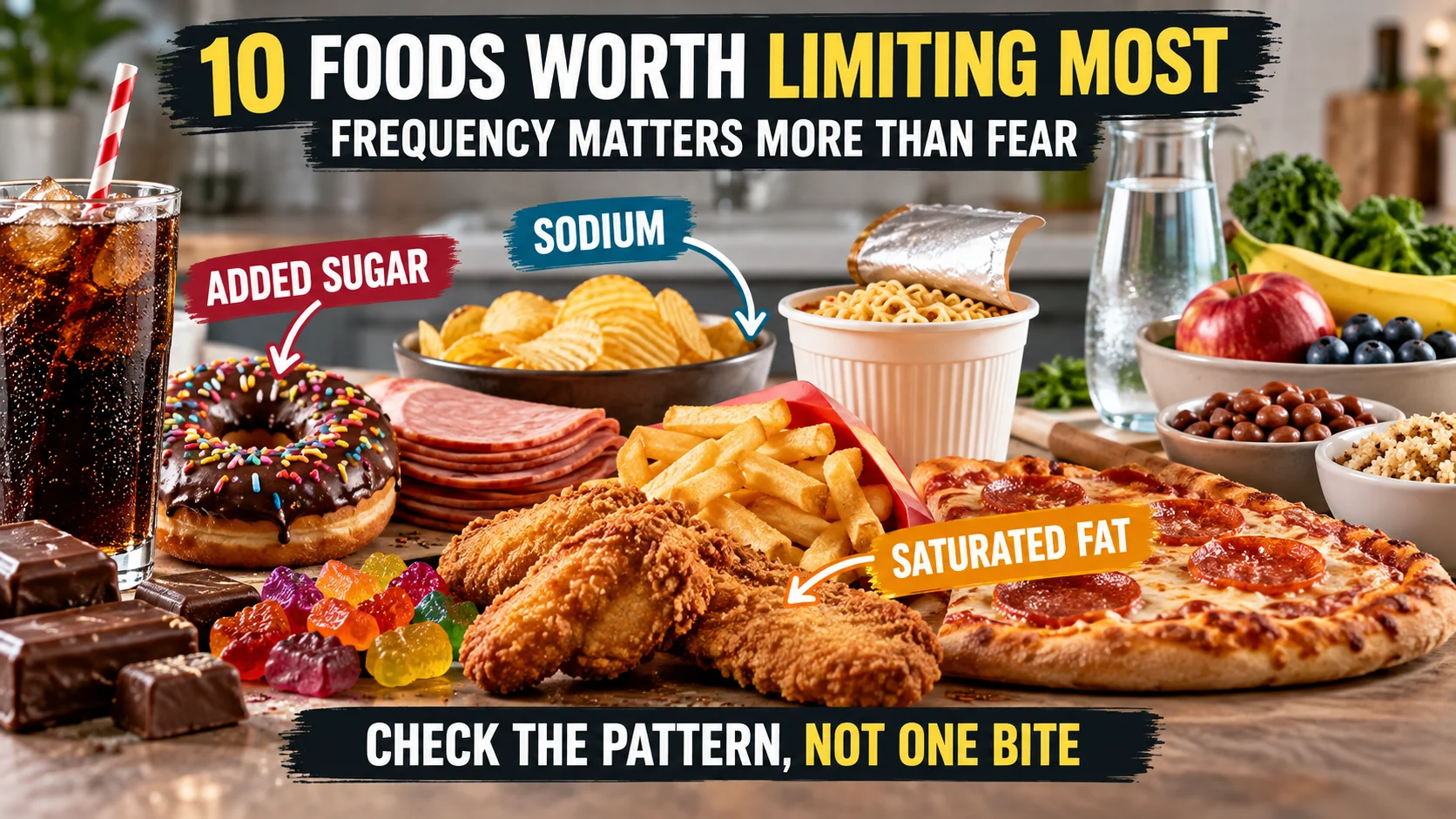

There is no official scientific ranking of the ten “worst” foods, and one serving does not make an otherwise balanced diet unhealthy. The more useful question is which foods are easiest to overconsume repeatedly while adding a lot of added sugar, sodium, saturated fat, processed meat, or very little fiber and nutrient density.
That changes how this list should be used. Treat it as a priority guide for foods worth limiting most often, then compare the serving size and nutrition label before deciding what deserves the biggest change in your own routine.
The 10 foods worth limiting most often
| Food or drink | Why it moves up the list | Better default |
|---|---|---|
| 1. Sugar-sweetened drinks | Added sugar can accumulate quickly in liquid form without adding fiber. | Water, sparkling water, unsweetened tea or coffee. |
| 2. Processed meats | Often high in sodium; processed meat also has a separate colorectal-cancer evidence concern. | Fish, poultry, beans, lentils, tofu, eggs, or minimally processed meat. |
| 3. Deep-fried fast foods | Can combine refined starch, sodium and substantial fat in a high-energy portion. | Grilled, baked or air-cooked options with vegetables or a whole-food side. |
| 4. Packaged doughnuts, cakes and pastries | Commonly combine refined flour, added sugar and saturated fat. | Fruit, plain yogurt with fruit, oats, or a smaller occasional dessert. |
| 5. Candy and sugar-heavy confectionery | High added-sugar density with little fiber or protein to balance the snack. | Fruit, nuts, or a smaller portion paired with a more filling food. |
| 6. Salty chips, puffs and similar snacks | Easy to eat beyond one serving while sodium and refined starch add up. | Unsalted nuts, vegetables with dip, or lower-sodium whole-grain snacks. |
| 7. High-sodium frozen pizza and ready meals | A single meal can concentrate sodium and saturated fat, especially when the package contains multiple servings. | Compare labels; choose lower-sodium meals and add vegetables or a simple home-cooked component. |
| 8. Sugar-heavy refined breakfast cereals and bars | A “breakfast” label can hide a dessert-like added-sugar load and low fiber. | Oats, higher-fiber cereal with less added sugar, eggs, fruit or plain yogurt. |
| 9. Instant noodles and cup soups | The seasoning packet can make sodium the dominant issue while the meal remains low in vegetables and fiber. | Use less seasoning and add vegetables plus a protein, or choose lower-sodium soup. |
| 10. Foods made with industrial trans fat where still present | Industrial trans fat has no nutritional advantage and is specifically targeted for elimination in public-health guidance. | Choose products made with unsaturated oils and check the ingredient list where trans fat remains a concern. |
This is deliberately not a toxicity ranking. A food can move up or down in importance depending on portion, frequency, the rest of the diet, medical needs, and the exact product formulation. If you want a broader foundation before changing individual foods, start with food basics and build the pattern first.
1. Sugar-sweetened drinks
Soda, sweetened tea, fruit drinks and many energy drinks can deliver a large dose of added or free sugar without the fiber that comes with whole fruit. That makes beverages one of the simplest places to reduce sugar without shrinking the amount of actual food on the plate.
The World Health Organization healthy-diet guidance recommends limiting free sugars and notes that foods high in free sugars, sodium and unhealthy fats should be limited. A practical first move is not “never drink anything sweet”; it is to stop making a sweet drink the automatic drink with every meal.
2. Processed meats
Bacon, hot dogs, sausages, salami and many deli meats commonly bring a large sodium load. Processed meat also deserves separate attention because the concern is not limited to salt or saturated fat.
The International Agency for Research on Cancer review of processed meat concluded that the evidence is sufficient that processed meat causes colorectal cancer; the Group 1 classification describes the strength of the evidence, not that eating bacon carries the same magnitude of risk as smoking. For routine meals, replacing some processed-meat servings with beans, lentils, fish, poultry, tofu, eggs or minimally processed meat is a more useful strategy than arguing over whether one sandwich is “bad.”
3. Deep-fried fast foods
French fries, fried chicken meals and similar fast-food combinations can stack several things at once: refined starch, salt, frying fat, a large portion and a calorie-dense sauce or sweet drink. The problem is rarely one ingredient in isolation; it is the complete meal becoming a frequent default.
If fast food is unavoidable, change one high-impact component. Water instead of soda, a grilled main instead of a fried one, a smaller fried side, or adding a vegetable can reduce the load without requiring a “perfect” order.
Use the label instead of the food name alone
Two products in the same category can have very different nutrition profiles. On a U.S. Nutrition Facts label, the FDA Daily Value guide treats 5% Daily Value or less per serving as low and 20% or more as high; it also encourages choosing foods lower in saturated fat, sodium and added sugars and higher in dietary fiber.
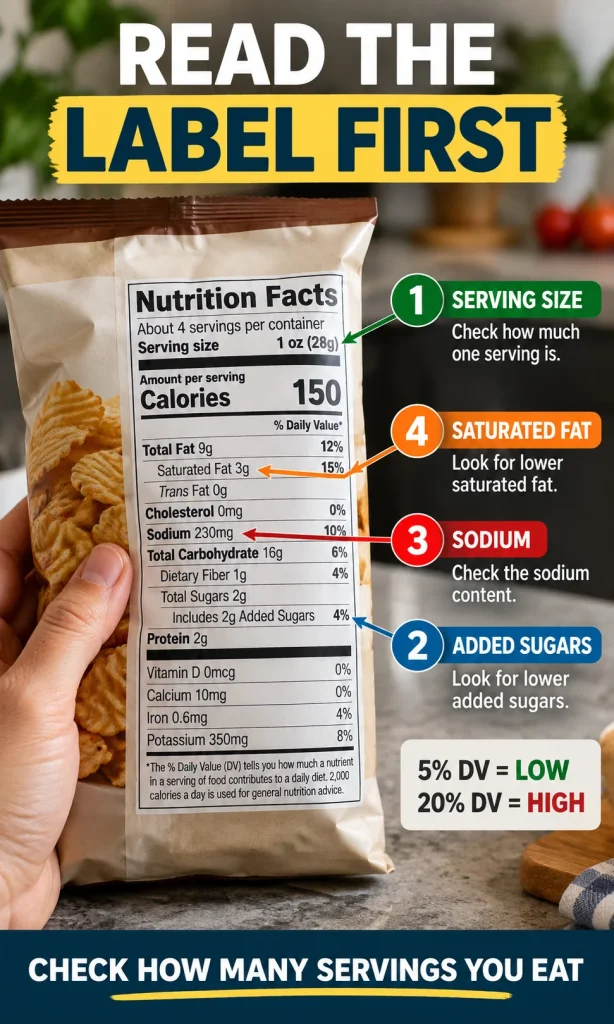
The serving-size check comes first because the label is written per serving. If the package lists 18% Daily Value for sodium but you usually eat two servings, the amount you actually consume is roughly double the sodium shown for one serving.
COMPARE WHAT YOU ACTUALLY EAT
Label Load Check
Enter the label values and the number of servings you eat. See which tracked nutrient contributes the most to the U.S. Daily Value - without calling the food “good” or “bad.”

STEP 1
Enter one food or drink
Reference values use the FDA Nutrition Facts Daily Values for a 2,000-calorie diet: added sugars 50 g, sodium 2,300 mg, saturated fat 20 g, and fiber 28 g. Individual needs can differ.
STEP 2
See the biggest contribution
Results will show the amount you entered, not a universal rating of the food.
Check the package serving size first. Then compare similar foods on the nutrient that contributes the most.
This experience compares only four label values. It does not assess allergies, medical conditions, calories, vitamins, protein quality, ingredient safety, or your full dietary pattern.
4. Packaged doughnuts, cakes and pastries
Packaged pastries often combine refined flour, added sugar and saturated fat in a compact portion. Their biggest weakness is usually not that they are “toxic”; it is that they can contribute a lot of energy while providing less fiber and satiety than a meal or snack built around whole foods.
If you enjoy them, portion and frequency are the useful controls. A pastry chosen occasionally is a very different pattern from a pastry plus sweet coffee becoming breakfast every morning.
5. Candy and sugar-heavy confectionery
Candy is easy to identify as a sweet, which is actually an advantage: you know what job it is doing. The issue appears when candy, sweet drinks, sweetened breakfast foods and desserts all stack into the same day, pushing added sugar up through several small choices.
Instead of searching for a “healthy candy” label, decide what you want from the snack. If the job is fullness, choose fruit, nuts, yogurt or another snack with fiber or protein; if the job is enjoyment, keep the sweet as the sweet and use an intentional portion.
Why frequency matters more than a forbidden-food list
A list can identify common pressure points, but it cannot see your pattern. Someone who drinks soda twice a day has a different priority from someone who drinks water but relies on processed meat and instant noodles for most meals.

Start with the category you eat most often and that contributes the biggest label load. This approach also fits the practical advice in getting healthy eating habits back on track: repeatable defaults usually matter more than a short burst of dietary perfection.
6. Salty chips, puffs and similar snacks
Salty snack foods are often eaten directly from a large bag, so portion size can drift without much friction. Sodium is the obvious label check, but also compare fiber and whether the snack actually keeps you satisfied long enough to be useful.
A smaller bowl rather than the bag is a simple control. If sodium is already high elsewhere in the day, a lower-sodium snack or unsalted nuts may be the more meaningful swap; see the site’s guide to foods low in sodium for more ways to make that comparison.
7. High-sodium frozen pizza and ready meals
Ready meals can be convenient and still fit into a balanced diet, but the label deserves more attention than the marketing on the front of the box. Sodium and saturated fat can climb quickly, and one package may contain more than one labeled serving.
Compare similar meals on the same serving basis. A useful ready meal gives you convenience without forcing you to spend most of the day’s sodium budget in one sitting, and it becomes stronger nutritionally when it includes vegetables, a reasonable protein source and some fiber.
8. Sugar-heavy refined breakfast cereals and bars
Breakfast foods can look nutritious because the package mentions vitamins, grains or energy. That does not cancel a high added-sugar load or low fiber, so compare the Nutrition Facts panel rather than relying on category reputation.
A better cereal default usually has more fiber and less added sugar, with milk or yogurt and fruit if those foods suit you. This is also why broad “healthy” labels need scrutiny; the site’s guide to healthy foods that are not always healthy covers the same front-of-pack problem from another angle.
9. Instant noodles and cup soups
Instant noodles are cheap, fast and shelf-stable, so telling people simply to “never eat them” ignores why they are useful. The practical weakness is often the seasoning packet: sodium can dominate the meal while vegetables, fiber and protein remain limited.
Use less of the seasoning, add frozen vegetables, and add an egg, tofu, chicken, beans or another protein that fits the dish. The result is still convenient, but the meal is less dependent on the packet for flavor and more complete nutritionally.
10. Foods made with industrial trans fat where still present
Industrial trans fat is different from the other entries because the public-health goal is elimination rather than balancing a useful nutrient. Availability and labeling vary by country, so this matters most where partially hydrogenated oils or other industrial trans-fat sources are still present in the food supply.
Check the ingredient list when that risk is relevant in your market. The broader rule is simple: prefer unsaturated fats from foods and oils such as nuts, seeds, fish, avocado and liquid plant oils over products designed around industrial trans fat.
How to improve the pattern without overhauling everything
Use one change that removes the biggest repeated load first. If sweet drinks dominate your added sugar, changing a snack while keeping two sodas a day misses the higher-impact opportunity; if sodium is your main issue, replacing a low-sodium dessert is not the priority.
- Added sugar is the biggest load: start with sweetened drinks, sweet coffee, candy or packaged desserts you consume most often.
- Sodium is the biggest load: compare processed meats, instant meals, soups, sauces and salty snacks before worrying about naturally low-sodium foods.
- Saturated fat is the biggest load: compare frying method, fatty processed meats, rich pastries and portion size; shift some meals toward unsaturated-fat sources.
- Fiber is consistently low: add beans, lentils, vegetables, fruit and whole grains rather than trying to “cancel out” a low-fiber pattern with one supplement or superfood.
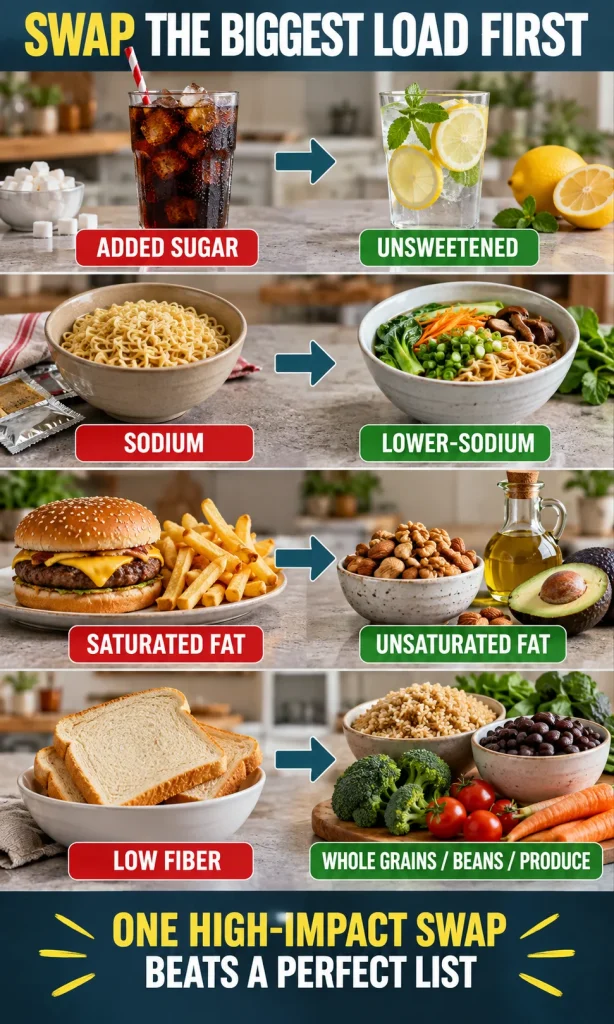
A good diet does not require fear around individual foods. It requires enough nutritious defaults that sweets, fried foods and convenience foods stay in proportion; if you want to test common claims before making a major restriction, compare them with these common food and nutrition myths.
What “worst” should mean in real life
For most people, “worst” is the food pattern that repeatedly displaces more nutritious choices or pushes a nutrient you already get too much of even higher. That is why the same food can matter very differently to two people, and why serving size, frequency and the rest of the diet belong in the decision.
If a food is medically restricted for you because of an allergy, kidney disease, diabetes, pregnancy, gastrointestinal disease or another condition, a generic top-ten list is not the right decision framework. Use individualized advice from an appropriate clinician or registered dietitian rather than treating this article as a personal medical prescription.
Frequently asked questions
What is the single worst food to eat?
There is no universally worst food for every person. A more useful priority is the food or drink you consume frequently that contributes the most added sugar, sodium, saturated fat, processed meat, or displacement of fiber-rich whole foods.
Are all processed foods unhealthy?
No. Processing includes useful steps such as freezing, canning, pasteurizing and cooking. The more relevant question is what the processing adds or removes and whether the final product is high in nutrients you want to limit or low in the nutrients you need more of.
Is it okay to eat foods on this list occasionally?
For most healthy adults, an occasional serving can fit within an overall balanced eating pattern. Frequency, portion size and what the food replaces are usually more informative than a rigid forbidden-food rule.
What should I check first on a Nutrition Facts label?
Check the serving size first, then compare the nutrients that matter for the decision. For many packaged foods, added sugars, sodium, saturated fat and dietary fiber give a useful first pass, but the whole label and ingredient list still matter.
What is the easiest food change to make first?
Change the highest-impact food you repeat most often. For many people that is a sweetened drink, salty convenience meal, processed meat or packaged snack rather than an occasional celebration food.
Next step
Pick one food you eat several times a week, check the real serving size, and compare its added sugars, sodium, saturated fat and fiber with a realistic alternative. That single comparison gives you a decision you can repeat – which is more useful than memorizing a permanent blacklist.