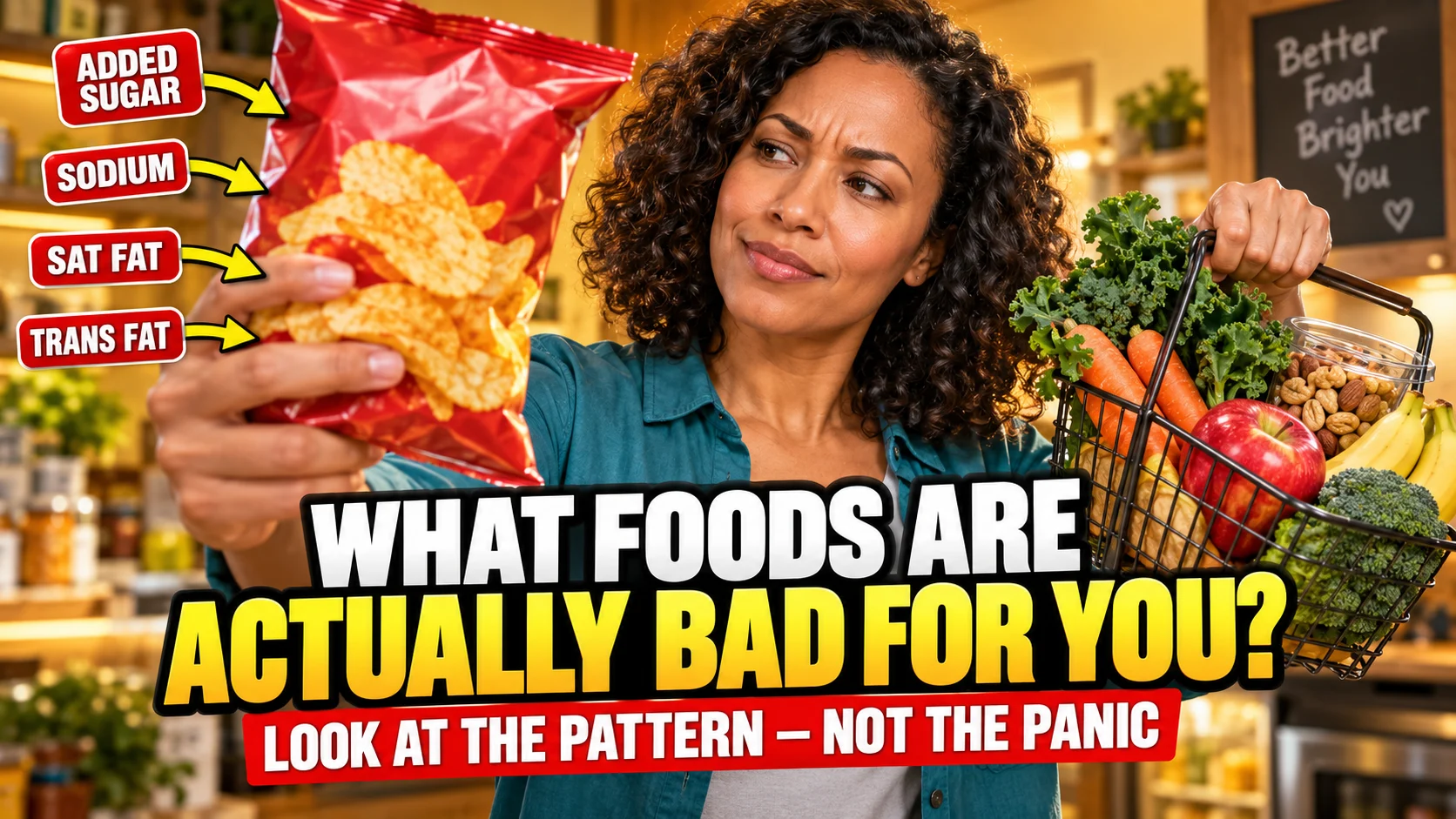

Most foods are not simply “good” or “bad,” but some deserve much stronger limits than others. The clearest concerns are foods that repeatedly deliver a lot of sodium, added or free sugars, saturated fat, or industrial trans fat, plus processed meat because its risk is not explained by the Nutrition Facts panel alone.
The useful question is therefore not “Is this food forbidden?” but “What does my real portion contribute, how often do I eat it, and what does it replace?” That approach is more accurate than judging a food from one ingredient, one marketing claim, or the fact that it has been processed.
| Food or pattern | Why it deserves attention | Practical treatment |
|---|---|---|
| Processed meat | It has a separate colorectal-cancer evidence base; the concern is not just sodium or fat. | Eat little, if any, and use fresh poultry, fish, eggs, tofu, beans or lentils more often. |
| Industrial trans fat | It raises cardiovascular risk and provides no nutritional advantage. | Avoid products containing industrial trans fat where it is still present. |
| Sugary drinks | Large amounts of free or added sugar can be consumed quickly without the fiber of whole fruit. | Keep them occasional; make water or unsweetened drinks the routine choice. |
| High-sodium packaged and restaurant foods | Frequent high sodium intake raises blood pressure in many people. | Compare similar foods and choose lower-sodium versions, especially for staples eaten often. |
| Foods high in saturated fat | Cardiovascular guidance favors replacing some saturated fat with unsaturated fat rather than simply cutting all fat. | Watch the total pattern and favor nuts, seeds, fish and unsaturated oils more often. |
| Ultra-processed-heavy dietary patterns | High exposure is associated with multiple adverse health outcomes, but the category contains very different foods. | Reduce routine reliance on nutrient-poor options rather than treating every processed food as equally harmful. |
The fastest way to judge a food
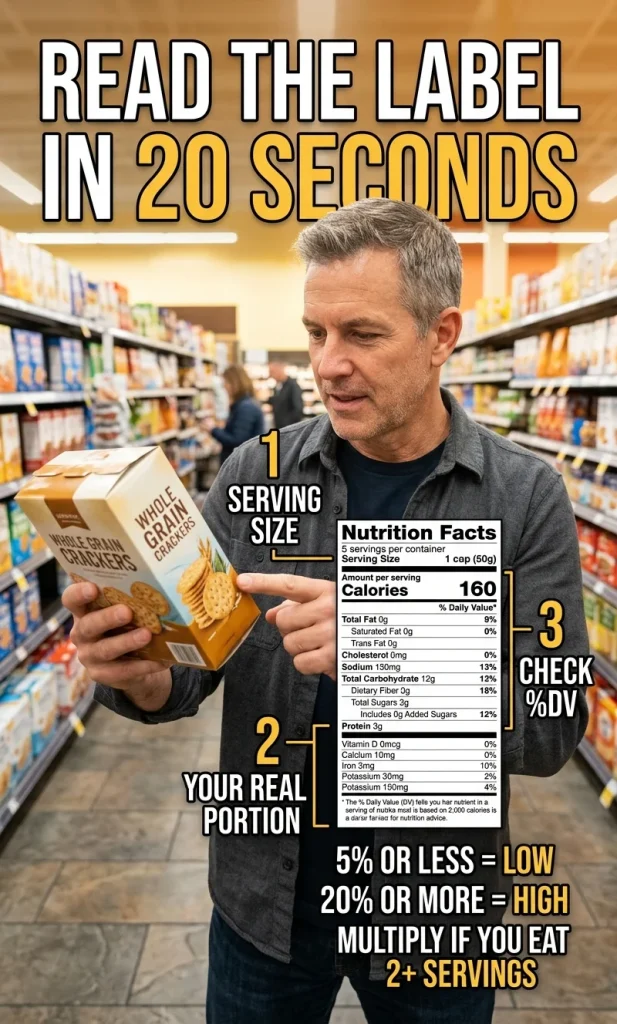
Start with the amount you will actually eat. A package may list a modest amount of sodium or sugar per serving while the container holds two or three servings, so the useful calculation is the label value multiplied by your real portion.
For U.S.-style Nutrition Facts labels, the FDA Daily Value guide gives a simple comparison rule: 5% Daily Value or less is low, while 20% or more is high. That shortcut is useful for saturated fat, sodium and added sugars, but it is not a complete health score; fiber, food type, ingredients, frequency and the rest of your diet still matter.
If you want a deeper label walkthrough, see What Information Does a Food Label Provide?. Then use the check below to translate one label into the portion you are actually planning to eat.
Food Reality Check
Turn one Nutrition Facts panel into a practical portion-and-frequency check without declaring a food “good” or “bad.”
Check the amount you will actually eat
Enter the values shown per serving, then tell the checker how many servings you expect to eat. The result uses FDA Daily Value percentages as a label-reading guide and keeps food type and eating frequency separate from the numbers.
How the check works
Why “processed” is too blunt a shortcut
Processing can mean washing, freezing, fermenting, canning, grinding, fortifying, baking, or combining many ingredients into a ready-to-eat product. Frozen vegetables, plain yogurt, canned beans, wholegrain bread and tofu are all processed in some sense, yet they can contribute useful protein, fiber, vitamins or minerals.
The more useful distinction is whether processing produces a food that is easy to overconsume and repeatedly high in the nutrients you are trying to limit. The World Health Organization’s healthy-diet guidance emphasizes moderation of free sugars, sodium, saturated fat and trans fat while encouraging whole grains, vegetables, fruit and pulses; that is a better decision framework than simply counting ingredients.
Ultra-processed foods still deserve attention as a dietary pattern. A large BMJ umbrella review of meta-analyses found that higher ultra-processed-food exposure was associated with many adverse outcomes, especially cardiometabolic and mortality outcomes, but much of the underlying evidence was low or very low quality. That means “eat less of the worst routine choices” is well supported, while “every ultra-processed item is harmful” goes further than the evidence can justify.
The foods with the strongest reason to limit
Processed meat
Bacon, ham, salami, hot dogs and many cured or smoked sausages sit in a different category from fresh meat because the processing itself is part of the concern. The World Cancer Research Fund recommends eating little, if any, processed meat and limiting red meat to moderate amounts.
This does not mean a single slice of bacon is a medical emergency. It means processed meat is a poor candidate for a daily staple when there are easy substitutes such as fish, poultry, eggs, beans, lentils or tofu.
Industrial trans fat
Industrial trans fat is one of the clearest examples of a dietary component with no useful reason to seek it out. WHO guidance treats industrially produced trans fat as something that should be eliminated from healthy diets, so a product that still contains it deserves a direct comparison with alternatives.
Labeling rules differ by country, and very small amounts may not always appear intuitively on the front of a package. When the ingredient list is relevant in your market, partially hydrogenated oils are a warning sign rather than a health claim to debate.
Sugary drinks and concentrated sweet drinks
Soft drinks, sweetened teas, energy drinks and many sweet coffee beverages can deliver a large amount of sugar very quickly. Because they contain little or none of the fiber found in whole fruit, they are also easy to consume without the same fullness that a solid food might provide.
Fruit juice deserves nuance: it can provide vitamins and plant compounds, but the sugars in juice count as free sugars in WHO guidance. If a drink is a daily habit, the simplest improvement is often to make water, sparkling water, unsweetened tea or another low-sugar drink the default rather than trying to find a “healthier” sweet drink.
High-sodium convenience foods
Sodium is not inherently bad; it is an essential mineral. The problem is that prepared foods can make it easy to consume a large share of a day’s sodium before dinner, especially when ready meals, soups, sauces, instant noodles, deli meats and salty snacks appear together.
The best fix is category comparison. A lower-sodium soup does not need to be “perfect” to be useful if you eat soup several times a week. For practical swaps, see Foods Low in Sodium: How to Avoid Foods High in Sodium.
Foods that make saturated fat the default fat
Saturated fat is not a toxin, but the fat that replaces it matters. Current American Heart Association dietary guidance emphasizes choosing unsaturated fats in place of saturated fats and building the whole pattern around vegetables, fruits, whole grains and healthy protein sources.
That is why a meal built around fried food, fatty processed meat, butter-heavy sauces and a rich dessert is a different dietary event from a small amount of cheese inside an otherwise high-fiber meal. The individual food matters, but the combination and repetition matter more.
Foods people often call “bad” that are not automatically bad
Eggs: for most people, dietary cholesterol is no longer treated as the primary cardiovascular target. What you eat with the eggs – for example, vegetables and wholegrain toast versus processed meat and buttery pastries – can change the overall meal far more than the egg itself. If cholesterol is your concern, Cholesterol Is Found in What Foods and Is Bad for Your Health? explains the broader context.
Potatoes: a baked potato and a large serving of deep-fried chips are not nutritionally equivalent. Cooking method, added salt, added fats, portion size and what accompanies the potato change the result.
Bread: bread is not automatically “bad carbs.” Wholegrain breads can contribute fiber and micronutrients; some refined breads are lower in fiber and easier to overeat. Compare the actual label instead of judging by the word “bread.”
Dairy: plain milk or yogurt can provide protein, calcium and other nutrients, while a sweetened dessert-style yogurt may add a large amount of sugar. The category name does not tell you enough.
Frozen and canned foods: frozen vegetables and fruit can be excellent staples, and canned beans can be useful and inexpensive. The practical check is whether sugar, salt or rich sauces have been added and whether a lower-sodium or unsweetened version is available.
How to make a better choice in 30 seconds
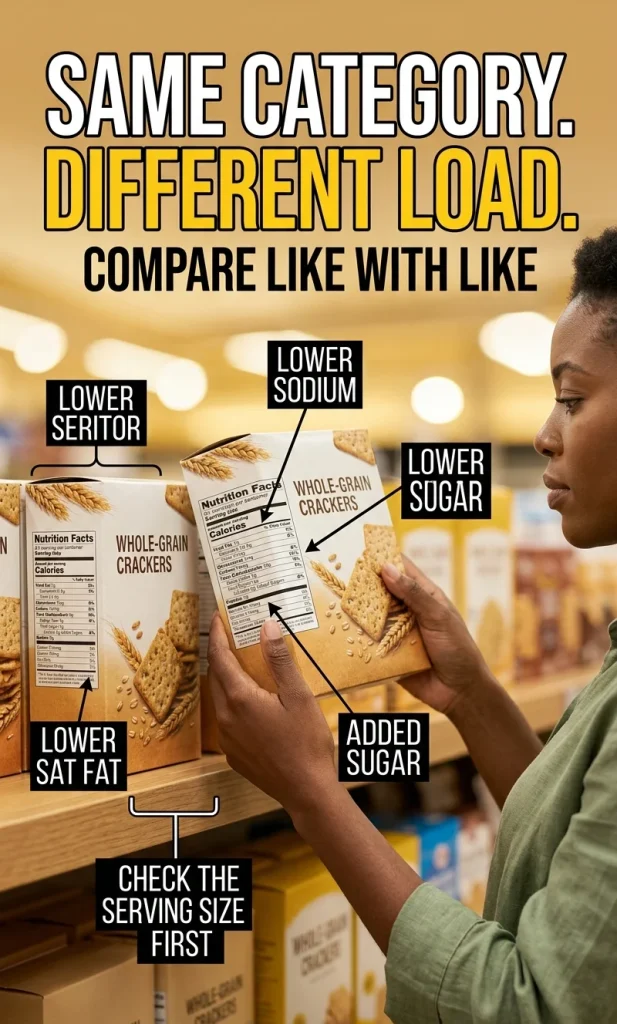
- Compare like with like. Compare two soups, two cereals or two yogurts instead of trying to compare unrelated foods.
- Use your real portion. Multiply the per-serving values if you usually eat more than one serving.
- Look first at saturated fat, sodium and added sugars. These are common label nutrients to limit, while fiber is often useful to seek.
- Use 5% and 20% DV as quick anchors. Low and high are easier to see when the values are on the same serving basis.
- Check frequency. A food eaten most days deserves more scrutiny than a food eaten once in a while.
- Ask what it replaces. A packaged food that replaces another nutrient-poor option may still be an improvement; one that displaces vegetables, whole grains or protein-rich foods may be a step backward.
For a wider view of misleading nutrition claims, see Healthy Eating: Common Myths About Food and Nutrition. If your goal is to improve the overall pattern rather than chase individual “superfoods,” Getting Healthy Eating Habits Back on Track is the more useful next step.
When “bad for you” depends on you
Population nutrition advice has limits. A person with high blood pressure may need to pay closer attention to sodium, someone with celiac disease must avoid gluten, a person with a severe food allergy may need to avoid an otherwise nutritious food completely, and people with kidney disease may have individualized potassium, phosphorus, protein or sodium targets.
The same is true for diabetes, pregnancy, gastrointestinal disease, eating disorders and medications that interact with food. General label guidance can help you compare products, but it should not replace a clinician or dietitian’s individualized plan when a medical condition changes your nutritional limits.

The bottom line
The foods that are “actually bad for you” are best understood as patterns with a strong reason to limit, not as a blacklist of ordinary foods. Processed meat and industrial trans fat deserve the strongest caution, while frequent sugary drinks, high-sodium foods and saturated-fat-heavy meals become more concerning as portions and frequency rise.
For everything else, compare the real serving, the label, the frequency and the replacement. That simple process is more reliable than front-of-package marketing, viral food fear, or a rule that every processed food is unhealthy.
Frequently Asked Questions
Is sugar itself bad for you?
Sugar is a carbohydrate, and the health concern is mainly excessive free or added sugar, especially when it becomes a routine source of calories without much fiber or other nutritional value. Whole fruit is different because its sugars come packaged with water, fiber and micronutrients.
Are ultra-processed foods always unhealthy?
No. The category is broad, and individual products vary in nutrient quality. High ultra-processed-food exposure is associated with poorer health outcomes, but you should still judge a specific food by its nutrient profile, serving size, ingredients, frequency and role in the overall diet.
Is red meat bad for you?
Fresh red meat is not the same as processed meat. Cancer-prevention guidance recommends moderate amounts of red meat and little, if any, processed meat, while also recognizing that red meat can provide protein, iron, zinc and vitamin B12.
What is the most important number on a food label?
There is no single number that works for every food. Serving size comes first because every other number depends on it; after that, saturated fat, sodium, added sugars and fiber are useful comparison points for many adults.
Can I eat junk food sometimes?
For many people, yes. An occasional dessert, salty snack or fast-food meal can fit inside an otherwise balanced eating pattern. Frequency, portion size and what your usual meals look like matter more than treating one food as a moral failure.
Are “natural” foods automatically healthier?
No. “Natural” does not tell you how much sodium, added sugar, saturated fat, fiber or protein a food contains. Read the actual nutrition and ingredient information rather than relying on a front-of-package word.
Should I avoid all fat?
No. Fat is essential, and the type of fat matters. Healthy dietary patterns favor unsaturated fats from foods such as nuts, seeds, fish and plant oils while limiting saturated fat and avoiding industrial trans fat.