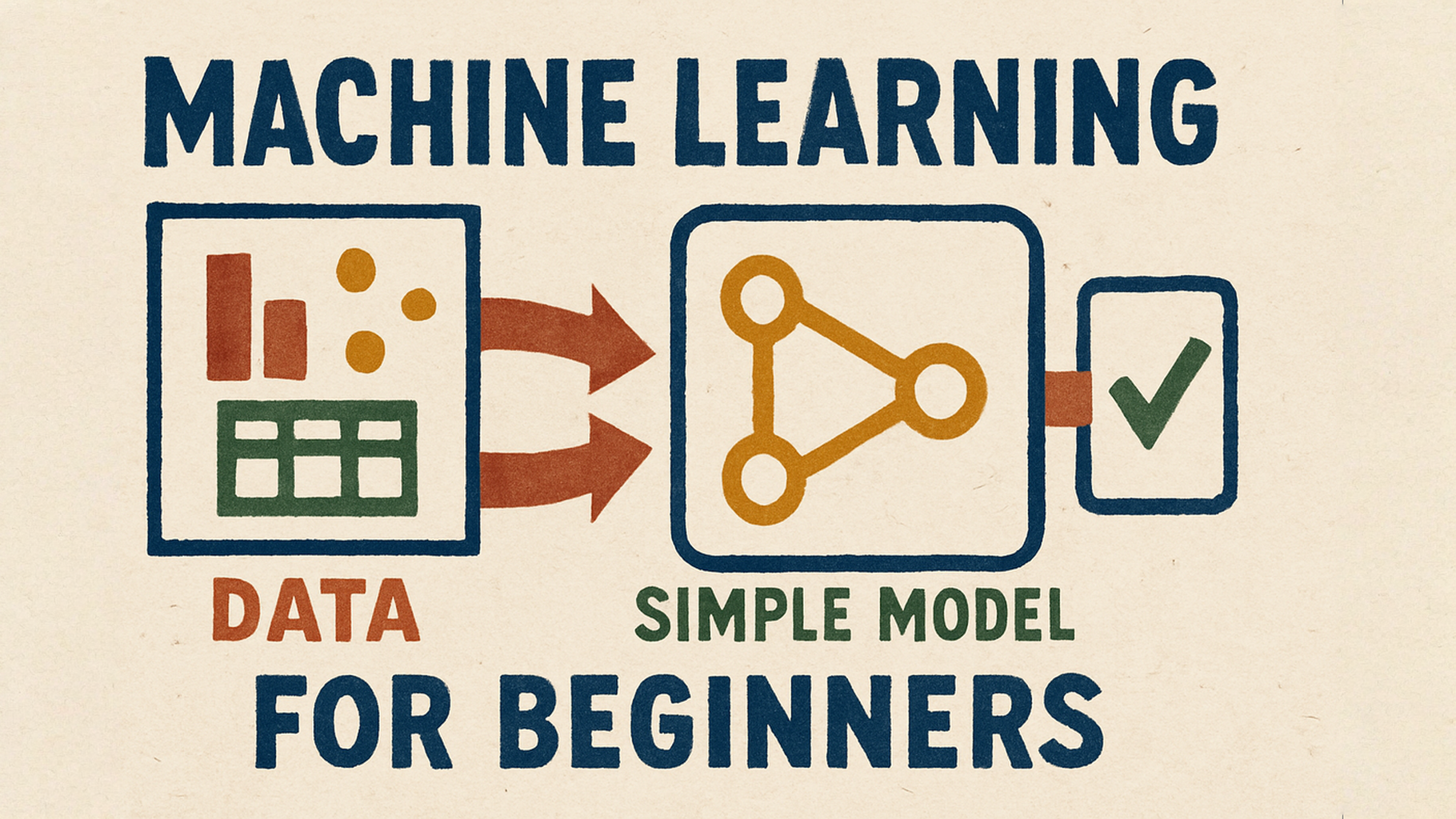

Machine Learning (ML) is one of the most important concepts in modern technology, yet many people believe it is complicated, mathematical, and only meant for engineers.
The truth is far simpler: machine learning is a system that learns from data – just like humans learn from experience.
In this article, we will break down ML in simple English, using real everyday examples such as social media feeds, Netflix recommendations, online shopping suggestions, email spam detection, and more.
By the end, you will understand exactly:
- What machine learning is
- How it works (no math required)
- The different types of machine learning
- Where you already use ML in daily life
- Why ML is important for the future
- Its limitations and risks
- How businesses apply ML today
This is a complete beginner-friendly guide designed for normal people – not programmers.
What Exactly Is Machine Learning? (Simple Definition)
Machine Learning is a method of teaching computers to learn from data instead of following fixed instructions.
A traditional computer program is like a strict recipe:
IF this happens → THEN do that.
But ML is different.
Instead of giving step-by-step rules, we give examples.
Simple explanation:
Machine Learning = A system learns patterns from data → uses patterns to make predictions or decisions.
Think of ML like how a child learns:
- Show a child 100 pictures of dogs
- Show 100 pictures of cats
- The child eventually learns the difference
- Next time, they can guess correctly even without being told
ML works exactly the same way.
It “learns from examples,” not rules.
Real-Life Examples of Machine Learning

Machine Learning is already everywhere around you.
Here are the most common examples you use daily – without realizing it.
1. Social Media Feeds (Facebook, TikTok, Instagram)
ML decides:
- Which posts you see
- Which videos appear on your For You page
- Which ads you are shown
- Which friends’ updates appear first
Every like, share, comment, pause, or swipe gives the ML model more data to learn your preferences.
2. Netflix / YouTube Recommendations
When Netflix recommends:
- “Because you watched Stranger Things…”
- Or YouTube suggests videos similar to your interests
That’s ML analyzing:
- Watch time
- Genre preferences
- Your past behavior
- Users similar to you
This is one of the most powerful ML applications today.
3. Online Shopping (Amazon, Shopee, Lazada)
ML decides:
- Products you might like
- Deals suggested to you
- Items placed on your homepage
- Frequently bought together bundles
Retailers call this Recommendation AI, and it increases sales dramatically.
4. Email Spam Detection
Your inbox uses ML to decide:
- What is spam
- What is junk
- What should land in “Primary”
- What should go to “Promotions”
This is one of the earliest ML applications in the world.
5. Google Search Results Ranking
When you search:
- “best phone 2025”
- “coffee near me”
Machine Learning decides which pages appear at:
- #1
- #2
- #3
It learns what you like based on your past behavior.
6. Siri, Alexa, Google Assistant
These voice assistants use ML to:
- Understand your words
- Recognize your voice
- Interpret the meaning of your question
- Answer correctly
Speech recognition = Machine Learning.
7. Photo Recognition (Face Unlock)
When your phone unlocks using your face,
ML compares your live face → stored model → matches patterns.
How Machine Learning Works (Simple Step-by-Step Explanation)
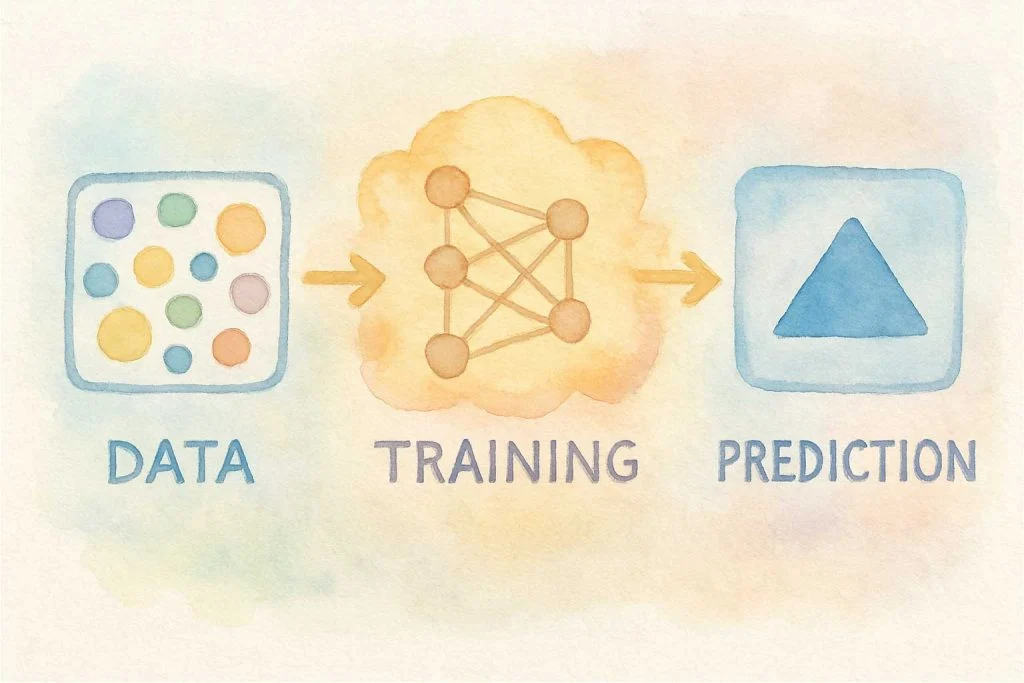
Many people imagine ML as a “black box” or something magical – but it follows a very clear, logical process.
Below is the simplest explanation of how every ML system works:
Step 1: Collect Data
ML needs examples to learn patterns.
Examples of data sources:
- Emails labeled as “spam” or “not spam”
- Images of cats vs dogs
- Customer purchase history
- Video watch behavior
- Medical records
- Website clicks
The quality of the data determines how smart the ML model becomes.
Step 2: Train the Model
During training, ML tries to find patterns, for example:
- “Spam emails often contain urgent or scam wording”
- “People who watch horror films also like thrillers”
- “This shape looks like a cat’s ear”
Think of it as the computer taking notes and spotting hidden relationships.
Step 3: Test the Model
The ML model is tested on data it has never seen before.
If it predicts correctly → good
If it predicts wrongly → the model gets adjusted
This loop repeats thousands or millions of times.
Step 4: Make Predictions
Once trained, the ML model can:
- Recommend videos
- Suggest products
- Predict house prices
- Recognize faces
- Translate languages
- Identify diseases from scans
All of these are predictions, not “thinking.”
Step 5: Improve Over Time
ML models improve with:
- More data
- Better features
- Updated training
- Real-world feedback
This is why Netflix becomes more accurate the longer you use it, or why TikTok adapts to your new interests immediately.
The 3 Main Types of Machine Learning (Simple & Clear)
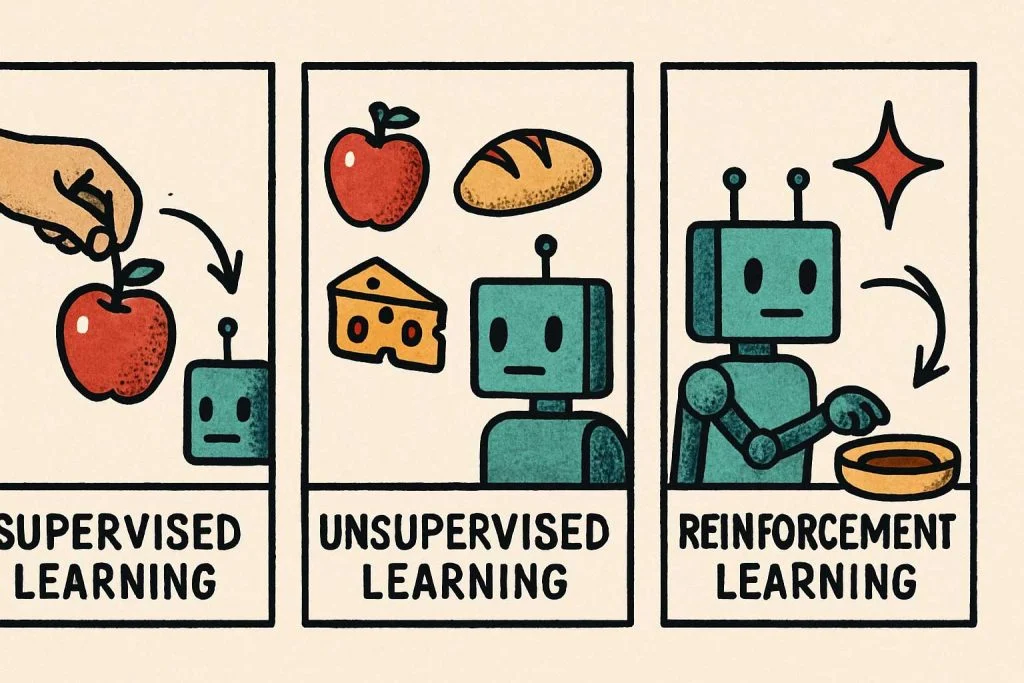
Machine Learning comes in many forms,
but every ML system belongs to one of these three main categories.
1. Supervised Learning (Most Common)
Supervised Learning = “learning from labeled examples.”
Simple explanation:
You show the model the correct answer during training.
For example:
| Input | Label (Correct Answer) |
|---|---|
| Email content | Spam / Not spam |
| Photo | Cat / Dog |
| House features | Price |
| Customer behavior | Likely to buy / Not likely |
Real-life examples:
- Email spam filters
- Face recognition
- Loan approval prediction
- Medical diagnosis models
This is the most widely used ML category today.
2. Unsupervised Learning (Clustering & Grouping)
Unsupervised learning = no labels.
The model finds hidden patterns by itself.
Simple explanation:
You give the model raw data and ask it to group similar things.
Real-life examples:
- Netflix grouping users with similar taste
- Shopee clustering shoppers into price-sensitive vs premium buyers
- Spotify grouping music genres automatically
- Marketing customer segmentation
This is extremely useful for understanding behavior.
3. Reinforcement Learning (Learning by Trial & Error)
Reinforcement learning = learning through rewards and penalties.
Simple explanation:
The model tries things → gets rewarded or punished → learns strategy over time.
Real-life examples:
- AI playing games like AlphaGo
- Robots learning to walk
- Delivery route optimization
- Inventory management
- Autonomous driving decision-making
It’s inspired by how animals and humans learn through experience.
Why Machine Learning Is So Powerful
ML is powerful because it can:
1. Handle huge amounts of data humans can’t process
Companies generate millions of data points every second.
ML can analyze all of it instantly.
2. Discover hidden patterns humans could never see
For example:
- Doctors may miss subtle early signs of disease
- ML can detect tiny pixel patterns unseen by human eyes
3. Make predictions faster and more accurately
From fraud detection to price forecasting, ML reacts instantly.
4. Personalize experiences for every user
ML adjusts:
- Your YouTube feed
- Your promotion emails
- Your shopping homepage
- Your Netflix suggestions
No two users see the same experience.
5. Automate repetitive tasks
Machine learning frees humans from:
- Tagging emails
- Filtering content
- Sorting data
- Making repetitive decisions
This boosts efficiency and reduces cost dramatically.
Where Machine Learning Is Used in Business
Here are the top real-world business uses:
1. Marketing
ML analyzes:
- Customer behavior
- Purchase history
- Click patterns
- Browsing data
Then delivers:
- Personalized ads
- Smart retargeting
- Optimized campaigns
2. Sales
ML boosts sales by:
- Predicting what customers will buy
- Ranking leads by buying likelihood
- Recommending the right products
- Suggesting discounts to increase conversion
3. Banking & Finance
ML is used for:
- Fraud detection
- Credit scoring
- Algorithmic trading
- Risk assessment
Banks heavily rely on ML systems to avoid losses.
4. Healthcare
ML helps with:
- Predicting diseases
- Medical image diagnosis
- Personalized treatment
- Drug discovery
In many cases, ML can catch abnormalities before doctors notice them.
5. Retail
From:
- Inventory stocking
- Pricing
- Customer insights
ML makes retail operations more efficient and profitable.
The Limitations of Machine Learning (Beginner-Friendly Explanation)
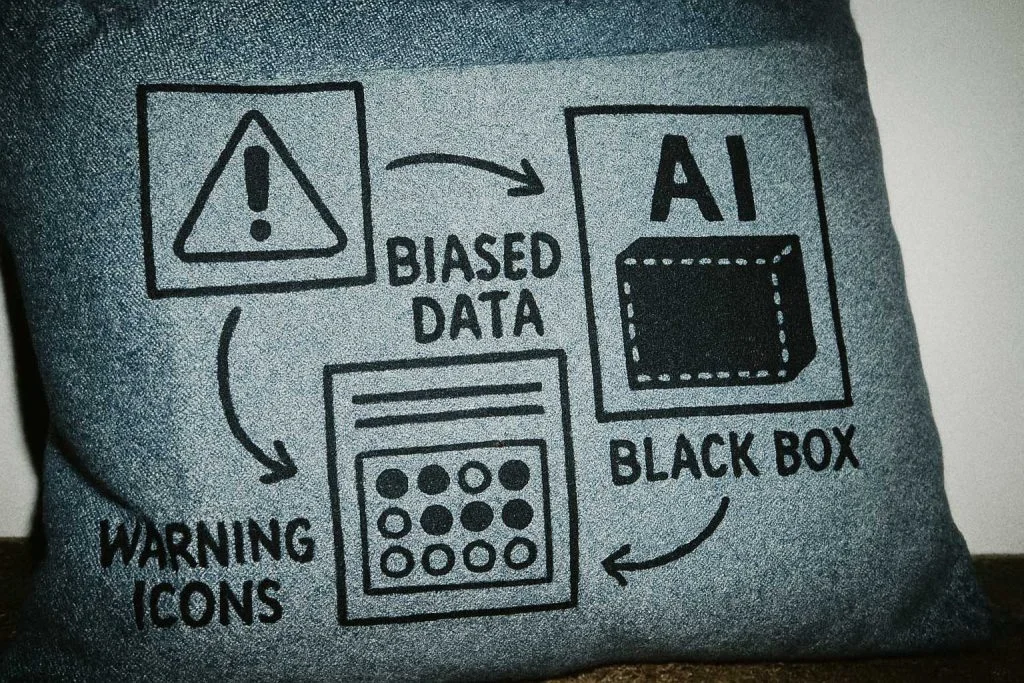
Machine Learning is powerful, but it is also deeply flawed.
Understanding its weaknesses is just as important as understanding its strengths.
Below are the most important limitations, explained simply.
1. Machine Learning Depends Entirely on Data
If the data is biased → the ML model becomes biased.
If the data is incomplete → the ML model becomes inaccurate.
If the data is low-quality → the ML model makes wrong decisions.
Example:
If a loan approval model is trained mostly on data from high-income customers,
it may unfairly reject low-income but reliable customers.
2. ML Cannot Understand Context Like Humans
ML recognizes patterns – not meaning.
It doesn’t truly “understand” the world.
Example:
When you ask a chatbot:
“Can I park my car on the moon?”
A human knows you’re joking.
ML may respond seriously with irrelevant facts — because it lacks emotional awareness.
3. ML Cannot Handle Unexpected Situations Well
ML performs well only when new data looks similar to training data.
When something unusual happens, errors spike.
Example:
Autonomous cars struggle in:
- Unexpected roadblocks
- Strange lighting conditions
- Rare or unusual objects
- Weather anomalies
4. ML Can Be Easily Manipulated
ML models can be attacked through:
- fake data
- misleading inputs
- adversarial examples (tiny pixel changes can confuse ML vision models)
Banks, medical systems, and governments must be careful with this.
5. ML Cannot Explain Its Decisions
This is called the “black box” problem.”
ML models often cannot explain:
- Why did it reject a loan?
- Why did it diagnose a disease?
- Why did it make this prediction?
This is a major challenge in ethical AI.
Why Machine Learning Makes Mistakes (Simple Explanation)
ML mistakes usually come from:
1. Biased Data
If ML only learns from one group of people,
its predictions become unfair.
2. Limited Training Examples
ML needs thousands or millions of examples.
If it learns from too few samples, it becomes inaccurate.
3. Overfitting
This happens when ML memorizes training data instead of learning real patterns.
4. No Common Sense
ML can’t use logic, emotions, intuition, or moral judgment.
It only sees patterns, not reasons.
5. Input Errors
A model is only as good as the input it receives.
If the input is wrong → the output is wrong.
The Ethics and Risks of Machine Learning
Machine Learning affects society deeply.
Here are the main ethical concerns.
1. Privacy
ML often requires huge amounts of personal data:
- photos
- search history
- messages
- purchase behavior
- medical data
This raises serious privacy questions.
2. Discrimination & Bias
ML can reinforce harmful patterns already in society.
Examples:
- Biased hiring
- Unfair loan rejection
- Racial bias in facial recognition
- Gender bias in job recommendations
3. Job Impact
ML automates repetitive tasks.
This may reduce the need for:
- data entry workers
- customer support
- clerical workers
- warehouse pickers
But it also creates new roles:
- prompt engineers
- data analysts
- AI quality testers
- ML operations specialists
4. Fake Content & Misinformation
AI deepfakes are getting more realistic.
ML makes it easier to generate:
- fake news
- fake images
- fake voices
- fake videos
This is dangerous if misused.
5. Overreliance on AI
People may rely too much on ML for:
- advice
- decision-making
- medical symptoms
- financial judgments
Human oversight is always necessary.
The Future of Machine Learning
ML will become:
1. More personalized
AI systems will understand individual preferences more deeply.
2. More autonomous
AI agents will take actions automatically, not just make suggestions.
3. More integrated
ML will appear in:
- home appliances
- cars
- jobs
- healthcare
- education
- finance
- entertainment
4. More regulated
Governments will enforce rules about:
- data
- ethics
- transparency
- responsibility
AI Safety will become increasingly important.
Summary for Beginners
Machine Learning is:
- simple at its core
- based on data
- pattern detection
- prediction-driven
You use ML every day:
- YouTube
- TikTok
- Netflix
- Shopping apps
- Email spam filters
- Maps & navigation
- Face unlock
- Credit scoring
ML is powerful, but it has major limitations:
- bias
- lack of context
- privacy concerns
- unpredictability
- lack of common sense
Understanding how ML works helps you use AI tools more wisely.
Conclusion
Machine Learning is not magic.
It’s a tool – a remarkably powerful one – that learns from data to make predictions.
When used responsibly, ML can improve daily life, increase business efficiency, and unlock new opportunities across all industries.
But like any tool, it must be used with caution.
As ML continues shaping the world, understanding its basics helps everyone – students, workers, business owners, and families – adapt to the AI-powered future confidently.
FAQ
What is machine learning in simple terms?
Machine learning is a way for computers to learn patterns from data and make predictions without being manually programmed.
Is machine learning the same as AI?
Machine learning is a subset of artificial intelligence. AI is the broader concept.
Where do we use machine learning daily?
Social media feeds, online shopping, email spam filters, streaming recommendations, and navigation apps.
What are the main types of machine learning?
Supervised, unsupervised, and reinforcement learning.
What are the risks of machine learning?
Bias, lack of transparency, privacy issues, and incorrect predictions when data is poor.