You do not need to invent a category that has never existed before to build a worthwhile startup. You need to find a customer who is still making an expensive, frustrating or inconvenient compromise, then give that customer a reason strong enough to change what they already do. The real question is not “Has someone built something like this?” but “Is there still a meaningful problem, a reachable customer and a credible switching trigger?”
That distinction changes how you should evaluate a crowded market. Existing competitors can be evidence that customers already spend money on the problem, but they can also make entry difficult when buyers are satisfied, switching costs are high or incumbents can copy your advantage quickly. A sensible founder therefore studies the gap between what customers tolerate today and what they would actually change behavior to obtain tomorrow.
The Quick Answer: Why Start a Business If the Market Already Looks Full?
A market can look “already invented” while still containing unsolved customer problems, underserved segments, outdated workflows, poor service, awkward distribution, weak pricing structures or products that became less suitable as technology and behavior changed. The OECD’s business-innovation framework does not restrict innovation to world-first inventions; it also includes significantly improved products and business processes. That is useful because most startup opportunities are judged by customer value, not by whether nobody in history has tried anything similar.
The presence of competitors is therefore neither a green light nor a red light by itself. The U.S. Small Business Administration recommends combining market research with competitive analysis so a business can understand customers, alternatives and its potential market advantage. A crowded category can still be attractive when you can identify a specific group that cares about an improvement enough to switch, pay and stay.
“Everything Has Been Invented” Is Usually the Wrong Frame
Customers rarely buy originality for its own sake. They buy a result: faster delivery, lower total cost, less risk, better fit, easier use, stronger reliability, better access, more confidence or a more pleasant experience. If a new company creates one of those outcomes for a meaningful customer segment, the business can matter even when the underlying category is familiar.
Consider a bookkeeping startup entering a market full of accountants and software. The opportunity might not be a new form of accounting; it might be a better workflow for independent medical practices that currently reconcile several payment systems manually and wait too long for useful monthly reporting. The founder’s opening is the specific friction, not the broad category label.
The same logic applies outside software. A local service company may win by reducing missed appointments, shortening response times or serving a neighborhood that existing providers neglect. A physical product company may use existing technology but improve repairability, configuration, durability or distribution. An established market can still contain room for a better operating model, a sharper customer focus or a more compelling combination of familiar elements.
Competition Can Be Useful Evidence, but It Does Not Validate Your Startup
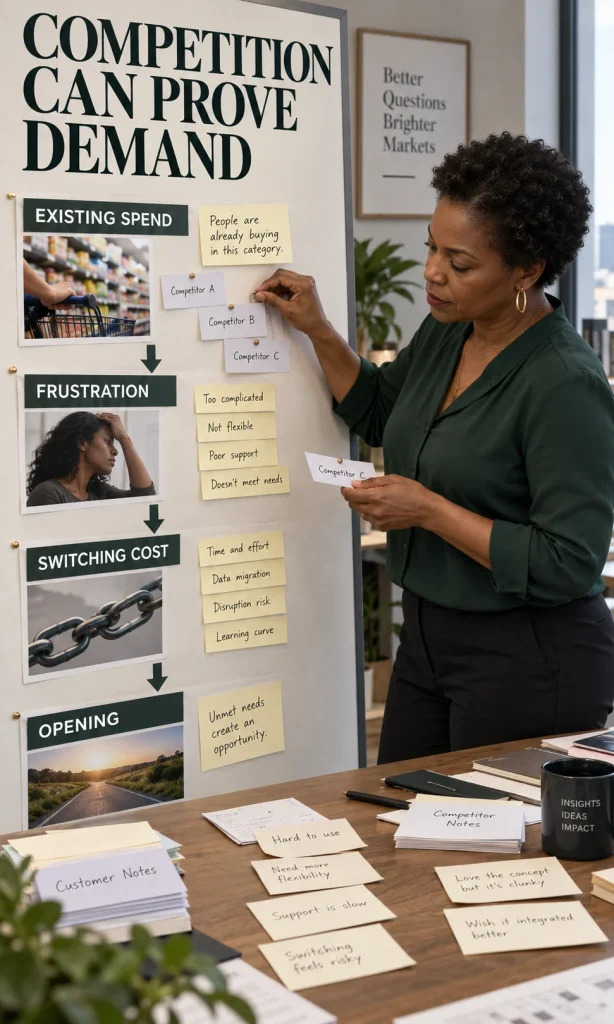
When customers already pay several companies to solve a problem, you have evidence that some demand exists. That can be more useful than entering a category where nobody has demonstrated willingness to spend money at all. It also gives you real products, prices, reviews, service models and customer complaints to study instead of forcing you to reason entirely from imagination.
Competition becomes dangerous when founders confuse category demand with demand for their own offer. Customers may be happy with the leader, locked into contracts, trained on the current workflow or unwilling to endure the disruption of switching. Your startup needs a reason for change that is meaningful enough to overcome those barriers.
This is why competitor research should go beyond making a feature checklist. The useful questions are where customers become dissatisfied, what they do when the product fails them, how expensive switching feels, which customer groups incumbents serve poorly and whether the gap affects a buying decision. The separate guide on how to know if your business idea is good goes deeper into evaluating whether a specific idea creates enough customer value to deserve attention.
Find the Customer Compromise Before You Build the Product
An existing market usually has a default behavior. Customers may buy from a familiar provider, combine several products, use spreadsheets, hire a freelancer, perform the task manually, tolerate a delay or simply live with the problem. Your first job is to understand what that current behavior costs them and why they have not changed already.
A useful opportunity often appears where the current solution forces a repeated compromise. The customer may accept poor usability because the product is deeply integrated, accept slow service because alternatives are unreliable or accept a high price because changing providers would create operational risk. These compromises are interesting only when they matter enough to influence action.
| Possible market opening | Evidence to look for | What can mislead you |
|---|---|---|
| Underserved customer segment | A specific group repeatedly describes needs the mainstream offer handles poorly. | Assuming a niche wants a custom solution merely because it is different. |
| Workflow friction | Customers use manual steps, duplicate work, exports, spreadsheets or workarounds. | Building automation for a task customers do not consider important. |
| Reliability or service gap | Delays, errors, poor support or inconsistent outcomes create measurable consequences. | Treating occasional complaints as evidence people will switch providers. |
| Distribution or access gap | Customers struggle to buy, book, receive or configure an otherwise useful solution. | Ignoring the cost of creating a new distribution channel. |
| Business-model gap | Customers dislike minimums, contracts, bundles, pricing structure or purchase risk. | Offering cheaper pricing without enough margin to sustain delivery. |
| Technology or behavior shift | A new capability or customer habit makes the old workflow less suitable. | Assuming every new technology automatically creates valuable demand. |
The best clues are usually tied to behavior rather than adjectives. “This software is annoying” is weaker than “we export the data every Friday, clean it for two hours and rebuild the same report in another system.” The second statement reveals a repeated cost that can be investigated, priced and compared with the effort required to switch. That behavioral detail gives you something concrete to test instead of relying on general dissatisfaction.
Your Startup Needs a Switching Trigger, Not Just a Difference
Founders often describe differentiation as a list of features. Customers experience differentiation as a reason to change behavior. A feature matters only when it improves an outcome enough to justify learning a new system, trusting an unknown company, moving data, changing a routine, paying more or giving up something familiar.
The switching trigger may be practical rather than dramatic. A company might win because it installs in one day instead of six weeks, integrates with a system the incumbent ignores, gives a specialized customer a workflow that feels native or delivers a service reliably during hours when competitors are unavailable. The improvement must connect to a decision the customer actually makes.
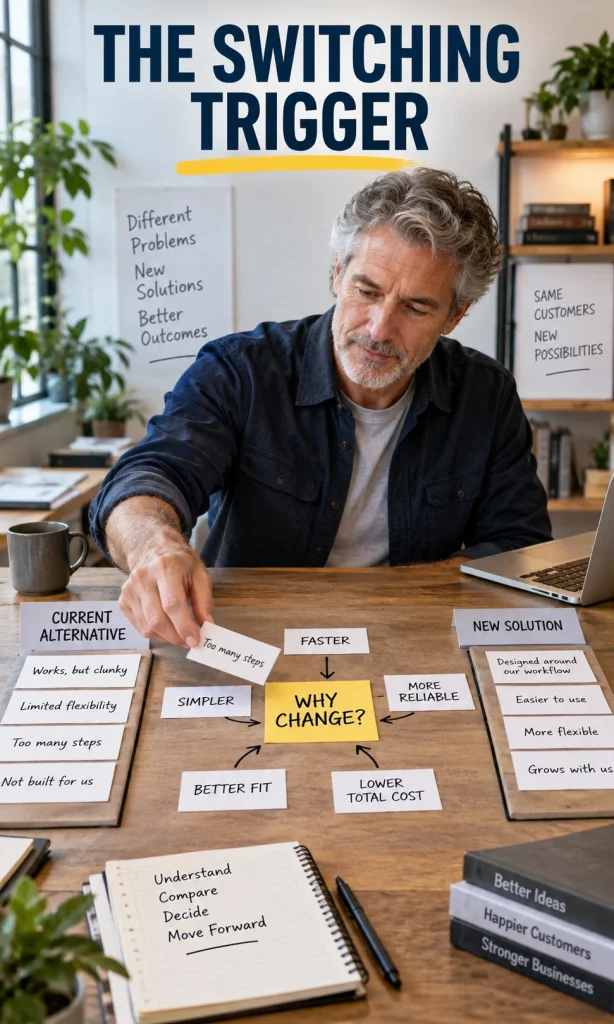
Ask what would have to happen for a customer to leave the current option. If the answer is “nothing, because they are satisfied and locked in for three years,” the market may be less open than the number of competitors suggests. If the answer is “they already use a workaround every week and would switch if migration were safe,” you have a much more useful hypothesis to test.
Seven Openings That Do Not Require a World-First Invention
A founder can create value in several ways without claiming to invent an entirely new category. The following openings are not guarantees of success, but each can produce a testable reason for a customer to consider changing. What matters is whether the improvement is meaningful to a reachable buyer and can be delivered economically.
- Serve a narrower customer better. General-purpose products often create room for a company that understands one industry, workflow, geography or customer constraint much more deeply.
- Remove a painful step. A product can be familiar while the purchasing, setup, migration, scheduling, reporting or support experience becomes materially easier.
- Improve reliability. In some markets, consistent delivery matters more than novelty because customers are paying to reduce uncertainty.
- Change the cost structure. A new operating model can lower total cost without simply underpricing competitors and destroying margin.
- Use a new distribution channel. Customers may value the same underlying outcome when it becomes easier to discover, buy, receive or use.
- Combine fragmented tasks. A startup can reduce coordination work by bringing several connected steps into one coherent experience.
- Adapt to a real shift. New technology, regulation, customer behavior or infrastructure can make an old solution less suitable and create room for a new operating model.
These openings become stronger when the customer already shows the cost of the gap. A workaround, repeated complaint, delayed project, extra employee, duplicate subscription or manual reconciliation can reveal that people are already paying in time or money. Your startup does not need to create the frustration; it needs to understand it better than the current alternatives do.
Use the Crowded Market Reality Check Before You Commit
A founder looking at an established category usually has several uncertainties at once: whether the problem is important, whether customers are dissatisfied enough to move, whether a clear switching reason exists and whether the new offer can be delivered at workable economics. Treating all of those questions as one vague “Is this idea good?” decision makes it easy to rationalize weak evidence. The interactive check below separates them and recommends the next experiment instead of producing a meaningless startup score.

Founder decision aid
Crowded Market Reality Check
Find the next assumption to test before you commit serious time or money.
Pressure-test the opening, not the originality
Existing competitors can prove that a problem attracts attention and spending. This check focuses on whether customers still make a meaningful compromise, whether they have a reason to change, and what evidence you should collect next.
Recommended next evidence step
Why this comes next
Three practical tests
Competitive reality
Check the alternatives customers can choose now
These actions open ordinary Search or Maps results. They do not fabricate competitor data or require an API key.
Look for repeated complaints, switching costs, underserved segments, workarounds and reasons customers stay with the incumbent.
This experience organizes evidence; it does not predict startup success, investment returns or market share.
Test the Gap Before You Build the Company Around It
Once you identify a plausible opening, the next job is not to make the product as complete as possible. It is to expose the riskiest assumption to reality as cheaply as you reasonably can. That means moving from conversations about the problem toward behavior, payment, delivery and repeat use.
The article on how to test business ideas uses an evidence ladder that becomes stronger as customers commit more. Interviews can confirm that a problem occurs, a landing page or booking request can test behavior, a paid pilot can test willingness to spend, and actual delivery can reveal whether the economics and workload are realistic. A founder should increase commitment only when the previous evidence earns the next experiment.
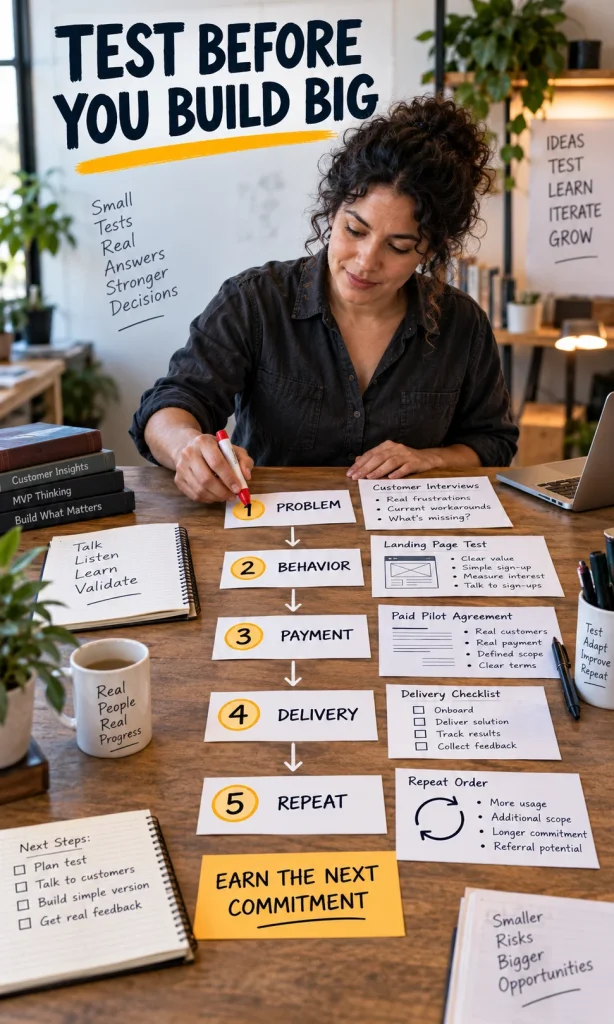
Suppose you want to build scheduling software for independent repair shops. You could spend six months building features, or you could begin by interviewing shops about how jobs are scheduled, what delays cost them, which systems they already use and what causes staff to bypass those systems. If the pain is real, the next experiment might be a narrow prototype or concierge service that solves one scheduling bottleneck for several shops before you automate the entire workflow.
Measure Evidence in the Order That Reduces Risk
Early evidence does not all answer the same question. A customer saying “I like it” does not show that the customer will switch, and a paid pilot does not prove that the business can acquire customers at scale. The point of testing is to replace the most dangerous assumption with stronger evidence before increasing the amount of money, time or reputation exposed.
| Question | Useful evidence | What you still do not know |
|---|---|---|
| Does the problem exist? | Customers describe recent examples, consequences and current workarounds without being led. | Whether they will choose your solution. |
| Will people act? | Qualified prospects request a demo, quote, trial, reservation or another meaningful next step. | Whether they will pay enough. |
| Will they pay? | Deposits, paid pilots, preorders or real purchases at a relevant price. | Whether delivery is repeatable and profitable. |
| Can you deliver? | The promised outcome is produced with realistic labor, cost, time and quality. | Whether acquisition and support remain workable at larger volume. |
| Will value persist? | Renewal, reorder, continued use or genuine referrals. | How the model behaves at broader scale. |
Use experiments that can disappoint you. If every result leads to “keep building,” you are not testing; you are collecting reassurance. A useful experiment has a defined weak result that would cause you to change the segment, offer, price, channel, delivery model or level of commitment.
Do Not Confuse a Large Market With an Easy Market
A large category can support many companies and still be difficult for a new entrant. Incumbents may have distribution, trust, proprietary data, long contracts, network effects, regulatory approvals, purchasing leverage or deeply embedded integrations. Your job is to understand which advantages actually matter to the customer segment you want to serve.
For local U.S. opportunities, Census Business Builder can help entrepreneurs examine local demographic and economic conditions, while SBA market-research guidance recommends studying demand, saturation, pricing and competitors. Those sources cannot tell you whether an individual customer will buy your offer, but they can prevent you from building a market story that conflicts with basic facts about the geography or industry.
For a digital startup, market size can be equally deceptive. A category may contain millions of potential users while the cost of reaching them is high, purchasing authority is unclear or customer attention is controlled by a small number of platforms. Reachability belongs inside the opportunity test rather than being added after the product is finished.
Watch the Cost of Being Wrong
You will never remove all uncertainty before starting a business. The useful move is to keep early mistakes survivable by matching the size of your commitment to the quality of your evidence. A founder can usually learn more safely from a small pilot, limited production run, temporary service process or narrow geographic test than from a long lease, large inventory order or full team hired around an unproven assumption.
The guide on risks when starting a business makes the same distinction between uncertainty and exposure. A weak $500 experiment is disappointing but contained; a weak demand assumption attached to years of fixed obligations can threaten the company. Reversibility is therefore part of startup strategy, not merely a defensive concern.
Be cautious with dramatic startup-failure claims as well. U.S. Bureau of Labor Statistics data show that survival varies by cohort and economic conditions; in its Business Employment Dynamics review, the 2018 birth cohort of establishments had a 57.3% five-year survival rate. Survival is not the same as venture success, profitability or founder return, but the figure is a better reminder than viral “almost everyone fails immediately” statistics: starting a business carries real risk, and the risk should be measured with accurate definitions.
When an Existing Market Is Probably a Poor Startup Bet
Some crowded markets are crowded because the available solutions already satisfy customers well. Others are difficult because the problem is real but the cost of reaching, switching or serving customers leaves little room for a newcomer. You should become more skeptical when several weaknesses appear together rather than forcing yourself to find a positive story for every idea.
- The problem is mild. Customers agree the issue exists but rarely spend time, money or effort trying to solve it.
- The switching trigger is vague. Your main difference is “better” without a specific outcome customers value enough to change behavior for.
- The incumbent advantage is structural. Contracts, regulation, network effects, distribution or integrations make switching unusually difficult and you have no credible way around that barrier.
- The economics depend on wishful pricing. Customers show interest only at a price that does not cover realistic delivery and acquisition costs.
- The first test requires a huge irreversible commitment. The business needs major capital before the most important demand assumption can be tested.
- You cannot reach the customer efficiently. The audience exists, but every credible acquisition route is expensive, restricted or controlled by another platform.
- Repeated credible tests stay weak. Different experiments keep producing low urgency, low action or low willingness to pay.
Stopping or changing direction after weak evidence is not proof that entrepreneurship was a mistake. It is evidence that the testing process protected you from committing more resources to an assumption that did not earn them. The money and time saved can be redirected toward another segment, problem or business model.
If a Big Company Can Copy You, Build an Advantage That Compounds
Many useful startup ideas are technically copyable. The relevant question is whether a larger company would notice, prioritize and execute the same solution for the same customer before you can build an advantage. Speed matters, but lasting advantage often comes from what the company learns and accumulates while serving customers.
That advantage might be specialized workflow knowledge, proprietary data created through usage, unusually efficient operations, distribution relationships, a trusted niche brand, community, switching integrations or a repeatable service system. None of those requires a patent to matter. They require disciplined execution and a customer relationship strong enough that copying the visible feature does not copy the whole business.
This is also where scalability eventually matters. If demand is proven but every new customer requires the founder to reinvent delivery, growth can become a trap rather than an advantage. The guide on how to build a scalable business explains why systems, capacity and founder independence become important after the market has earned expansion.
Turn the Opportunity Into a Working Business Plan
Once customer evidence is becoming credible, planning should connect the market story to resources and economics. The purpose is not to write a ceremonial document; it is to make sure the customer, price, capacity, cash requirements and operating decisions agree with one another. The guide on business planning treats the plan as a system that should change when evidence changes.
Basic break-even thinking becomes useful at this stage. SBA guidance defines break-even as the point where total cost and total revenue are equal, and its standard unit formula uses fixed costs divided by price minus variable cost per unit. You do not need to forecast the future with false precision, but you do need to know whether the number of customers required by your economics looks plausible relative to the market you can actually reach.
That is the point where “everything has already been invented” becomes a much less useful concern. The founder’s job is to connect a real customer problem, a compelling reason to switch, evidence of willingness to pay, a delivery model that works and an operating system that can survive growth. Originality can help, but evidence and execution decide whether the idea deserves more commitment.
The Practical Decision
Build the next experiment when you can identify a customer who experiences a meaningful problem, explain why the current alternatives leave a gap and describe a specific reason that customer might switch. Keep the experiment small until behavior and payment support the story, then test delivery and economics before increasing irreversible commitments. If the evidence stays weak, change the idea rather than trying to out-argue the market.
A startup does not need to prove that nobody has ever tried anything similar. It needs to prove that enough customers still care about an outcome the current market does not deliver well enough. That is a narrower challenge than inventing the future from nothing, but it is also much more demanding because the customer—not the founder—gets to decide whether the difference matters.
Is competition a bad sign for a startup?
No. Competition can show that customers already spend money on the problem, which gives you useful evidence about demand, pricing and alternatives. It becomes a problem when customers are satisfied, switching costs are high or your proposed advantage is too weak to change behavior.
Does a startup idea have to be completely original?
No. A startup can create value by improving an existing product, workflow, service model, distribution method or customer experience. The important question is whether the change creates enough value for a specific customer to choose, pay for and continue using the offer.
How do I find a gap in a crowded market?
Look for repeated customer compromises: manual workarounds, poor service, delays, confusing pricing, weak reliability, difficult access or a segment that mainstream competitors treat as secondary. Then test whether the frustration changes behavior rather than assuming complaints automatically create demand. The strongest opening is one where customers already pay a meaningful cost for the compromise and can explain what would make them change.
What if a large company can copy my startup?
Many useful ideas are copyable, so the business should try to accumulate advantages beyond one visible feature. Specialized workflow knowledge, customer trust, distribution, data, integrations, efficient operations and repeatable delivery can become harder to copy than the surface idea alone. Build those advantages from real customer use rather than assuming a feature list will protect the business.
How much validation should I do before building?
Do enough testing to reduce the highest-risk assumptions before making a larger commitment. Customer conversations can test the problem, behavioral experiments can test action, paid pilots can test willingness to pay, and early delivery can test workload and economics. Stop when the remaining uncertainty is small enough to justify the next commitment rather than trying to eliminate every unknown.
When should I stop pursuing a startup idea?
Consider pausing or changing the idea when repeated credible tests show low customer urgency, weak willingness to switch, pricing that cannot support the business or risks that require too much irreversible commitment. One weak test can be misleading, but several well-designed tests pointing in the same direction should change your decision. A pause is useful when it prevents a weak assumption from turning into a large fixed cost.